The MACD — Moving Average Convergence Divergence — is one of the most popular indicators in trading, prized because it elegantly bundles both trend and momentum into a single tool built entirely from moving averages. Its name is a mouthful and its three-part display can look intimidating, but the underlying idea is simple, and once you understand what the MACD line, the signal line and the histogram each represent, it becomes a genuinely useful and readable indicator. This guide breaks down the MACD's components, explains how to read its crossovers, zero line and divergence, and covers the limitations to keep in mind.
It builds directly on the moving averages it is made from, and sits within the framework of technical indicators explained as both a trend and momentum tool.
Key takeaways
Q: What is the MACD indicator?
A: The MACD (Moving Average Convergence Divergence) is a trend-following momentum indicator built from moving averages. It has three parts: the MACD line (the difference between two EMAs), the signal line (an EMA of the MACD line), and the histogram (the gap between them), used to gauge momentum and trend shifts.
Q: How do you read MACD crossovers?
A: When the MACD line crosses above the signal line, it is a bullish signal; when it crosses below, bearish. A cross of the MACD line above or below the zero line indicates a broader shift in trend direction. Crossovers are the most common way the MACD is traded.
Q: What is the MACD histogram?
A: The histogram is the difference between the MACD line and the signal line, drawn as bars. It visualises momentum: growing bars show momentum building in the current direction, shrinking bars show it fading — often hinting at a crossover before it happens.
The three components
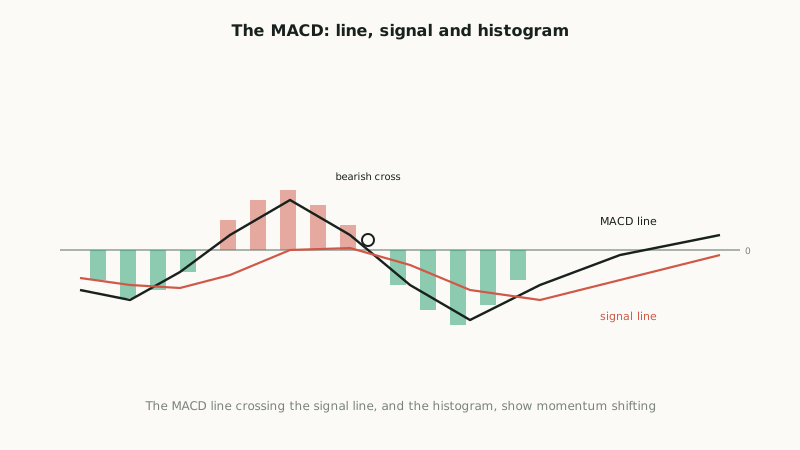
The MACD has three parts, all derived from moving averages. The MACD line is the heart of it: the difference between two exponential moving averages of price, conventionally the 12-period EMA minus the 26-period EMA. When the faster (12) EMA is above the slower (26), the MACD line is positive; when below, negative. The MACD line therefore captures the relationship between a short-term and a longer-term average — a measure of momentum and trend in one number.
The signal line is an EMA of the MACD line itself (conventionally 9-period) — a smoothed version of the MACD line that lags it slightly, used to generate crossover signals. The histogram is the difference between the MACD line and the signal line, drawn as bars above and below a zero line; it visualises the gap between the two lines, growing as they diverge and shrinking as they converge. Together these three — the MACD line (momentum), the signal line (a smoothed reference), and the histogram (the gap between them) — give a layered picture of how momentum is behaving. The conventional 12, 26, 9 settings are the standard default, though they can be adjusted.
Reading crossovers
The most common way to read the MACD is through crossovers of the MACD line and the signal line. When the MACD line crosses above the signal line, it is a bullish signal — momentum is turning up. When the MACD line crosses below the signal line, it is a bearish signal — momentum is turning down. These crossovers are the MACD's bread-and-butter signal, flagging shifts in momentum as the faster MACD line moves relative to its smoothed signal line.
A second, broader signal comes from the zero line. The MACD line crossing above zero means the faster EMA has risen above the slower EMA — a shift toward an uptrend. Crossing below zero means the opposite — a shift toward a downtrend. Where the signal-line crossover flags shorter-term momentum shifts, the zero-line crossover marks a more significant change in the underlying trend. Many traders watch both: a signal-line crossover for the momentum shift, confirmed by the MACD's position relative to zero for the broader trend context. As with all moving-average-based tools, these crossovers are lagging — they confirm shifts after they begin rather than predicting them — so they are most reliable as confirmation in trending conditions.
The histogram and momentum
The histogram is the MACD's most underrated component, because it visualises momentum directly and can hint at crossovers before they happen. Since the histogram is the gap between the MACD line and the signal line, growing bars mean the two lines are pulling apart — momentum is building in the current direction — while shrinking bars mean they are converging, momentum is fading, and a crossover may be approaching. The histogram thus gives an earlier read on momentum than waiting for the crossover itself.
Reading the histogram adds a layer of nuance to the MACD. Bars growing taller above the zero line show strengthening bullish momentum; bars shrinking back toward zero show that bullish momentum weakening, even before the lines actually cross. This makes the histogram useful for gauging the health of a move and anticipating shifts — a trader might note bullish histogram bars shrinking as an early warning that an uptrend's momentum is tiring, prompting them to watch for a bearish crossover or tighten a stop. The histogram turns the abstract crossover into a continuous, visual sense of momentum building and fading, which is part of why the MACD is so popular.
The MACD is really moving averages in disguise — so it inherits their lag. Its crossovers confirm momentum shifts after they begin, not before. The histogram is the early-warning layer: when its bars shrink, momentum is fading and a crossover may be coming. Read the histogram for the hint, the crossover for the confirmation.
Divergence on the MACD
Like the RSI, the MACD can show divergence between price and the indicator, and it is one of its more valued signals. Bearish divergence occurs when price makes a higher high but the MACD makes a lower high — the move is continuing but with weakening momentum. Bullish divergence is the mirror: price makes a lower low but the MACD makes a higher low, suggesting downside momentum is fading. As with RSI divergence, this can provide an early warning of a potential reversal, capturing a loss of momentum beneath a price move that is not yet obvious in price alone.
MACD divergence carries the same caveats as RSI divergence: it signals weakening momentum, not a guaranteed reversal, and momentum can fade and then reaccelerate without a turn. It is best treated as a warning to watch closely and seek confirmation, rather than as a standalone trigger. The MACD's divergence, crossover and histogram signals can also combine — for instance, a bearish divergence followed by a bearish signal-line crossover and a histogram rolling over is a more compelling case than any one alone. This layering of related signals from a single indicator is part of the MACD's appeal, though it remains, like all indicators, processed price best used as confirmation.
Limitations and forex use
The MACD's main limitation flows from its moving-average foundation: it is a lagging indicator that confirms shifts after they begin, and it generates false signals in ranging, choppy markets, where the lines cross back and forth without meaningful follow-through. Like moving averages, the MACD shines in trending conditions and struggles in sideways ones — a stream of whipsaw crossovers in a range can be costly if traded mechanically. Recognising whether the market is trending or ranging is therefore essential before relying on MACD signals, exactly as with moving averages.
On forex, the MACD works on any pair and timeframe and is among the most widely used indicators, valued for combining trend and momentum in one tool. The disciplined approach is the familiar one: use it as confirmation of price action rather than a standalone signal; combine its layered signals (crossover, zero line, histogram, divergence) for a fuller momentum picture; pair it with a different kind of tool (price-action levels, or a volatility indicator) rather than redundant momentum oscillators; and respect the market condition. Used this way, the MACD is a versatile and readable indicator — a momentum and trend gauge that, like the moving averages it is built from, rewards traders who understand both its strengths and its inescapable lag.
Settings and practical tips
The conventional MACD settings — 12, 26, 9 — are the standard default and a sensible starting point, but they can be adjusted to change the indicator's character. Shorter settings (smaller EMA periods) make the MACD more responsive, generating earlier but noisier signals; longer settings make it smoother and slower, with fewer but more reliable signals. As with all such choices, this is the familiar responsiveness-versus-reliability trade-off, and the right setting depends on your timeframe and style. Most traders find the standard 12, 26, 9 perfectly serviceable and adjust only with good reason.
The most important practical tip flows from the MACD's great weakness — false signals in ranging markets. The fix is to use a trend filter: only act on MACD crossovers that align with the broader trend, ignoring counter-trend signals. For instance, take only bullish MACD crossovers when price is above a long-term moving average (confirming an uptrend), and only bearish ones when below it. This single discipline filters out a large share of the whipsaw signals that the MACD generates in choppy, directionless conditions, where crossovers fire back and forth meaninglessly. Combining the MACD with a simple trend filter transforms it from a whipsaw-prone signal generator into a more reliable momentum confirmation tool.
A second practical tip is to weight the zero line for trend context: a MACD operating mostly above zero indicates a bullish regime in which bullish crossovers are more trustworthy, and vice versa below zero. And use the histogram as an early read, watching it shrink for a hint that a crossover may be coming. None of these refinements escapes the MACD's fundamental nature as a lagging, trend-condition-dependent tool — but applied together (standard settings, a trend filter, attention to the zero line and histogram), they make the MACD a genuinely useful and disciplined momentum indicator rather than a source of constant false alarms.
The MACD combines trend and momentum from moving averages: the MACD line (12-EMA minus 26-EMA), the signal line (9-EMA of it), and the histogram (the gap). Read signal-line crossovers for momentum shifts, the zero line for trend direction, the histogram for building/fading momentum, and divergence for reversal warnings. Standard 12/26/9 settings are fine; the key tip is to use a trend filter — take only crossovers aligned with the broader trend — to cut the whipsaws it suffers in ranges. Use it as confirmation, not a standalone signal.