
The Relative Strength Index, or RSI, is one of the most popular indicators in trading — and one of the most misunderstood. It is a momentum oscillator that swings between 0 and 100, measuring the speed of price movement to flag when a move may be running out of steam. Its appeal is obvious: a single number that seems to say "this has gone too far." But that very simplicity leads to the classic beginner error — blindly selling when it reads "overbought" and buying when it reads "oversold" — which can be ruinous in a trending market. This guide explains what the RSI actually measures, what overbought and oversold really mean, the powerful concept of divergence, and the mistakes to avoid.
It is the classic momentum oscillator within the framework of technical indicators explained, complementing the trend-focused moving averages.
Key takeaways
Q: What is the RSI indicator?
A: The Relative Strength Index (RSI) is a momentum oscillator that moves between 0 and 100, measuring the speed and magnitude of recent price changes. It is used to identify potentially overbought or oversold conditions and to spot divergence between price and momentum.
Q: What do overbought and oversold mean on the RSI?
A: An RSI above 70 is considered overbought, suggesting price may be overextended to the upside; below 30 is oversold, suggesting overextension to the downside. These are not automatic sell or buy signals — in strong trends the RSI can stay overbought or oversold for a long time.
Q: What is RSI divergence?
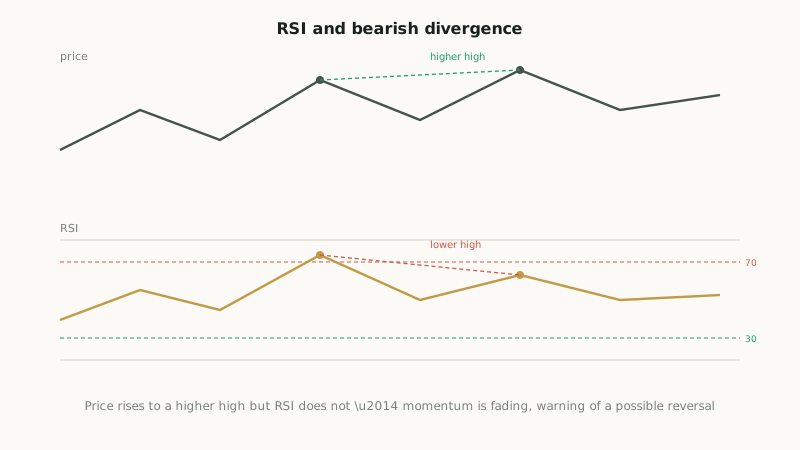
A: RSI divergence occurs when price and the RSI move in different directions — for example, price makes a higher high but the RSI makes a lower high (bearish divergence). It signals weakening momentum behind the price move and can warn of a potential reversal.
What the RSI measures
The RSI is a momentum oscillator developed by J. Welles Wilder, plotted on a scale from 0 to 100 (usually in a panel below the price chart) and most commonly calculated over a 14-period setting. It measures the speed and magnitude of recent price changes — essentially comparing the size of recent gains to recent losses to gauge how strongly and quickly price has been moving in one direction. A high RSI means price has been rising rapidly and persistently; a low RSI means it has been falling rapidly and persistently.
Because it measures momentum rather than price level, the RSI gives a different view from a moving average: it tells you not where price is or which way it is trending, but how forcefully it has been moving. This makes it useful for judging whether a move is gaining or losing steam. As an oscillator bounded between 0 and 100, it is particularly suited to identifying when momentum has reached an extreme — the "overbought" and "oversold" readings it is famous for — and, more subtly and valuably, for spotting when momentum is diverging from price. Understanding that the RSI is fundamentally a momentum gauge, not a price or trend gauge, is the key to using it correctly.
Overbought and oversold — carefully
The RSI's most famous use is identifying overbought and oversold conditions. Conventionally, an RSI reading above 70 is considered overbought — suggesting price has risen rapidly and may be overextended to the upside — while a reading below 30 is considered oversold, suggesting overextension to the downside. The intuitive interpretation is that an overbought market is "due" for a pullback and an oversold one "due" for a bounce.
Here lies the most important and most violated rule of the RSI: overbought does not mean sell, and oversold does not mean buy. This is the classic, costly beginner mistake. In a strong trend, the RSI can remain overbought (or oversold) for a very long time while price continues powerfully in the same direction — a roaring uptrend can keep the RSI above 70 for weeks as price climbs and climbs. A trader who mechanically shorts every overbought reading in such a trend is repeatedly run over, selling into strength again and again. Overbought means momentum is strong and the move is extended, which in a trend is a sign of strength, not an imminent reversal. The readings are best treated as context — a flag that a move is extended — not as standalone signals, and they work far better in ranging markets (where price does tend to revert from extremes) than in trending ones.
Divergence: the RSI's best signal
Arguably the RSI's most valuable use is spotting divergence — a disagreement between price and the indicator that reveals weakening momentum beneath the surface. Bearish divergence occurs when price makes a higher high but the RSI makes a lower high: price is still climbing, but with less momentum than before, hinting that the uptrend is tiring and may reverse. Bullish divergence is the mirror: price makes a lower low but the RSI makes a higher low, suggesting the downtrend is losing force and may turn up.
Divergence is valued because it can provide an early warning of a potential reversal, before it is obvious in price alone — the momentum is fading even as price makes its final push. This makes it one of the more genuinely useful indicator signals, capturing something not immediately visible on the price chart. That said, divergence is not infallible: it signals weakening momentum, but momentum can weaken and then reaccelerate without a reversal, and divergence can persist for some time before (or without) a turn. It is best used as a warning to watch for a reversal and to seek confirmation (from price action, a break of structure, or another signal), rather than as a standalone trigger. Used this way, RSI divergence is among the most respected applications of any oscillator.
The deadliest RSI mistake is treating overbought as "sell" and oversold as "buy." In a strong trend the RSI can sit at an extreme for ages while price keeps running — so an overbought reading in an uptrend is a sign of strength, not a reversal. The RSI's overbought/oversold readings work in ranges; its divergence signal works more broadly.
Other uses and settings
Beyond extremes and divergence, the RSI has further uses. The centreline (50) can serve as a momentum-bias gauge: readings above 50 suggest bullish momentum, below 50 bearish, giving a quick read of which side has the upper hand. Some traders adjust the conventional levels to suit conditions — using 80/20 instead of 70/30 to filter for more extreme readings, or shifting the bands in a strong trend (for instance, treating 40 rather than 30 as the oversold reference in an uptrend, since pullbacks in a strong uptrend rarely reach the conventional oversold zone).
The standard 14-period setting is the most widely used and a sensible default, but the period can be shortened for a more responsive (and noisier) RSI or lengthened for a smoother (and slower) one, with the usual responsiveness-versus-reliability trade-off. As with all indicators, these are refinements on top of the core principles, not substitutes for understanding them. The RSI is a momentum gauge: read its extremes as context (especially in ranges), respect that they mean little against a strong trend, watch for divergence as an early reversal warning, and — above all — confirm its signals with price action rather than trading them blindly.
The RSI on forex
On forex, the RSI works on any pair and timeframe and is among the most popular oscillators traders apply. It pairs naturally with the trend tools: a common, sound approach is to establish the trend first (with price action or a moving average) and then use the RSI in the direction of that trend — for instance, in an uptrend, watching for the RSI to dip toward oversold on a pullback as a potential entry to join the uptrend, rather than fighting the trend by shorting overbought readings. This trend-aligned use sidesteps the classic overbought/oversold trap and turns the RSI into a timing tool within a larger directional view.
Combined with the discipline that runs through all indicator use — treating the RSI as confirmation rather than a magic signal, not overloading the chart with redundant oscillators, and matching its use to the market condition — the RSI is a genuinely useful momentum gauge. Its divergence signal in particular adds real value, flagging fading momentum that price alone may not yet show. But its power is unlocked only by avoiding the overbought-means-sell trap that catches so many beginners, and by remembering that, like every indicator, it is processed price in a supporting role to the price action itself.
Failure swings and reading the oscillator
Beyond the basics, the RSI rewards more sophisticated reading. Wilder, its creator, described failure swings — a reversal signal based purely on the RSI's own movement, independent of price. A bullish failure swing occurs when the RSI drops into oversold, bounces, pulls back but holds above its prior low, then breaks above its recent peak — a structure showing momentum has turned even before price confirms. A bearish failure swing is the mirror in overbought territory. Failure swings are essentially the RSI forming its own higher lows or lower highs, signalling a momentum shift through the oscillator's structure.
This points to a broader, underused idea: you can apply price-analysis techniques to the RSI line itself. The RSI forms peaks and troughs, support and resistance levels, and even trendlines, just as price does — and breaks of these can be informative. An RSI that has been respecting a rising trendline (drawn on the oscillator), then breaks below it, signals weakening momentum, sometimes ahead of a visible break in price. Treating the oscillator as a chart in its own right, with its own structure to read, extends the RSI well beyond simple overbought/oversold readings.
These techniques share a theme with divergence: the most valuable RSI signals come not from the raw 70/30 levels but from the structure and behaviour of the momentum it measures — how momentum is building, fading, or diverging from price. This is why experienced traders rarely trade the RSI as a crude overbought/oversold trigger and instead read it for these richer momentum cues, always in the context of the trend and confirmed by price action. The RSI is far more than an overbought/oversold light; read properly, it is a nuanced window onto the momentum beneath price.
The RSI is a momentum oscillator (0–100, usually 14-period). Above 70 is overbought, below 30 oversold — but these are not automatic sell/buy signals: in strong trends the RSI can stay extreme for ages, so overbought in an uptrend signals strength. Its richest signals come from structure: divergence (price and RSI disagreeing), failure swings, and trendlines or support/resistance on the oscillator itself. Use it trend-aligned, as confirmation, respecting whether the market is ranging or trending.