Bollinger Bands wrap price in an envelope that breathes. As volatility rises the bands widen; as it falls they narrow — a living, adapting frame around price that reveals two valuable things: when a market has coiled into low-volatility quiet (often before a big move), and when price has stretched unusually far from its average. Developed by John Bollinger, the bands are among the most popular and versatile indicators, but they are also widely misused by traders who treat a touch of the band as an automatic reversal signal. This guide explains how the bands work, the famous "squeeze," riding the band in trends, mean reversion, and the mistakes to avoid.
It is the classic volatility indicator within the framework of technical indicators explained, built on a moving average core.
Key takeaways
Q: What are Bollinger Bands?
A: Bollinger Bands are a volatility indicator made of three lines: a middle band (usually a 20-period moving average) and an upper and lower band placed a number of standard deviations (usually two) above and below it. The bands widen when volatility rises and narrow when it falls.
Q: What is a Bollinger Band squeeze?
A: A squeeze is when the bands narrow sharply, reflecting unusually low volatility as price consolidates. Because periods of low volatility tend to be followed by periods of high volatility, a squeeze often precedes a strong directional move or breakout.
Q: Does price always reverse at the Bollinger Bands?
A: No. While price often reverts toward the middle in ranging markets, in a strong trend price can 'ride the band' — hugging the upper or lower band as it trends. Touching a band is not an automatic reversal signal, which is a common and costly misconception.
How the bands are built
Bollinger Bands consist of three lines. The middle band is a moving average, conventionally a 20-period simple moving average — the central reference around which the bands are built. The upper and lower bands are placed a set number of standard deviations (conventionally two) above and below the middle band. Standard deviation is a statistical measure of how spread out price has been, so the distance of the bands from the middle reflects recent volatility directly.
This construction gives the bands their defining behaviour: they widen when volatility rises and narrow when it falls. When price is swinging wildly, the standard deviation is large, so the bands push far apart; when price is quiet and range-bound, the standard deviation is small, so the bands contract tightly around price. The bands therefore adapt to market conditions automatically, framing price within a volatility-adjusted envelope. Because of the statistical basis, price spends the large majority of its time within the bands, with the bands expanding and contracting as a living measure of how turbulent or calm the market currently is. Reading that expansion and contraction — the bands' "breathing" — is central to using them.
The squeeze
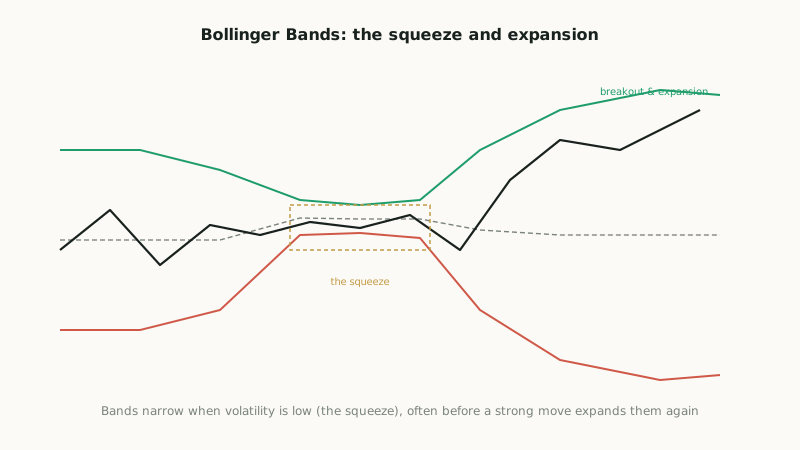
The most celebrated Bollinger Band signal is the squeeze — a period when the bands narrow sharply, contracting tightly around price. A squeeze reflects unusually low volatility: price has gone quiet, consolidating in a tight range, and the standard deviation has shrunk. The significance of the squeeze rests on a well-observed market tendency: periods of low volatility tend to be followed by periods of high volatility. Markets cycle between calm and turbulence, and an unusually calm, coiled period often precedes an unusually energetic one.
This makes the squeeze a valuable heads-up: when the bands pinch tightly together, it signals that the market is coiled and that a strong directional move — a breakout — may be approaching, as volatility reverts from its low. The squeeze does not, however, tell you which direction the move will go; it only flags that a move is brewing. Traders therefore watch a squeeze closely and prepare to act on the breakout when it comes, often combining the squeeze with other tools (price-action levels, the direction of the eventual band expansion) to judge direction. The squeeze is one of the clearest practical uses of any volatility indicator: a visual signal that the market's quiet is likely the calm before a move.
Riding the band versus mean reversion
Here lies the most important and most misunderstood aspect of Bollinger Bands. The naive interpretation is that when price touches the upper band it is "too high" and will reverse down, and when it touches the lower band it is "too low" and will reverse up — a pure mean-reversion reading, expecting price to revert from the bands back toward the middle. In ranging markets, this tendency does often hold: price oscillates between the bands, reverting from the extremes toward the middle, and the bands can frame a range nicely.
But in a strong trend, this interpretation is dangerously wrong. In a powerful uptrend, price can "ride the band" — hugging or repeatedly touching the upper band as it climbs persistently higher, with each "overbought" touch leading not to a reversal but to further gains. A trader who mechanically shorts every touch of the upper band in such a trend is repeatedly run over, exactly like the RSI trader who shorts every overbought reading. Touching a band means price is relatively high or low for current volatility — it does not mean an automatic reversal. The mean-reversion reading works in ranges; the riding-the-band behaviour dominates in trends. Knowing which condition you are in is essential, and conflating them is the classic Bollinger Band mistake.
A touch of the band is not a reversal signal. In a range, price reverts from the bands toward the middle; in a strong trend, price rides the band and keeps going. Shorting every tag of the upper band works in a range and is ruinous in an uptrend — so read the condition first, exactly as with the RSI's overbought trap.
Using the bands well
Used wisely, Bollinger Bands offer several genuine insights. The band width itself is information: narrow bands (a squeeze) warn of a brewing move, while very wide bands indicate high volatility that often eventually contracts. The middle band (the moving average) serves as a dynamic support/resistance and trend reference, just like any moving average. And in ranging conditions, the upper and lower bands can frame mean-reversion opportunities — with the crucial proviso that you have correctly identified a range rather than a trend.
John Bollinger himself stressed that the bands are not a standalone system and should be combined with other tools and price action rather than traded mechanically. A touch of the lower band that coincides with a support level and a bullish reversal candle, in a ranging market, is a far better signal than a band touch alone. Pairing the bands (a volatility tool) with a momentum indicator like the RSI, or with price-action analysis, gives the genuine multi-angle confluence that single signals lack — and avoids the redundancy of stacking similar indicators. The bands tell you about volatility and relative price extension; combined with tools that tell you about trend and momentum, and read with awareness of whether the market is trending or ranging, they are a versatile and insightful addition to the toolkit.
Bollinger Bands on forex
On forex, Bollinger Bands work on any pair and timeframe, needing no volume data, and are widely used to gauge volatility and frame price. The squeeze is particularly useful on currencies, which often alternate between quiet consolidation and sharp, news-driven expansion — a squeeze ahead of a major economic release, for instance, can flag a market coiled for the volatility that the release may unleash. As ever, the bands are best as one input among several: a volatility lens that complements the trend tools (moving averages), momentum tools (RSI, MACD) and price action that make up a rounded technical approach.
The overriding lesson is the one that recurs across every indicator on this site: Bollinger Bands are processed price, valuable as a volatility gauge and a relative-extension reference, but not a magic reversal signal. Respect the squeeze as a warning of a coming move, never short the upper band blindly in a trend, lean on mean reversion only in confirmed ranges, and always combine the bands with price action and a complementary tool. Read this way — with awareness of volatility, condition and confluence — Bollinger Bands round out the indicator toolkit as the natural volatility complement to the trend and momentum indicators covered in this cluster.
Bandwidth, %b and Bollinger's patterns
John Bollinger devised two companion measures that quantify what the bands show visually. Bandwidth measures the width of the bands (the distance between upper and lower as a proportion of the middle), turning the visual squeeze into a number — a low bandwidth reading identifies a squeeze precisely, flagging the low-volatility coil that often precedes a move. Watching bandwidth fall to unusually low levels is a more rigorous way to spot squeezes than eyeballing the chart. %b (percent b) measures where price sits within the bands on a scale where 0 is the lower band and 1 is the upper — quantifying how high or low price is relative to the current volatility envelope, and making it easy to see band touches, breaches, and the relationship between price and the bands numerically.
Bollinger also identified chart patterns that play out against the bands. A W-bottom is a double-bottom-like formation where the second low holds inside or higher relative to the lower band even as price makes a similar or lower low — a sign of waning downside momentum, conceptually close to bullish divergence. An M-top is the mirror at highs. He also described "walking the bands," the strong-trend behaviour already discussed, where price rides along a band rather than reverting — the very behaviour that makes naive mean-reversion trading so dangerous in trends.
These refinements reinforce the core lessons rather than replacing them. Bandwidth makes the squeeze precise; %b makes price's position within the bands precise; the W-bottom and M-top tie the bands to reversal structure; and walking the bands names the trend behaviour to respect. All of them deepen the same fundamental understanding: the bands measure volatility and relative price extension, must be read with awareness of whether the market is trending or ranging, and work best combined with price action and complementary tools — never as a mechanical "touch the band, take the trade" system, which Bollinger himself warned against.
Bollinger Bands are a volatility indicator: a middle moving average with bands two standard deviations away, widening in high volatility and narrowing in low. The squeeze (narrow bands, low bandwidth) warns a strong move may be coming, though not its direction. A band touch is not an automatic reversal — price reverts to the middle in ranges but rides the band in strong trends. Companion measures (bandwidth, %b) and patterns (W-bottoms, M-tops) refine the reading. Use the bands as a volatility lens with price action, never as a standalone signal.