Technical indicators are the most popular tools in all of trading — and the most misused. Open any trading platform and you will find dozens of them, and beginners often pile them onto a chart in the hope that more lines mean more insight. The reality is humbler and more useful to understand: every indicator is simply price, repackaged through a calculation. Indicators do not contain secret information or predict the future; they reorganise the price data you already have into a form that can confirm, clarify or highlight what is happening. Used with that understanding, they are genuinely valuable. Used as magic signal generators, they disappoint. This guide explains what indicators are, the four families, and how to use them well.
Indicators are a complement to the raw-price reading of price action trading and the patterns covered elsewhere in this section — tools that organise price, not replace the reading of it.
Key takeaways
Q: What are technical indicators?
A: Technical indicators are mathematical calculations based on price (and sometimes volume) plotted on a chart to help analyse the market. They fall into families such as trend, momentum, volatility and volume indicators, and are used to identify direction, gauge momentum, and confirm trading decisions.
Q: What is the difference between leading and lagging indicators?
A: Lagging indicators follow price and confirm trends after they begin, like moving averages — reliable but late. Leading indicators attempt to anticipate moves and give earlier signals, like some oscillators — timelier but with more false signals. Most popular indicators are lagging.
Q: How many indicators should you use?
A: Few. Using too many indicators, especially redundant ones from the same family, causes confusion and conflicting signals — 'paralysis by analysis.' A small number of complementary indicators that confirm price action is far more effective than a cluttered chart.
What an indicator really is
A technical indicator is a mathematical calculation based on price (and sometimes volume), plotted on or below the chart to aid analysis. A moving average averages recent prices; the RSI measures the speed of recent price changes; Bollinger Bands measure how far price is straying from its average. In every case, the raw material is the price data you can already see — the indicator simply processes it through a formula and displays the result in a way that may reveal something less obvious in the raw chart.
This leads to the single most important thing to understand about indicators: because they are derived from price, they cannot add information that is not already in the price. An indicator repackages price; it does not transcend it. This is why no indicator is a crystal ball, why indicators based on the same underlying data tend to agree (and so add little when stacked together), and why price action itself remains the primary truth, with indicators in a supporting role. Grasping that indicators are processed price, not independent oracles, immediately inoculates you against the most common misuse — treating an indicator's signal as a magic instruction rather than as one more lens on the price you can already read.
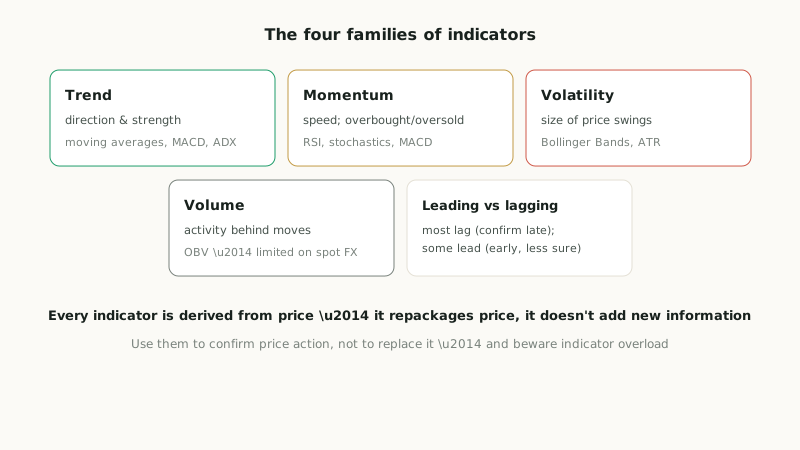
The four families
Indicators fall into four broad families, each highlighting a different aspect of price behaviour. Trend indicators identify the direction and strength of a trend — the classic example being moving averages, which smooth price into a directional line, along with the MACD and ADX. Momentum indicators (or oscillators) measure the speed of price movement and flag overbought or oversold conditions — chiefly the RSI and stochastics, with the MACD straddling trend and momentum.
Volatility indicators measure the magnitude of price swings — most notably Bollinger Bands and the ATR — helping gauge how much the market is moving. Volume indicators are based on trading volume, though these are of limited use in spot forex, which has no true centralised volume, only the imperfect proxy of tick volume. Each family answers a different question: which way is the market going (trend), how fast (momentum), how much is it moving (volatility), and how much activity is behind it (volume). Knowing which family an indicator belongs to tells you what it is actually measuring — and helps you avoid the common error of stacking several indicators that all measure the same thing.
Leading versus lagging
A second useful distinction is between lagging and leading indicators. Lagging indicators follow price and confirm what has already begun — a moving average only turns up after price has been rising for a while. They are reliable (they confirm real moves) but late (the signal comes after the move is underway). Most popular indicators, including moving averages and MACD, are lagging. Leading indicators attempt to anticipate moves before they happen, giving earlier signals — many oscillators, used to spot overbought/oversold conditions or divergence, fall here. They are timelier but generate more false signals, because anticipating is inherently less certain than confirming.
This is a fundamental trade-off with no free lunch: earlier signals are less reliable, and more reliable signals are later. A trader using lagging indicators accepts late entries in exchange for fewer false starts; one using leading indicators accepts more false signals in exchange for earlier entries. Understanding which type an indicator is sets the right expectation — you should not be surprised when a lagging indicator confirms a move "late," because that is its nature, nor when a leading indicator gives a false signal, because that too is its nature. Many traders combine the two: a leading indicator to flag a possible setup and a lagging one to confirm it.
There is no free lunch in indicators: a signal can be early or reliable, not both. Lagging indicators confirm late but truly; leading indicators anticipate early but often wrongly. Knowing which kind you are using tells you exactly what to expect from it — and stops you blaming a tool for behaving as its type dictates.
The danger of indicator overload
The most common mistake with indicators is using too many of them. Beginners, reasoning that if one indicator helps then five must help more, cover their charts in overlapping tools — and end up worse off. The problem is twofold. First, indicators from the same family are redundant: since they are all derived from price and measure the same thing, three momentum oscillators will mostly agree and add no real information, while creating a false sense of "confluence" that is really just one signal counted three times. Second, a cluttered chart produces conflicting signals — one indicator says buy while another says sell — leading to confusion and "paralysis by analysis," where the trader cannot act at all.
The disciplined approach is to use a small number of complementary indicators — ideally from different families, so each adds genuinely different information — alongside price action, rather than a crowd of redundant ones. A trend indicator plus a momentum indicator, for instance, gives you direction and speed from two different angles; adding a third momentum oscillator gives you nothing but clutter. Many of the most successful traders use very few indicators, or none at all, relying primarily on price action with an indicator or two for confirmation. Less is almost always more: a clean chart with one or two well-understood, complementary indicators beats a cluttered one every time.
Using indicators well
Bringing it together, a few principles govern the effective use of indicators. Treat them as confirmation, not prediction — they support and clarify a reading of price action rather than generating standalone signals to obey blindly. Understand what each one measures and which family and type (leading/lagging) it belongs to, so you use it for what it is good at and expect its characteristic weaknesses. Seek genuine confluence by combining different kinds of evidence — a momentum indicator confirming a price-action setup at a key level is real confluence; three oscillators agreeing is not.
And always remember the conditions: indicators behave differently in trending versus ranging markets. Trend indicators like moving averages work beautifully in trends and whipsaw badly in ranges; oscillators like RSI work well in ranges and give misleading "overbought" readings in strong trends. Matching the indicator to the market condition is part of using it well. Above all, keep price action primary and indicators secondary — the indicator is a useful lens, but the price is the thing it is a lens on. The detailed guides in this cluster cover the most important individual indicators, but they all rest on these foundations: indicators are processed price, used to confirm, in small numbers, with awareness of their type and the market's condition.
Combining indicators well
Since the goal is a few complementary indicators rather than many redundant ones, it helps to know how to combine them well. The principle is to choose indicators from different families, so each adds genuinely different information. A classic, effective combination is a trend indicator plus a momentum indicator: the trend tool (say a moving average) tells you which way the market is going, and the momentum tool (say the RSI) tells you about the strength and timing of moves within that trend. The two answer different questions and so reinforce rather than echo each other.
A common, sound workflow built on this is to use the trend indicator to establish direction and then use the momentum indicator only for signals in that direction — for instance, in an uptrend identified by a rising moving average, watching for the RSI to dip on a pullback as a timing cue to join the uptrend, rather than taking momentum signals against the trend. Adding a volatility indicator (like Bollinger Bands) as a third, different-family tool can refine this further, flagging when conditions are coiled or stretched. The point is that three indicators from three families give three genuinely different angles, whereas three momentum oscillators give one angle counted three times.
Another powerful technique is multi-timeframe analysis: reading an indicator on a higher timeframe for the broader context and a lower one for entry timing — for example, confirming the trend on the daily chart before taking signals on the hourly. This adds genuine information (different timeframes) rather than redundancy. However you combine them, the test is the same: does each tool add something the others don't? If yes, it earns its place; if it merely echoes another, it is clutter. A clean chart with a trend tool, a momentum tool and perhaps a volatility tool — each understood and each adding a distinct angle — is the disciplined ideal.
Indicators are price repackaged — they confirm and clarify but never predict. They come in four families: trend, momentum, volatility and volume. Lagging indicators confirm late but reliably; leading ones anticipate early but with more false signals. Avoid overload: combine a few complementary indicators from different families (e.g. trend + momentum + volatility), use the trend tool for direction and the others for timing, consider multiple timeframes, and always treat indicators as confirmation of price action, matched to the market condition.