Strip away every indicator, every moving average and oscillator, and what remains is the only thing that actually determines whether you make or lose money: price itself. Price action trading is the discipline of reading that raw information directly — the candles, the trends, the levels — to judge who is in control of the market and where it is likely to head next. It is the oldest approach in technical analysis and, in a real sense, the foundation beneath all the others: order blocks, supply and demand zones, even Elliott Wave are ultimately just structured ways of reading price action. This guide explains what it is and how to build an approach around it.
Price action is the common ancestor of the frameworks across this site, and understanding it makes everything else clearer — including how it relates to its modern descendant in SMC vs price action.
Key takeaways
Q: What is price action trading?
A: Price action trading is the practice of making decisions based on the movement of price itself — candlesticks, trends, support and resistance, and chart patterns — rather than on lagging indicators. It reads raw price to judge who is in control and where the market is likely to go.
Q: Is price action trading effective?
A: Price action is a sound and widely used foundation because price is the most direct, least lagging information available. Its effectiveness depends on the trader's skill in reading context, since the same candlestick signal means very different things in different locations.
Q: What are the main price action signals?
A: Common signals include pin bars (long-wicked rejection candles), engulfing candles (where one candle's body engulfs the previous), and inside bars (consolidation within a prior candle's range). Their meaning depends heavily on where they appear.
The philosophy: price is primary
The case for price action rests on a simple observation: every indicator is derived from price, which means indicators are by nature one step removed and lagging. A moving average is just an average of past prices; an oscillator is just a transformation of recent price movement. Whatever an indicator tells you, price already told you first, and usually sooner. The price action trader's argument is therefore that you should read the source directly rather than its delayed, processed echoes.
This does not mean indicators are useless — many traders use them well — but it reframes their role as secondary aids rather than primary signals. The price action purist keeps the chart clean and learns to read the raw information: the shape of the candles, the structure of highs and lows, the levels where price has reacted before. The skill being developed is a direct, unmediated feel for what buyers and sellers are doing, which is the most fundamental competence a technical trader can have and the one that makes every other tool more effective.
Reading candlesticks
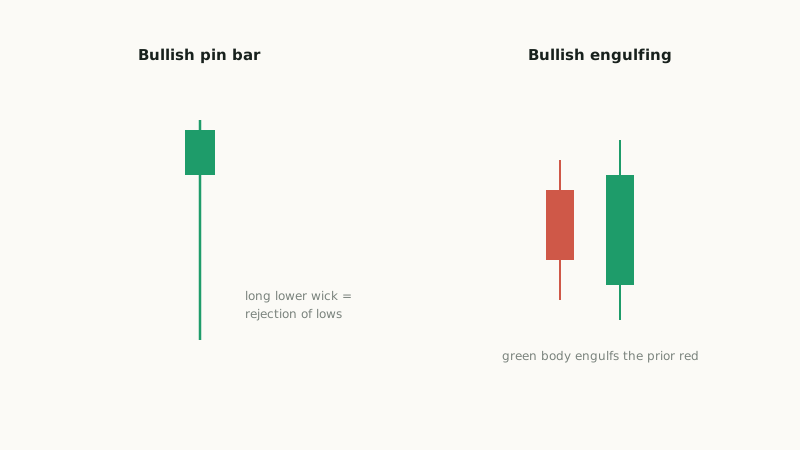
The basic unit of price action is the candlestick, and learning to read candles is where most price action study begins. A candle encodes a battle: its body shows where price opened and closed, its wicks show how far buyers and sellers pushed before being repelled. A few formations recur often enough to be worth knowing well.
- Pin bars — candles with a small body and a long wick, showing that price was pushed strongly in one direction and then rejected. A long lower wick is bullish (sellers tried and failed); a long upper wick is bearish.
- Engulfing candles — a candle whose body completely engulfs the previous candle's body, signalling a decisive shift in control from one side to the other.
- Inside bars — a candle that trades entirely within the previous candle's range, indicating consolidation and a potential breakout to come.
Context is everything
Here is the single most important lesson in price action, and the one beginners most often miss: a candlestick signal means nothing on its own. A bullish pin bar in the middle of a range is noise; the same pin bar at a significant support level, after a pullback in an uptrend, is a high-quality signal. The candle is identical; the context is what gives it meaning. Price action is not pattern-spotting — it is reading signals in light of where they occur.
This is why serious price action trading always combines candle signals with two other layers: structure (the trend and the sequence of highs and lows) and levels (support, resistance, and supply and demand zones). The question is never simply "is this a pin bar?" but "is this a pin bar at a meaningful level, in line with the larger structure?" When all three align — a strong candle signal, at a significant level, in the direction of the trend — you have the kind of confluence that defines a genuine price action setup. When they do not, the signal is best ignored, however textbook the candle looks.
The candle is the trigger; the level and the trend are the reason. A price action signal is only worth taking when the pattern, the location and the structure all point the same way. Trading candles without context is the most common way price action goes wrong.
Trend and structure
Underpinning the candle signals is the reading of trend and structure — the same higher-high, higher-low sequences that Smart Money Concepts formalises as break of structure and change of character. A price action trader identifies whether the market is trending or ranging, where the significant swing points are, and which direction carries the advantage, before ever looking for a candle signal. This structural read provides the bias; the candle signal provides the timing.
The discipline of trading with structure rather than against it is what keeps a price action trader on the right side of the market. In a clear uptrend, the approach is to wait for pullbacks to support or a demand zone, then look for a bullish candle signal to time an entry in the trend's direction. In a range, the approach shifts to fading the edges — looking for rejection signals at the range boundaries. Reading structure first, then timing with candles, is the rhythm of competent price action trading, and it maps directly onto the structure concepts covered in break of structure explained.
Strengths and limitations
Price action's strengths are real. It is universal — it works on any market and any timeframe, because every market produces price. It is direct, reading the source rather than lagging derivatives. It keeps charts clean and forces the trader to develop genuine market-reading skill rather than dependence on a particular indicator's settings. And it is adaptable, since reading what price is actually doing lets a trader respond to changing conditions rather than waiting for a rigid signal.
The limitations are equally real and worth being honest about. Price action is subjective: reading context and structure involves judgement, and two traders can read the same chart differently — the same critique that applies to Elliott Wave and SMC. It requires screen time and experience to develop the necessary feel, with no shortcut. And because it lacks mechanical signals, it is harder to backtest rigorously and easier to apply inconsistently. Price action is a skill to be developed, not a system to be switched on, and that learning curve is its main cost.
Building a price action approach
For a forex trader, a sound price action approach is built in layers. Start with the higher-timeframe trend and structure to establish a directional bias. Mark the significant levels — support and resistance, supply and demand zones, previous highs and lows. Then wait, patiently, for price to reach one of those levels and produce a clear candle signal in line with the trend. Enter on the signal, place a stop beyond the level that invalidates the idea, and target the next significant structural level. It is unglamorous and demands patience, but it is the foundation on which every more elaborate framework is built.
The reward for developing this skill is that it makes everything else better. Whether you go on to trade Smart Money Concepts, supply and demand, or any other method, a strong price action foundation means you are reading the underlying reality those frameworks describe rather than merely following their rules. Price action is, in the end, simply the ability to read the market in its own language — and that ability never stops being useful.
Levels and chart patterns
Beyond individual candles, price action reading rests heavily on support and resistance — the horizontal levels where price has repeatedly reacted. A support level is a price floor where buyers have previously stepped in; a resistance level is a ceiling where sellers have appeared. These levels matter because market participants remember them and place orders around them, making them self-reinforcing. A key principle is that broken levels switch roles: support that breaks tends to become resistance, and resistance that breaks tends to become support, as the traders trapped by the break provide orders on the retest. Reading where these levels sit, and which have flipped, gives price action its map of meaningful prices.
Layered on top are chart patterns — recognisable multi-candle formations that price action traders use to anticipate the next move. Continuation patterns such as flags and triangles suggest a trend is pausing before resuming; reversal patterns such as double tops and bottoms or head-and-shoulders suggest a trend is ending. These patterns are themselves just structured descriptions of how price action behaves at levels, and like candle signals they only carry weight in context — a double top at significant resistance after an extended rally is meaningful, while the same shape in the middle of a range is not. Combined with candle signals and structure, support and resistance and chart patterns complete the price action toolkit: levels tell you where to watch, patterns tell you what may be developing, and candles tell you when to act.
Price action trading reads raw price — candlesticks, structure, support and resistance, and chart patterns — rather than lagging indicators. The candle is only the trigger; its meaning comes from context, so trade signals only where pattern, level and trend agree. It is universal and direct but subjective and skill-intensive, and it is the foundation beneath every other technical framework.