Markets spend a surprising amount of their time going nowhere. Between the trends, price often drifts sideways, oscillating between a floor and a ceiling in a range — and far from being dead time, this sideways behaviour is a genuine opportunity. Range trading turns the oscillation into profit by buying near the floor and selling near the ceiling, repeatedly, for as long as the range holds. It is the natural counterpart to trend following: where trend following profits from price going somewhere, range trading profits from price going nowhere. This guide explains how to identify a range, how to trade it, how to time entries, and how to manage the ever-present risk of a breakout.
It is the core strategy for ranging conditions within the framework of forex trading strategies — the complement to trend following.
Key takeaways
Q: What is range trading?
A: Range trading is a strategy for sideways markets, where price oscillates between a support level (floor) and a resistance level (ceiling). The trader buys near support and sells near resistance, profiting from the repeated swings within the range rather than from a directional trend.
Q: How do you identify a trading range?
A: A range shows price repeatedly bouncing between a horizontal support level and a horizontal resistance level, without making the higher highs and higher lows (or lower highs and lower lows) that define a trend. The more times price tests and respects the boundaries, the clearer the range.
Q: What is the main risk of range trading?
A: The main risk is a breakout — price eventually breaking decisively out of the range into a new trend. Range trades placed at the boundaries can suffer losses when a boundary gives way, so stops just outside the range and respect for breakouts are essential.
Identifying a range
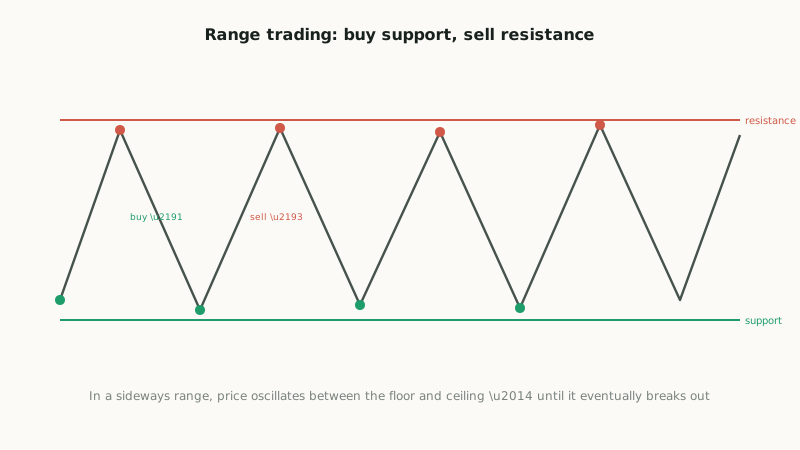
Range trading begins, like trend following, with correctly identifying the condition — here, that the market is ranging rather than trending. A range is characterised by price repeatedly bouncing between a horizontal support level (the floor, where price stops falling and turns up) and a horizontal resistance level (the ceiling, where price stops rising and turns down), without making the progressive higher highs and higher lows (or lower highs and lower lows) that define a trend. Price moves sideways, oscillating within the boundaries.
The more times price tests and respects the support and resistance levels, the clearer and more reliable the range — each successful bounce confirms the boundary's significance, much as repeated tests confirm a double or triple top. The key discipline is the mirror of the trend follower's: just as a trend follower must confirm a real trend exists, a range trader must confirm a real range exists, with defined, respected boundaries and no directional structure. Mistaking a trend for a range (and so fighting the trend) is the range trader's version of the whipsaw trap. Honestly reading the condition — ranging, with clear boundaries — is the essential first step before deploying the strategy.
Buying support, selling resistance
The core mechanic of range trading is simple: buy near support and sell near resistance. As price falls toward the support floor, the range trader looks to buy, anticipating a bounce back up toward resistance; as price rises toward the resistance ceiling, they look to sell, anticipating a fall back toward support. The trade targets the opposite side of the range: a buy at support aims for resistance, a sell at resistance aims for support. This is a form of mean reversion — betting that price, having reached an extreme of the range, will revert back toward the middle and beyond.
This approach inverts the trend follower's logic in an instructive way. The trend follower buys strength (new highs) and sells weakness; the range trader buys weakness (price at the support lows) and sells strength (price at the resistance highs). This is why the two strategies suit opposite conditions: in a trend, buying weakness means catching a falling knife; in a range, buying weakness means buying the predictable bounce. The range trader is, in effect, betting against continuation at the boundaries — expecting the move to the boundary to fail and reverse — which works precisely because, in a genuine range, the boundaries hold. Trading the boundaries the right way round (buy the floor, sell the ceiling) is the essence of the strategy.
Timing entries with oscillators
Range trading pairs naturally with momentum oscillators like the RSI and stochastics, because their overbought/oversold readings work best in exactly the ranging conditions where range trading operates. As covered in the RSI guide, overbought and oversold signals are unreliable in trends (where price can stay extreme for ages) but genuinely useful in ranges, where price does tend to revert from extremes. This makes oscillators a good fit for timing range-trading entries.
The practical use: as price approaches the support floor, an oscillator reaching oversold helps confirm a potential buy — price is at the range low and momentum is stretched to the downside, a stronger signal together than either alone. As price approaches resistance, an oscillator reaching overbought helps confirm a potential sell. The boundary (support/resistance) gives the location; the oscillator gives the timing confirmation; and ideally a price-action signal (a reversal candle at the boundary) confirms the actual turn. This confluence of boundary, oscillator and price action — each a different kind of evidence — is far more reliable than trading the boundary alone, and it puts the indicators to use in the condition they suit best.
Range trading and trend following are mirror images: the range trader buys weakness and sells strength at the boundaries, betting the move fails; the trend follower buys strength and sells weakness, betting it continues. This is exactly why each suits the opposite condition — and why deploying the wrong one for the market is so costly.
The breakout risk
Every range trader must respect one ever-present danger: the range will eventually break. No range lasts forever; sooner or later price breaks decisively out of one of the boundaries into a new trend, and a range trade placed at that boundary — buying support just as support gives way, or selling resistance just as it breaks — can turn into a significant loss as price runs in the breakout direction. This is the range trader's equivalent of the trend follower's whipsaw: the characteristic way the strategy fails when the condition changes.
Two disciplines manage this risk. First, place stops just outside the range — below support for a buy, above resistance for a sell — so that if the boundary genuinely breaks, the loss is small and defined, and you are taken out of a trade whose premise (the range holding) has been invalidated. Second, do not fight a confirmed breakout: once price has decisively broken out, the range is over, and continuing to trade it as if the boundaries still hold is a path to repeated losses. The astute trader recognises when a range is breaking and either stands aside or switches to a breakout approach (covered next). Respecting that the range will eventually end — with tight stops outside the boundaries and a refusal to fight a real breakout — is what keeps range trading's losses small and survivable.
Range trading on forex
Range trading suits forex well, partly because of the trading sessions covered earlier: the quieter Asian session, with its often tighter, range-bound conditions, can be well suited to range strategies, while the more directional London open tends to favour trends and breakouts. Currencies also frequently consolidate in ranges between trends, especially during quiet periods or ahead of major news, providing regular range-trading opportunities for those who can identify them.
The strategy's strengths and weaknesses are the precise inverse of trend following's: it profits in ranging markets and fails when a trend begins, just as trend following profits in trends and fails in ranges. This complementarity is why understanding both — and reading the current condition correctly — is so valuable: together they cover the two states a market can be in. The disciplined range trader trades ranges selectively (only when a clear range exists), uses oscillators and price action to time entries at the boundaries, places tight stops just outside the range, and respects breakouts when they come. Combined with sound position sizing, range trading is a sound, profitable approach to the substantial portion of the time that markets spend going nowhere.
Practical range-trading tips
A few practical refinements sharpen range trading. The first concerns where in the range to act: the edges (support and resistance) are where the opportunities lie, while the middle of the range is a no-man's-land offering poor risk-reward, since price could head to either boundary from there. Disciplined range traders wait for price to reach the extremes — near support or near resistance — before entering, rather than trading the indecisive middle. Entering at the boundary gives a tight stop (just outside the range) and a target at the far side, a favourable risk-reward; entering mid-range gives neither.
The second concerns the quality of the range. Wider ranges offer more room between boundaries and thus more profit potential per trade and clearer levels, while very tight ranges leave little room for profit after costs and are more prone to messy, ambiguous breaks. The more times price has cleanly tested and respected the boundaries, the more reliable the range — a level touched and held several times is far more tradeable than one tested only once. Favouring well-defined, adequately wide ranges with proven boundaries improves the odds considerably.
A third, more advanced tip is that a failed breakout can be a range-trading signal. When price pokes beyond a boundary and then snaps back inside the range (a false breakout), it often signals that the range is reasserting itself and can offer a high-probability entry back toward the opposite boundary — the failed break has trapped the breakout traders, whose exit fuels the move back into the range. This connects range trading to the false-breakout dynamics covered in the breakout guide: the same fakeout that hurts a breakout trader can reward an alert range trader. Used together, these tips — trade the edges not the middle, favour wide well-tested ranges, and fade failed breakouts — turn basic range trading into a more selective, higher-probability approach.
Range trading suits sideways markets: buy near the support floor (targeting resistance) and sell near the resistance ceiling (targeting support). Confirm a genuine range first, and time entries with oscillators plus price action. Trade the edges, not the indecisive middle; favour wide, well-tested ranges; and consider fading failed breakouts back into the range. The key risk is a real breakout: keep stops just outside the range and never fight a confirmed one. It's the mirror of trend following — match the strategy to the condition.