There is a particular kind of energy in a market that has been coiled and quiet, pressing against a level, until it finally breaks free — and the move that follows can be fast and powerful. Breakout trading aims to catch exactly that moment: the transition from a range-bound, consolidating market into a new directional move. It is the third core strategy, trading the transition between conditions where trend following trades trends and range trading trades ranges. The great prize of breakout trading is getting in at the start of a new move; the great challenge is the false breakout, the fakeout that breaks the level and then reverses. This guide explains how to trade breakouts and, crucially, how to handle the fakes.
It trades the transition within the framework of forex trading strategies, and it connects directly to the consolidation patterns like triangles and the Bollinger squeeze.
Key takeaways
Q: What is breakout trading?
A: Breakout trading is a strategy that enters as price breaks decisively out of a consolidation, range or key level into a new directional move. It aims to catch the start of a new trend at the moment the market transitions from ranging to trending, when a strong move often follows.
Q: How do you tell a true breakout from a false one?
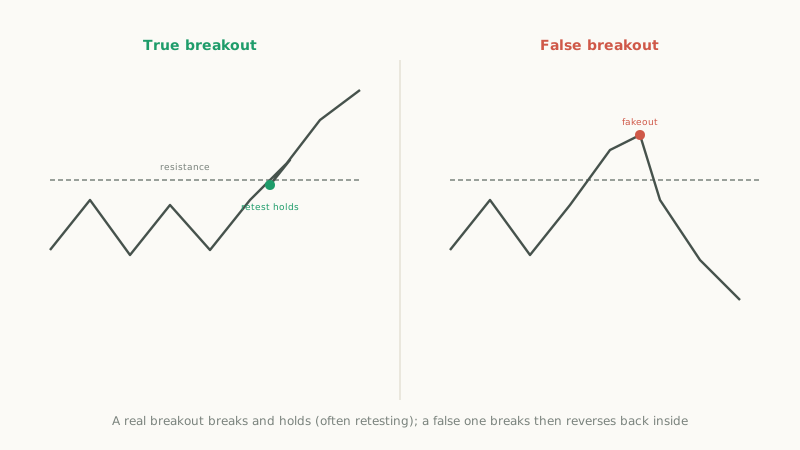
A: A true breakout breaks decisively and holds, often retesting the broken level as new support or resistance before continuing. A false breakout (fakeout) breaks the level briefly then reverses back inside. Waiting for a decisive close beyond the level and a successful retest helps filter false breakouts.
Q: Where do you enter a breakout trade?
A: The two main entries are on the break itself (entering as price decisively clears the level, earlier but riskier) or on the retest (waiting for price to break, return to the broken level, and hold it as new support or resistance, later but more confirmed).
What a breakout is
A breakout occurs when price breaks decisively out of a consolidation — a range, a chart pattern like a triangle, or a key support/resistance level — into a new directional move. The logic is one of pent-up energy releasing: while price consolidates, buying and selling pressure build up against the boundary, and when one side finally wins and price breaks through, the release of that pressure often produces a strong, sustained move as the new direction takes hold and more participants pile in. Breakout trading aims to enter at this moment of release, catching the new trend near its inception.
Breakouts connect to much of the technical analysis covered elsewhere on this site. The levels that price breaks out of are the support and resistance of price action; the patterns that precede breakouts include the triangles, flags and rectangles of chart-pattern analysis; and the low-volatility consolidation before a breakout is exactly what the Bollinger Band squeeze identifies. A breakout is, in a sense, the resolution of all these consolidation structures — the moment the coiled pattern finally fires. This makes breakout trading a natural complement to chart-pattern and volatility analysis, and the consolidation that precedes the breakout is often the signal to prepare for one.
The false breakout problem
The central challenge of breakout trading is the false breakout — the "fakeout" — where price breaks beyond a level, triggering breakout entries, and then reverses back inside, leaving those traders trapped on the wrong side. False breakouts are common and costly, and they are the characteristic way breakout trading fails. They happen for various reasons: insufficient momentum behind the break, a deliberate "stop hunt" sweeping the orders clustered beyond the level, or simply the range reasserting itself. Whatever the cause, the breakout trader who enters every break naively will be repeatedly caught by fakes.
This makes distinguishing true breakouts from false ones the core skill of the strategy, and it is the same challenge encountered with triangle patterns and elsewhere. The defining difference is that a true breakout breaks and holds — price clears the level decisively and continues, often returning to retest the broken level as new support or resistance before moving on — whereas a false breakout breaks and quickly reverses back inside. Since you cannot know with certainty in advance which a given break will be, breakout trading is largely about filtering for the characteristics of genuine breaks and managing the inevitable fakes with tight risk control. The techniques below address exactly this.
Confirmation and entries
Several techniques help filter false breakouts and define entries. The first is requiring a decisive break rather than a marginal poke — ideally a candle closing clearly beyond the level on your timeframe, not just a wick that pierces it and pulls back. A close beyond the level is far more meaningful than an intrabar spike, and waiting for it filters out many shallow fakes. This gives the first entry approach: entering on the break (or its confirming close), which is earlier and catches more of the move, but carries more false-breakout risk.
The second, more conservative technique is to wait for a retest. After a genuine breakout, price often returns to the broken level — the old resistance now acting as support (for an upside break), or old support as resistance — before continuing in the breakout direction. Entering on the retest, once price has broken, returned, and held the level, provides much stronger confirmation that the breakout is real: the level has flipped its role, demonstrating the break's validity. The trade-off is that you enter later and miss the initial move, and occasionally a strong breakout never retests, leaving you behind. Many breakout traders prefer the retest entry for its higher reliability, accepting the occasional missed move as the price of avoiding fakeouts. In both approaches, the stop goes back inside the broken level — if price returns inside, the breakout has failed — keeping the loss small when a fake does catch you.
You cannot eliminate false breakouts — only filter and survive them. Demand a decisive close beyond the level, favour the retest entry where the old level flips to support or resistance, and place your stop back inside the level so a fake costs little. A failed upside break that snaps back can even become a short setup, turning the fake into information.
Targets and managing the trade
Once in a confirmed breakout, the trade is often managed like a trend-following trade, since a successful breakout is the birth of a trend. The target can be set by the measured move of the pattern that broke (as covered in chart patterns — the height of the triangle or range projected from the breakout), by the next significant structural level, or by trailing a stop to ride the new trend for as long as it runs. Many breakout traders take partial profit at a measured-move target and trail the remainder, capturing both a defined gain and the potential of a larger trend.
This is where the three core strategies connect into a coherent whole. Breakout trading catches the transition from range to trend; once the breakout succeeds and a trend establishes, trend-following techniques take over to ride it; and when that trend eventually exhausts and the market settles into a new range, range trading becomes appropriate again. The astute trader reads which condition the market is in — ranging, breaking out, or trending — and applies the matching strategy, transitioning between them as the market itself transitions. Breakout trading is the bridge between the range and the trend, and trading it well means recognising the consolidation, filtering the break, managing the fakes, and handing off to trend-following discipline once the new move is confirmed.
Breakouts on forex
Breakout trading suits forex, where the session structure and news flow create natural breakout conditions. The London open frequently produces breakouts as the most active session injects direction into ranges built up during the quieter Asian hours, and major news releases can trigger sharp breakouts from consolidation as the market repositions on new information. The Bollinger squeeze, often forming during quiet periods or ahead of news, is a useful early flag that a forex pair is coiled and a breakout may be near.
The volume caveat that runs through forex technical analysis applies here too: classical breakout confirmation often uses a surge in volume to validate a break, but spot forex offers only tick volume as an imperfect proxy, so currency traders lean more heavily on the price evidence — the decisive close and the successful retest — as primary confirmation. With that adaptation, and with disciplined management of the false-breakout risk through tight stops inside the level, breakout trading is a powerful way to catch the strong moves that emerge when a forex pair finally breaks free of its consolidation — the third pillar of a complete, condition-matched approach to trading.
Volatility and the best breakout setups
The best breakout setups share a recognisable signature, and volatility is the key to spotting them. The strongest breakouts tend to follow periods of unusually low volatility — long, tight consolidations where price has coiled into an ever-narrower range. This is the principle behind the Bollinger Band squeeze: low volatility tends to be followed by high volatility, so a market that has gone quiet and compressed is precisely the one most likely to produce an explosive breakout when it finally releases. A long, tight squeeze is the breakout trader's favourite setup.
The logic is intuitive. A prolonged, tight consolidation reflects a genuine standoff, with buying and selling pressure building against the boundaries; the longer and tighter it goes, the more energy accumulates, and the more forceful the eventual release. By contrast, a breakout from a loose, brief, or already-volatile consolidation has less coiled energy behind it and is more prone to fizzling or faking. So breakout traders actively hunt for the tight, mature consolidations — the narrow triangles, the prolonged tight ranges, the pronounced Bollinger squeezes — because these are where the highest-quality, most powerful breakouts originate.
A practical corollary is to watch for volatility expansion as confirmation: a genuine breakout is typically accompanied by a sharp pickup in volatility (the Bollinger Bands suddenly widening as price surges out of the squeeze), whereas a fake tends to lack this expansion. Combining the setup (a tight, mature consolidation) with the confirmation (a decisive break accompanied by volatility expansion) and the entry discipline (a decisive close and ideally a retest) gives the breakout trader a high-quality, filtered approach. The squeeze identifies where a breakout is likely; the decisive, volatility-expanding break confirms that it is real.
Breakout trading enters as price breaks decisively out of a consolidation into a new move — trading the transition from range to trend. The core challenge is the false breakout: filter it with a decisive close beyond the level and a retest entry (old level flips to support/resistance), with a stop back inside so fakes cost little. The best setups follow long, tight, low-volatility consolidations (the Bollinger squeeze), confirmed by volatility expansion on the break. Target the measured move or trail into the new trend.