
A triangle is the chart's way of showing a market coiling. As the highs and lows compress toward each other, buyers and sellers are squeezing into an ever-tighter range, building pressure toward an eventual decision. Triangles are among the most common chart patterns, and they are useful precisely because the slope of their boundaries often hints at which way the decision will go — and because, when price finally breaks out, it tends to do so with conviction. This guide explains the three types of triangle, what each signals, and how to trade the breakout.
Triangles are usually continuation patterns within the framework of chart patterns explained. Note that the classical chart triangle here is distinct from the specific five-leg corrective Elliott Wave triangle, though the two share the converging shape.
Key takeaways
Q: What are the three types of triangle pattern?
A: The ascending triangle (a flat top with rising lows, typically bullish), the descending triangle (a flat bottom with falling highs, typically bearish), and the symmetrical triangle (two converging boundaries, a bilateral pattern that can break either way, usually continuing the prior trend).
Q: Are triangle patterns bullish or bearish?
A: It depends on the type and context. Ascending triangles tend to break upward and descending triangles downward, especially as continuations of the prior trend. Symmetrical triangles are neutral until they break, most often continuing the existing trend.
Q: How do you calculate a triangle's target?
A: Measure the height of the triangle at its widest point (the base) and project that distance from the breakout point in the direction of the break. This measured move gives an estimated target for the move out of the triangle.
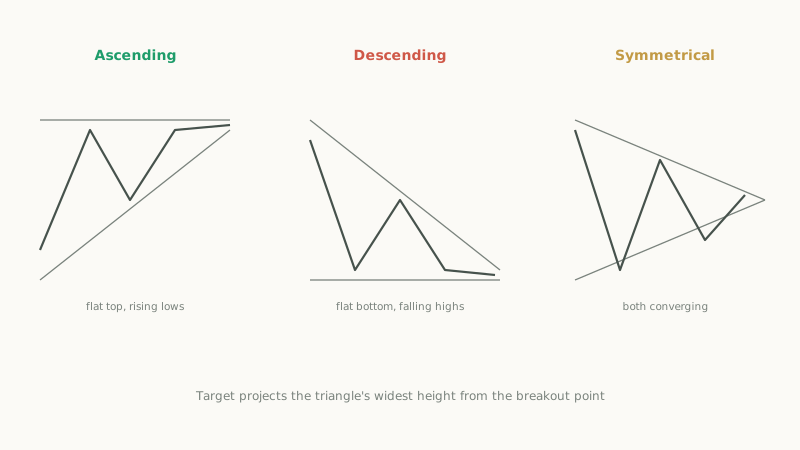
The ascending triangle
The ascending triangle has a flat top and a rising bottom. Price repeatedly tests the same horizontal resistance level while the lows climb steadily higher, compressing into the apex. The story this tells is one of building buying pressure: each pullback is bought at a higher level, showing that buyers are growing more aggressive, while the flat top represents a supply level being repeatedly tested. The rising lows suggest the buyers are winning the squeeze, which is why the ascending triangle is generally a bullish pattern that tends to break upward through the resistance.
It is most reliable as a continuation pattern within an uptrend — the market pausing and coiling before resuming higher — though ascending triangles can also appear as bottoming patterns. The flat resistance line is the level to watch: a decisive break above it confirms the pattern and triggers the trade. The repeated tests of that resistance, with higher and higher lows pressing against it, are the visual signature of demand overwhelming a fixed supply level.
The descending triangle
The descending triangle is the mirror image: a flat bottom and a falling top. Price repeatedly tests the same horizontal support level while the highs step steadily lower. Here the story is building selling pressure: each rally is sold at a lower level, showing sellers growing more aggressive, while the flat bottom is a demand level being repeatedly tested. The falling highs suggest the sellers are winning, which makes the descending triangle generally a bearish pattern that tends to break downward through the support.
It is most reliable as a continuation pattern within a downtrend, the market pausing before resuming lower. The flat support line is the key level: a decisive break below it confirms the pattern. As with the ascending triangle, the repeated tests of the fixed level — here support — combined with the encroaching trendline of lower highs, visually capture one side steadily overwhelming the other until the level finally gives way.
The symmetrical triangle
The symmetrical triangle has two converging boundaries — a downward-sloping line of lower highs and an upward-sloping line of higher lows — squeezing toward a central apex. Unlike the other two, it has no flat side and no inherent directional bias: it is a bilateral pattern that can break either way. It represents a genuine equilibrium, with neither buyers nor sellers in clear control, as the range tightens toward a decision point.
Because it lacks a directional bias of its own, the symmetrical triangle takes its cue from context. In practice it most often resolves as a continuation of the prior trend — a symmetrical triangle in an uptrend usually breaks upward, in a downtrend usually breaks downward — reflecting the tendency of a trend to resume after a pause. But this is a tendency, not a rule, and the disciplined approach is to wait for the actual breakout rather than assuming the direction. The symmetrical triangle is, more than the others, a pattern that must be allowed to declare itself.
Read the flat side. An ascending triangle's flat top is the level buyers are attacking — bullish. A descending triangle's flat bottom is the level sellers are attacking — bearish. A symmetrical triangle has no flat side and no bias — it follows the trend, but only the breakout confirms which way.
The breakout and measured target
All three triangles are traded the same way: wait for the breakout. The pattern is only confirmed when price breaks decisively beyond a boundary — above the resistance of an ascending triangle, below the support of a descending one, or through either side of a symmetrical one. Trading before the breakout means guessing the direction of a coiling market, which is exactly the uncertainty the triangle represents. Patience for the confirmed break, ideally with a retest of the broken boundary, is essential.
The measured target follows the standard method: measure the height of the triangle at its widest point (the base, at the left of the pattern) and project that distance from the breakout point in the direction of the break. One practical note: triangles are best traded when price breaks out before reaching the apex — ideally somewhere around two-thirds of the way along. A triangle that drags all the way to its apex without breaking tends to lose its energy and produce a weaker, less reliable move, so the cleaner breakouts come from triangles that resolve with room to spare.
Trading triangles on forex
On currencies, triangles are common and traded as on any market. The workflow: identify the triangle and its type, note the prevailing trend for context (especially for symmetrical triangles), draw the boundary lines, and wait for a decisive breakout. The entry comes on the confirmed break or retest; the stop goes on the opposite side of the triangle (or just beyond the broken boundary); and the target is the measured move from the base height.
The volume caveat applies once more: classical analysis expects volume to contract as the triangle forms and expand on the breakout, helping distinguish a genuine break from a false one, but forex offers only tick volume as a proxy. Lean on the decisiveness of the price break and a successful retest as primary confirmation. False breakouts — price poking beyond a boundary then reversing back into the triangle — are the main hazard, which is exactly why waiting for a decisive break and a retest, rather than acting on the first poke, is the key discipline. Traded that way, triangles are a reliable way to capture the resumption of a trend after a consolidation.
Handling false breakouts
The single biggest hazard in trading triangles is the false breakout — price pushing beyond a boundary just far enough to trigger entries and stops, then reversing back into the triangle and often breaking out decisively the other way. Triangles are especially prone to this because their converging, widely-watched boundaries concentrate orders just beyond the lines, creating exactly the pools of liquidity that a sharp fake-out can sweep. A trader who jumps on the first poke beyond a boundary is repeatedly caught by these traps.
Several defences reduce the damage. The first is to require a decisive break rather than a marginal poke — ideally a candle closing clearly beyond the boundary on the timeframe you trade, not just a wick that pierces it and pulls back. A close beyond the line is far more meaningful than an intrabar spike. The second is to wait for a retest: after a genuine breakout, price often returns to the broken boundary, which now acts as support or resistance, before continuing. Entering on the retest rather than the initial break trades a little missed movement for considerably more confidence that the break is real.
The third defence is simply to accept that some false breakouts are unavoidable and to manage them with a sensible stop — and, in keeping with the broader principle, to treat a clear false breakout as potential information about the true direction. A triangle that fakes upward and then breaks hard downward has told you which way the real move is going, and the failed upside break can itself become a short setup. Between demanding decisive breaks, favouring retests, and reading failed breaks as signals, the false-breakout problem becomes manageable rather than ruinous — but it is the reason patience at the boundary matters so much with triangles.
Triangles are coiling, usually-continuation patterns: ascending (flat top) tends bullish, descending (flat bottom) tends bearish, symmetrical (both converging) follows the trend. Read the flat side for bias but always wait for a decisive breakout — ideally a close beyond the boundary plus a retest — because false breakouts are the main hazard. Target by projecting the base height from the break, favour triangles that resolve before the apex, and treat a clear false break as a clue to the true direction.