
A chart pattern is the visible shape a crowd draws when it hesitates, reverses or resumes. When thousands of participants react to the same price action in similar ways — piling in, taking profit, panicking, consolidating — they trace out recurring formations that, with experience, can be read like a story. Chart patterns are simply the named, recurring versions of these formations, and learning them turns a chart from a random-looking squiggle into something far more legible. This guide explains the two families of pattern, the measured-move concept that links them all, and the principles — confirmation, context, realism — that separate using patterns well from seeing them everywhere.
Chart patterns are an application of the raw-price reading covered in price action trading, organised into recognisable, repeatable shapes.
Key takeaways
Q: What are chart patterns?
A: Chart patterns are recurring formations in price that traders use to anticipate the next move. They fall into two families: reversal patterns, which signal a trend is likely to change direction, and continuation patterns, which signal a trend is pausing before resuming.
Q: What is the measured move in chart patterns?
A: The measured move is a method of estimating a price target from a pattern. It takes the height of the pattern and projects that distance from the breakout point, giving a reasoned objective for how far the move may travel after the pattern completes.
Q: Do chart patterns actually work?
A: Chart patterns are useful as a probabilistic framework but are not guaranteed. They are partly self-fulfilling, fail regularly, and depend heavily on context and confirmation. They work best combined with trend analysis and risk management rather than as standalone signals.
The two families
Almost every chart pattern belongs to one of two families, and knowing which family a pattern is in tells you most of what you need to know about it. Reversal patterns form at the end of a trend and signal that it is likely to change direction — a topping pattern after an uptrend, or a bottoming pattern after a downtrend. The classic examples are the head and shoulders and the double top or bottom. Continuation patterns form during a trend and signal that it is merely pausing before resuming in the same direction — the flag, the pennant, and (usually) the triangle.
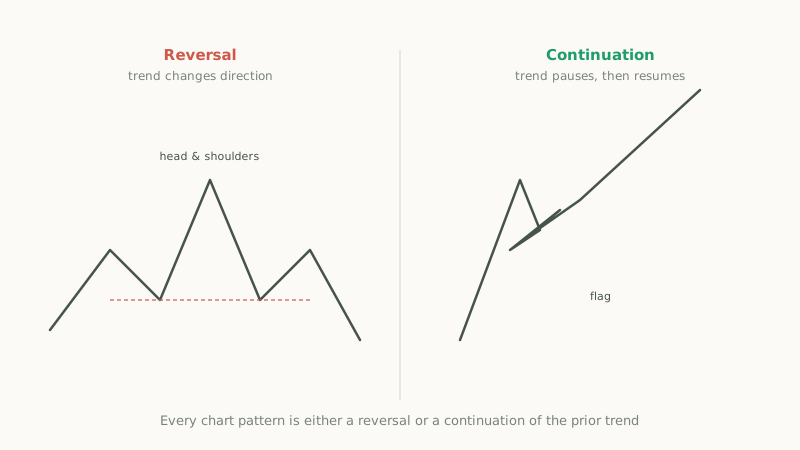
This single distinction is the most important thing to establish about any pattern, because it determines how you trade it. A reversal pattern says "the trend is ending — prepare for the opposite direction"; a continuation pattern says "the trend is intact — prepare for more of the same." Misreading which family a formation belongs to leads to trading directly against the resolution, so the first question to ask of any pattern is always: is this a reversal or a continuation?
The measured move
The concept that links nearly all chart patterns is the measured move — a method of projecting a price target from the pattern itself. The principle is simple and consistent: measure the height of the pattern (its vertical extent), then project that same distance from the breakout point in the direction of the expected move. A pattern that is 100 pips tall, for instance, projects a target roughly 100 pips beyond the point where price breaks out of it.
This gives chart patterns something many tools lack: a built-in, objective way to estimate how far a move might travel, not just its direction. The logic is that the energy contained in the pattern — reflected in its height — is released into a proportional move once the pattern resolves, an idea closely related to Wyckoff's law of cause and effect. The measured move is an estimate rather than a guarantee, and price may fall short of or overshoot it, but it provides a reasoned, repeatable target that anchors a complete trade. Each specific pattern applies this same principle to its own particular shape.
Confirmation and the breakout
A pattern is not a pattern until it confirms, and the confirmation almost always comes in the form of a breakout — price decisively breaking the key boundary of the formation. A head and shoulders is not confirmed until price breaks the neckline; a triangle is not confirmed until price breaks a boundary line; a flag is not confirmed until price breaks out of the consolidation. Until that break occurs, the pattern is only potential, and acting before confirmation means betting on a shape that may never complete.
The single most common mistake with chart patterns is anticipating them — trading the pattern before it confirms, on the assumption that the obvious shape must play out. Patterns fail constantly: a head and shoulders that never breaks the neckline, a triangle that breaks the "wrong" way, a double top that makes a third push to new highs. Waiting for the confirming breakout, and ideally a successful retest of the broken level, is the discipline that filters out these failures. It means occasionally entering a little later, but it avoids the far costlier error of trading patterns that dissolve before completing.
A pattern is a hypothesis, not a prophecy. The shape suggests what might happen; the breakout confirms whether it is happening. Trade the confirmation, not the anticipation — the patterns that look most obvious before they complete are exactly the ones that fail most painfully.
Context is everything
As with candlestick signals and Fibonacci levels, a chart pattern only carries meaning in context. A reversal pattern requires a prior trend to reverse — a "head and shoulders" in the middle of a directionless range is not a meaningful topping pattern, because there is no established uptrend for it to end. A continuation pattern requires a clear prior trend to continue. The same shape can be significant or meaningless depending entirely on where in the larger structure it appears.
This is why pattern trading should never be divorced from trend analysis. The disciplined approach reads the larger trend first, then looks for patterns that make sense within it: continuation patterns in the direction of the trend, reversal patterns only after an extended, mature trend that is plausibly ending. A pattern that aligns with this larger context — a bull flag in a strong uptrend, a head and shoulders after a long, tired advance — is far more reliable than the same shape appearing at random. The pattern is the trigger; the trend and structure are the reason.
An honest word on reliability
Chart patterns deserve the same clear-eyed treatment as every other tool on this site. They are genuinely useful, but they are not magic, and several honest caveats apply. They are subjective — once you know the shapes, you can see them everywhere, including where they do not meaningfully exist, and two traders can disagree about whether a given formation "counts." They fail regularly, which is why confirmation and risk management are essential. And they likely work, in large part, because they are self-fulfilling: so many traders recognise and trade the same patterns that their collective action helps the patterns play out.
None of this undermines their practical value, but it does dictate how to use them: as a probabilistic framework, always confirmed by a breakout, always in the context of the trend, and always with a stop that makes the inevitable failures survivable. Treated this way, patterns are a powerful way to organise price action into recognisable, tradeable scenarios. Treated as guaranteed predictions, they are a fast route to overconfidence and losses. The specific patterns — covered in the dedicated guides on the head and shoulders, double tops and bottoms, triangles and flags and pennants — all rest on these same foundations.
Chart patterns on forex
Chart patterns translate well to forex, with the usual volume caveat. Because they are price-based shapes, they appear on currency charts exactly as on any market, and forex's deep, heavily-charted, around-the-clock liquidity means the patterns are widely watched — strengthening their self-fulfilling tendency. The one limitation is that classical pattern analysis often uses volume to confirm breakouts (volume should expand on a genuine breakout), and spot forex offers only tick volume as an imperfect proxy. Lean on the price structure — the decisive breakout and ideally a retest — as primary confirmation, treating tick volume as supporting.
The practical workflow is the one that runs through all of technical analysis: identify the trend, look for patterns that make contextual sense within it, wait for a confirmed breakout, project a measured-move target, and trade with a defined stop and sensible position size. Done this way, chart patterns become a reliable part of a forex trader's toolkit — a structured vocabulary for reading what the crowd is doing and anticipating what it is likely to do next.
When a pattern fails
One of the most useful and least taught ideas in pattern trading is that a failed pattern is itself a signal. When a well-formed pattern sets up an expectation and then does the opposite, the failure often produces a strong move in the unexpected direction — because all the traders who positioned for the expected resolution are now trapped and must exit, fuelling the move against them. A head and shoulders that breaks the neckline, then sharply reverses back above it, can trigger a powerful rally as the would-be shorts are squeezed out.
This is why the discipline of using a defined stop is not just about limiting losses but about reading information. When your stop is hit because a pattern failed, the market is telling you something: the expected scenario was wrong, and the opposite scenario may now be in play. Experienced traders watch specifically for pattern failures — a triangle that breaks one way then reverses, a double bottom that breaks down instead of up — and treat them as potential setups in the new direction rather than merely as losses to absorb. The failed pattern flips the story, and the trapped traders provide the fuel for the move that follows. Recognising failure as a signal, not just a disappointment, is a mark of pattern-trading maturity — and another reason confirmation and defined risk matter so much.
Chart patterns are recurring formations in two families: reversal (trend changes) and continuation (trend resumes). The measured move projects a target by taking the pattern's height from the breakout point. A pattern is only confirmed on a decisive breakout — trade the confirmation, not the anticipation — and only matters in the context of the prevailing trend. They are probabilistic and partly self-fulfilling, and a failed pattern is itself a signal: pair them always with confirmation, context and risk management.