After a sharp, powerful move, a market rarely just stops — it pauses to catch its breath, lets early entrants take some profit, and then, more often than not, continues in the same direction. Flags and pennants are the chart's depiction of that pause. They are brief continuation patterns that form after a strong impulse, and for the trader they offer something valuable: a second chance to join a strong trend that has already proven its strength, at a more favourable price than chasing the initial move. This guide explains both patterns, how they differ, and how to trade them.
They are continuation patterns within the framework of chart patterns explained, and close relatives of the consolidating triangle patterns.
Key takeaways
Q: What is a flag pattern in trading?
A: A flag is a continuation pattern that forms after a sharp price move (the flagpole). It is a brief consolidation in a small channel that slopes against the trend, followed by a breakout that continues the original move. The flag offers a second entry into a strong trend.
Q: What is the difference between a flag and a pennant?
A: Both follow a sharp move and signal continuation, but the consolidation differs in shape. A flag is a small rectangular channel that usually slopes against the trend, while a pennant is a small symmetrical triangle that converges to a point.
Q: How do you set a target for a flag or pennant?
A: Measure the height of the flagpole — the sharp move that preceded the pattern — and project that distance from the breakout point in the direction of the trend. This measured move gives the estimated target for the continuation.
The flagpole
Both patterns begin with the same thing: a flagpole. This is the sharp, steep, often near-vertical price move that precedes the consolidation — a powerful surge driven by strong momentum, frequently sparked by a news event or a decisive break. The flagpole is essential, because it establishes the strength of the trend that the pattern will continue, and because its height is what determines the measured target. No sharp prior move, no genuine flag or pennant; the pattern is meaningless without the impulsive thrust that creates it.
The flagpole also explains why these are reliable continuation patterns. A steep, high-momentum move signals strong conviction in one direction. The brief consolidation that follows is simply a pause — profit-taking and a gathering of breath — rather than a genuine reversal, because the underlying momentum has not dissipated. Once the pause completes, that momentum tends to reassert itself, driving price onward in the original direction. The strength of the flagpole is the strength of the case for continuation.
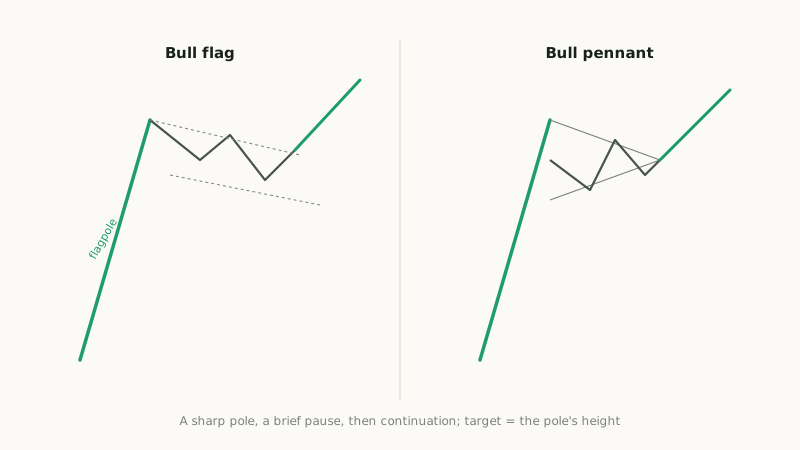
The flag
A flag is a brief consolidation that takes the shape of a small rectangular channel, typically sloping against the direction of the trend. After a sharp move up, a bull flag drifts gently downward or sideways in a tight parallel channel — a modest, orderly pullback — before breaking out upward to continue the advance. The counter-trend slope is characteristic: it represents controlled profit-taking, a gentle retracement that does not threaten the underlying momentum. The flag is small and short-lived relative to the flagpole; a consolidation that drags on too long or retraces too deeply is something other than a flag.
The pattern is confirmed when price breaks out of the channel in the direction of the original trend — above the upper boundary for a bull flag, below the lower boundary for a bear flag. That breakout is the trigger to enter in the trend's direction. The bull flag is one of the most reliable continuation patterns in trending markets, precisely because it combines proven momentum (the flagpole) with a low-risk entry (the controlled pullback) and a clear confirmation (the breakout).
The pennant
A pennant is the flag's close cousin, differing only in the shape of the consolidation. Where a flag is a small parallel channel, a pennant is a small symmetrical triangle — the highs and lows converging to a point, much like a miniature version of the symmetrical triangle pattern but compressed into the brief pause after a flagpole. After a sharp move, price coils into this tiny triangle before breaking out to continue the trend.
In practice, flags and pennants are so similar in their formation, meaning and trading that many traders treat them as a single category, and the distinction matters little. Both follow a flagpole, both represent a brief pause in a strong trend, both are continuation patterns, both are confirmed by a breakout in the trend's direction, and both use the same measured target. Whether the consolidation happens to take the rectangular shape of a flag or the converging shape of a pennant, the interpretation and the trade are effectively identical.
Flags and pennants are gifts to trend traders: a strong move you may have missed pauses and offers a second, lower-risk entry to join it. The flagpole proves the trend's strength; the brief pause is the opportunity; the breakout is the trigger. Just make sure the pause stays brief and shallow — a deep or lengthy consolidation is a warning, not a flag.
The measured target
Flags and pennants use a distinctive measured move based on the flagpole rather than the consolidation. Measure the height of the flagpole — the sharp move that preceded the pattern — and project that same distance from the breakout point in the direction of the trend. The logic is that the consolidation is merely a pause, and the second leg of the move (after the breakout) tends to roughly match the first leg (the flagpole) in size.
This makes the target straightforward to set: a tall flagpole projects a large continuation, a modest one a smaller move. As with all measured moves, it is an estimate, and price may fall short or extend further, but it provides a reasoned objective for the trade. Combined with the favourable entry the pattern offers — entering on the breakout after a shallow pullback, with a stop just beyond the consolidation — the flagpole-based target gives flags and pennants an attractive risk-to-reward profile when they work.
Trading flags and pennants on forex
On currencies, flags and pennants form frequently, especially around news releases and session opens that produce sharp, momentum-driven flagpoles. The workflow: identify a strong, impulsive move (the flagpole) in the direction of the trend, watch for a brief, shallow consolidation (flag or pennant) to form, and wait for a decisive breakout in the trend's direction before entering. The entry comes on the breakout; the stop goes just beyond the opposite side of the consolidation; and the target is the flagpole height projected from the breakout.
The key disciplines are to ensure the consolidation stays brief and shallow — a deep retracement or a long, drawn-out pause suggests the momentum has faded and the pattern may fail — and to wait for the confirmed breakout rather than anticipating it. The volume caveat applies: classically, volume drops during the consolidation and surges on the breakout, but forex offers only tick volume as a proxy, so rely on price. Used with these disciplines, flags and pennants are among the most practical continuation patterns for forex, offering a structured, lower-risk way to join a trend that has already demonstrated its strength.
What makes a high-quality flag
Not every consolidation after a move is a tradeable flag, and learning to filter for quality is what makes the difference between a reliable continuation setup and a failed one. Several features mark a high-quality flag or pennant. The first is a strong, steep flagpole: the sharper and more impulsive the prior move, the more conviction it reflects and the more reliable the continuation. A flag attached to a weak, hesitant move lacks the momentum that makes the pattern work.
The second is a brief, shallow consolidation. A genuine flag is a short pause — a modest pullback that retraces only a small portion of the flagpole over a limited number of bars. The moment the consolidation becomes deep (retracing a large part of the pole) or drawn-out (lasting far longer than the pole took to form), it stops being a flag and starts being a potential reversal: the longer and deeper the pause, the more the original momentum has faded. A useful rule of thumb is that the consolidation should look small and orderly next to the flagpole, not comparable to it.
The third feature is the characteristic counter-trend slope or tight coil: a bull flag that drifts gently down (or sideways) in an orderly channel, or a pennant that coils into a small symmetrical triangle, reflects controlled profit-taking rather than aggressive selling. A "flag" that slopes steeply in the trend's own direction, or that is wild and disorderly, is suspect. The same applies in reverse for bear flags, which drift gently up against a downtrend. Filtering for a strong pole, a brief and shallow orderly pause, and a sensible slope is what separates the flags worth trading from the consolidations that fail — and, combined with waiting for the confirmed breakout, is the core discipline of trading these patterns well.
Flags and pennants are continuation patterns after a sharp flagpole — a flag is a small counter-trend channel, a pennant a small symmetrical triangle — confirmed by a breakout in the trend's direction, with the target the flagpole's height projected from the break. Quality matters: favour a strong steep pole, a brief and shallow orderly consolidation, and a counter-trend slope. A deep or drawn-out pause is a warning, not a flag. Wait for the confirmed break for a low-risk second entry into a strong trend.