
Some patterns are elaborate; the double top and double bottom are beautifully simple. The story is as plain as it gets: a trend pushes to a level, fails, tries the same level a second time, fails again — and, having proven it cannot break through, gives up and reverses. On the chart this traces an M (the double top) or a W (the double bottom), two of the most recognisable shapes in all of trading. Their simplicity makes them an ideal starting point for pattern trading, and their logic — a level that holds twice is a level that matters — is sound. This guide explains both and how to trade them.
They are reversal patterns within the framework of chart patterns explained, and a close cousin of the head and shoulders.
Key takeaways
Q: What is a double top pattern?
A: A double top is a reversal pattern that forms after an uptrend, shaped like an M. Price makes a high, pulls back, then rises again to roughly the same high and fails. A break below the neckline (the intervening trough) confirms a likely reversal to the downside.
Q: What is a double bottom pattern?
A: A double bottom is the bullish mirror, shaped like a W. After a downtrend, price makes a low, bounces, then falls again to roughly the same low and holds. A break above the neckline (the intervening peak) confirms a likely reversal to the upside.
Q: How do you trade a double top?
A: Wait for price to break decisively below the neckline to confirm the pattern. Enter on the break or a retest of the neckline, place a stop above the double-top highs, and target the measured move — the pattern's height projected down from the neckline.
The double top
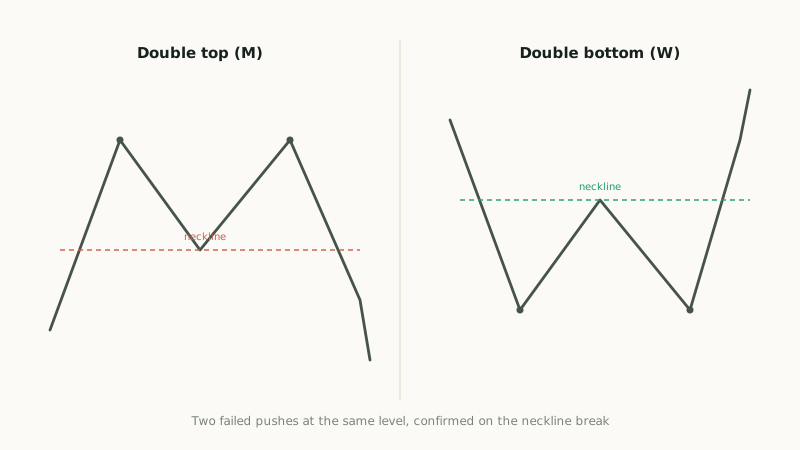
A double top forms after an uptrend and signals a potential reversal to the downside. Price rises to a high (the first peak), pulls back to an intervening trough, then rises again to a second peak at roughly the same level as the first — and fails to break above it. The failure of the second push to exceed the first is the essence of the pattern: the buyers tried the same ceiling twice and could not break it, revealing that demand has been exhausted at that level. The two peaks and the trough between them form the characteristic M shape.
The neckline of a double top is the horizontal level at the intervening trough — the low point between the two peaks. As with the head and shoulders, this neckline is what confirms the pattern: a double top is only confirmed when price breaks decisively below the neckline after the second peak fails. Until that break, the formation is merely a potential double top that could still resolve higher. The two equal peaks suggest the pattern; the neckline break confirms it.
The double bottom
The double bottom is the exact mirror, forming after a downtrend and signalling a potential reversal to the upside. Price falls to a low (the first trough), bounces to an intervening peak, then falls again to a second trough at roughly the same level — and holds, failing to break lower. The sellers tried the same floor twice and could not break it, revealing that supply has been exhausted. The two troughs and the peak between them form the W shape.
The neckline of a double bottom is the horizontal level at the intervening peak, and the pattern is confirmed when price breaks decisively above it after the second trough holds. Everything that applies to the double top applies in reverse: the two equal lows suggest the pattern, the neckline break confirms it, and the failure of the second push to make a new extreme is the key tell. Double bottoms are among the more reliable bottoming patterns, for the same reason double tops are reliable tops — a level that rejects price twice has demonstrated genuine significance.
The measured target
Both patterns use the standard measured move. For a double top, measure the height of the pattern — the vertical distance from the peaks down to the neckline — and project that distance downward from the neckline break to estimate the target. For a double bottom, measure from the troughs up to the neckline and project that distance upward from the breakout. The taller the pattern, the larger the projected move.
This measured target gives the pattern a complete trade structure. As always, it is an estimate rather than a certainty, and many traders combine it with nearby structural levels or Fibonacci extensions to refine the exit, often taking partial profit at the measured target. The key is that the pattern provides not just a direction but a reasoned objective, allowing the whole trade — entry on the neckline break, stop beyond the pattern's extreme, target at the measured move — to be planned in advance.
The power of these patterns is the double rejection. One failure at a level is just a pullback; two failures at the same level is evidence that the level genuinely matters and the trend cannot break it. But the evidence only becomes a trade when the neckline breaks — two peaks without a neckline break is just a range.
Triple tops and bottoms
A natural variant is the triple top or triple bottom, in which price tests the same level three times before reversing rather than twice. The logic is identical and arguably stronger — three rejections at a level demonstrate even more conclusively that it cannot be broken — and the pattern is traded the same way, with the neckline drawn across the intervening troughs (or peaks) and confirmation coming on the decisive break. Triple tops and bottoms are less common than their double counterparts, simply because a level that holds twice often reverses before a third test, but when they form they carry the same meaning with added conviction.
The broader point is that double and triple tops and bottoms are all expressions of the same idea: repeated failure at a level signals exhaustion and a likely reversal. Whether price tests the level twice or three times, the principle and the trading approach are the same. This shared logic also connects them to the head and shoulders, which is in effect a more complex version of the same exhaustion story told through three peaks of differing heights rather than equal ones.
Trading them on forex
On currencies, double tops and bottoms are traded with the standard discipline. Identify a mature trend, watch for price to test a level twice (or three times) and fail, draw the neckline at the intervening extreme, and wait for a decisive break before entering. The entry comes on the confirmed neckline break or a retest of it; the stop goes above the double-top peaks or below the double-bottom troughs; and the target is the measured move projected from the breakout.
The usual caveats apply. Volume confirmation (expanding on the breakout) is classical practice but limited on forex by the lack of true volume, so rely on price structure. Context matters: these are reversal patterns and need a genuine prior trend to reverse, not a directionless range where every swing looks like a "double" something. And confirmation is essential, because unconfirmed double tops frequently resolve into continuations or simply a third push to new highs. Traded with a confirmed break, a measured target and a defined stop, the double top and bottom are simple, reliable, and an excellent foundation for pattern-based trading.
Telling a real pattern from a range
The most common error with double tops and bottoms is mistaking ordinary range-bound chop for a meaningful pattern. Because any sideways market produces repeated touches of the same high and low, it is easy to label every such touch a "double top" or "double bottom" — but most are not. A few conditions separate a genuine, tradeable pattern from mere noise.
First, there must be a prior trend to reverse. A double top is a reversal pattern, so it needs a real uptrend leading into it; two equal highs in the middle of a long-established range are just the range's boundary being tested again, not a reversal signal. Second, the two peaks (or troughs) should be meaningfully separated in time, with a clear intervening pullback — a proper M or W shape, not a tight double-tap. Two highs a few candles apart are less significant than two distinct pushes separated by a genuine reaction. Third, and most importantly, the pattern is not confirmed until the neckline breaks: until then, two equal highs are simply resistance holding, which is entirely normal and not yet a reversal.
The discipline, then, is to require the full picture: a real prior trend, two distinct and separated tests of a level, and — decisively — a confirmed break of the neckline. A formation missing any of these is best treated as ordinary support or resistance rather than a reversal pattern. This filtering is what stops a trader from shorting every minor double-tap of a high and instead reserves the pattern for the situations where it carries genuine meaning. As always, context and confirmation do the heavy lifting; the shape alone is not enough.
A double top (M) reverses an uptrend with two failed pushes at the same high; a double bottom (W) reverses a downtrend with two failed pushes at the same low. The neckline confirms the pattern when broken decisively; target by projecting the height from the break. Distinguish a real pattern from range chop: require a genuine prior trend, two clearly separated tests, and a confirmed neckline break — two equal highs alone are just resistance holding.