If chart patterns have a celebrity, it is the head and shoulders. It is the most widely recognised reversal pattern in trading, and it earns its fame by telling an unusually clear story: an uptrend pushes to a high, pulls back, makes one final and slightly higher push that fails, then rolls over — the buyers, having given their all and fallen short, hand control to the sellers. Reading that story through the head, the two shoulders and the neckline that confirms it is one of the most useful pattern-recognition skills a trader can develop. This guide explains how to identify the pattern, both versions, and how to trade it.
It is a reversal pattern within the framework set out in chart patterns explained, and it pairs naturally with the other classic reversal, the double top and bottom.
Key takeaways
Q: What is a head and shoulders pattern?
A: A head and shoulders is a reversal pattern that forms at the end of an uptrend. It consists of three peaks — a left shoulder, a higher head, and a lower right shoulder — with a neckline connecting the two intervening troughs. A break below the neckline confirms a likely reversal to the downside.
Q: What is an inverse head and shoulders?
A: An inverse (or reverse) head and shoulders is the bottoming version, forming at the end of a downtrend. It has three troughs — a left shoulder, a lower head, and a higher right shoulder — with a break above the neckline confirming a likely reversal to the upside.
Q: How do you calculate the head and shoulders target?
A: Measure the vertical distance from the top of the head to the neckline, then project that same distance from the point where price breaks the neckline. This measured move gives an estimated price target for the reversal.
The anatomy of the pattern
A head and shoulders top forms after an uptrend and consists of three peaks. The left shoulder comes first: price rises to a high and pulls back. The head follows: price rises again to a higher high — the peak of the pattern — then pulls back again. The right shoulder completes it: price rises a third time but only to a lower high, roughly level with the left shoulder, before turning down. The two pullbacks, between the shoulders and the head, define the neckline — a line connecting the two intervening troughs.
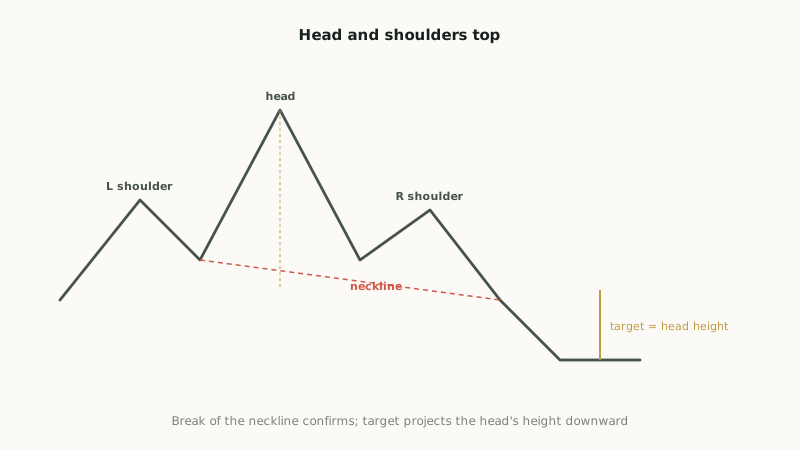
The story the shape tells is one of failing momentum. The head making a higher high keeps the uptrend technically intact, but the right shoulder's failure to match the head — making only a lower high — is the crucial tell: the buyers could not push price to a new extreme, signalling that their strength is spent. The pattern captures, in three peaks, the precise moment an uptrend runs out of fuel.
The neckline and confirmation
The neckline is the most important line in the pattern, because it is what confirms it. Until price breaks below the neckline, the head and shoulders is only a potential pattern — a suggestive shape that has not yet completed and may still resolve as a continuation of the uptrend. The pattern is only confirmed when price decisively breaks below the neckline after forming the right shoulder. That breakdown is the trigger; everything before it is anticipation.
This is where the discipline emphasised throughout pattern trading applies most sharply. Many promising head and shoulders patterns never confirm — the right shoulder forms, but price fails to break the neckline and instead resumes higher, leaving traders who anticipated the breakdown on the wrong side. Waiting for the decisive neckline break, and ideally a subsequent retest in which price returns to the broken neckline and finds resistance there before continuing down, is what separates trading the confirmed pattern from gambling on its appearance. The neckline break is the line between hypothesis and trade.
The measured target
The head and shoulders provides a clear measured-move target. Measure the vertical distance from the top of the head down to the neckline — the height of the pattern — and then project that same distance downward from the point where price breaks the neckline. The result is an estimated target for how far the reversal may carry. A pattern with a tall head projects a larger move; a shallow one, a smaller move, reflecting the energy contained in the formation.
As with all measured moves, this is an estimate rather than a guarantee — price may stop short of the target or run well beyond it — but it provides a reasoned objective that anchors the trade. Many traders take partial profit at the measured target and trail the remainder, or use the target in combination with other structural levels and Fibonacci extensions to refine where to exit. The measured move turns the pattern from a directional signal into a complete trade with a defined objective.
The right shoulder is the heart of the pattern. The head making a higher high is normal; the right shoulder failing to exceed the head is the evidence that buyers are exhausted. No failed right shoulder, no head and shoulders — and no neckline break, no trade.
The inverse head and shoulders
The pattern works equally well upside down. The inverse (or reverse) head and shoulders is the bottoming version, forming at the end of a downtrend. It consists of three troughs: a left shoulder, a lower head (the lowest point), and a higher right shoulder, with a neckline connecting the two intervening peaks. A decisive break above the neckline confirms a likely reversal to the upside, and the target is measured by projecting the head-to-neckline height upward from the breakout.
The story is the mirror image: a downtrend pushes to a low, the head makes a lower low, but the right shoulder fails to make a new low — the sellers are exhausted, and control passes to the buyers. Everything that applies to the topping pattern applies in reverse to the inverse: the right shoulder's failure is the key tell, the neckline break is the confirmation, and the measured move sets the target. The inverse head and shoulders is one of the more reliable bottoming patterns, precisely because, like its sibling, it tells such a clear story about the exhaustion of the prior trend.
Trading the pattern on forex
On currencies, the head and shoulders is traded as on any market. The workflow: identify a mature uptrend (for a top) or downtrend (for an inverse), watch for the three-peak or three-trough structure to form, draw the neckline, and wait for a decisive break of it — ideally with a retest — before entering. The entry comes on the confirmed neckline break or retest; the stop goes above the right shoulder (for a top) or below it (for an inverse), the level that would invalidate the reversal; and the target is the measured move projected from the breakout.
The volume caveat applies: classical analysis expects volume to decline through the pattern's formation and expand on the neckline break, but forex offers only tick volume as a proxy, so lean on the price structure for confirmation. As always, the pattern is most reliable in context — after a genuine, extended trend that is plausibly ending — and least reliable when forced onto a directionless chart. Traded with confirmation, a measured target and a defined stop, the head and shoulders is among the most dependable reversal patterns available to the forex trader.
Common mistakes and false patterns
The head and shoulders is so famous that traders see it everywhere, which is the source of most errors with it. The first mistake is anticipating the pattern — entering short as the right shoulder forms, before the neckline has broken, on the assumption that the obvious shape must complete. Many do not: the right shoulder forms and price then breaks to new highs instead, leaving the early short trapped. The neckline break is the confirmation for a reason, and acting before it is gambling on a shape, not trading a pattern.
The second mistake is forcing the shape onto a chart that lacks context. A head and shoulders is a reversal pattern and requires a genuine, mature uptrend to reverse. Three bumps in the middle of a directionless range are not a meaningful head and shoulders, however much they resemble one, because there is no established trend for them to end. The pattern's reliability comes from its context, and a shape without context is just three bumps.
A third issue is over-precision: real head and shoulders patterns are rarely textbook-neat. Shoulders are seldom perfectly equal, necklines are often sloped rather than horizontal, and the formation can be messy. Demanding a flawless shape means missing valid patterns, while accepting any vaguely three-peaked formation means trading noise — judgement is required. Finally, beware the failed head and shoulders: a neckline break that quickly reverses back above the neckline is a failure that often leads to a sharp move up, trapping the shorts. As with all patterns, the failure is itself information, and a defined stop above the right shoulder is what turns that failure from a disaster into a small, manageable loss.
A head and shoulders is a reversal pattern: three peaks (left shoulder, higher head, lower right shoulder) with a neckline, confirmed only when price decisively breaks the neckline. The right shoulder's failure to exceed the head is the key tell. Target by projecting the head-to-neckline height from the break; the inverse version bottoms a downtrend. Don't anticipate the break, don't force the shape without trend context, and use a stop beyond the right shoulder — a failed pattern often runs hard the other way.