
Among the corrective patterns, the triangle is the one that signals continuation rather than reversal. Where a zigzag is sharp and a flat is choppy, a triangle is a converging, sideways consolidation that tells you a trend is merely catching its breath before one final push. Because triangles appear in a very specific position — just before the last wave of a larger structure — recognising one gives you something genuinely valuable: advance warning that a move is approaching its end, and a way to estimate how far the final thrust might run.
This is a more advanced corrective form; it fits within the corrective family described in the ABC correction and the broader framework of Elliott Wave theory explained.
Key takeaways
Q: What is a triangle in Elliott Wave theory?
A: A triangle is a sideways corrective pattern of five overlapping legs labelled A-B-C-D-E, each subdividing into three. Its boundary lines usually converge, and it signals that a trend is pausing before one final move rather than reversing.
Q: Where does an Elliott Wave triangle appear?
A: Triangles appear in the wave 4 position of an impulse or the wave B position of a correction — the spot just before the final wave of the larger structure. After the triangle completes, a thrust follows in the direction of the prevailing trend.
Q: What is the thrust after a triangle?
A: The thrust is the sharp, often fast move that follows the completion of a triangle, in the direction of the larger trend. Its size is frequently estimated from the width of the widest part of the triangle.
The five-leg structure
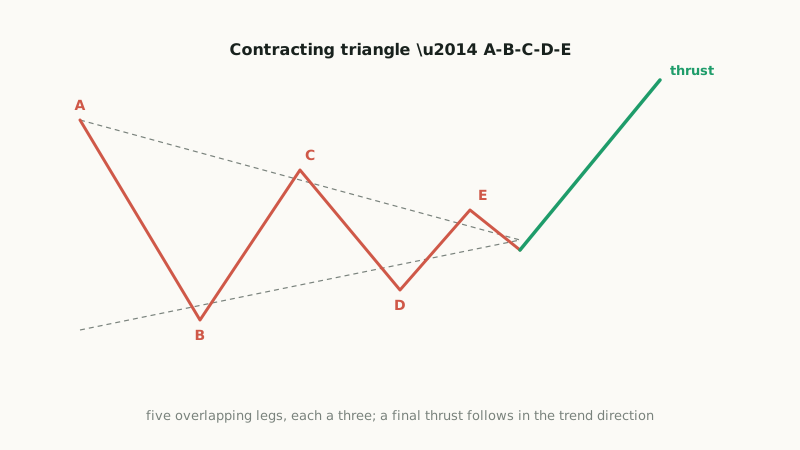
Unlike the zigzag and flat, which are three-wave (A-B-C) patterns, a triangle has five legs, labelled A-B-C-D-E. Each of those legs subdivides into a three, giving the triangle an overall 3-3-3-3-3 internal structure. The legs overlap and progressively shrink (in the common contracting form), tracing out a series of swings that fit between two converging boundary trendlines. The result is the familiar narrowing wedge or coil, with price oscillating in an ever-tighter range as the pattern approaches its apex.
That converging, overlapping, five-leg shape is the triangle's signature, and it is what distinguishes it from the other corrections. A zigzag slants sharply; a flat moves sideways in three roughly equal legs; a triangle coils inward across five. When you see price making a sequence of overlapping swings that are getting smaller and fitting inside narrowing trendlines, a triangle is the most likely interpretation.
Contracting and expanding triangles
Triangles come in a contracting family and a rarer expanding one. The contracting triangle, with converging boundary lines, is by far the most common and includes the symmetrical (both lines sloping toward each other), ascending (flat top, rising bottom) and descending (flat bottom, falling top) variants. In all of these, the swings shrink and the range narrows as the pattern matures.
The expanding triangle does the opposite — its boundary lines diverge and the swings grow larger, producing a broadening, megaphone shape. Expanding triangles are unusual and harder to trade, so in practice the contracting form is the one to know well and the default assumption when a coiling, overlapping correction appears.
The penultimate position
The most important fact about triangles is where they appear. A triangle almost always occupies a penultimate position in the larger structure — specifically the wave 4 of an impulse, or the wave B of a larger correction (or wave X in a combination). In other words, a triangle sits just before the final wave of the structure it belongs to. This is enormously useful: spotting a triangle tells you that, once it completes, only one more major move — the final wave — remains in that structure.
This positional reliability is what makes the triangle a forecasting tool rather than just a shape. When you correctly identify a wave-4 triangle, you know that wave 5 — the last leg of the impulse — is what comes next, and that the larger trend is approaching its conclusion. Few patterns give such a clear read on where you are in the overall structure.
The thrust
When a triangle completes — usually at the end of wave E, near the apex — it is followed by a thrust: a sharp, often fast move in the direction of the prevailing trend. The thrust is the final wave the triangle was preceding (wave 5 of an impulse, or wave C of a correction). Its magnitude can frequently be estimated from the width of the widest part of the triangle (the distance between the boundary lines at the start of the pattern), projected from the breakout point. That projection gives a concrete target for how far the final move might travel.
Two practical wrinkles are worth noting. Wave E, the final leg inside the triangle, sometimes overshoots the boundary line briefly — a throw-over — before the thrust begins, trapping traders who read the overshoot as a breakout. And because the thrust is the final move of the larger structure, it is often followed by a significant reversal once that structure completes. A triangle, therefore, is simultaneously a continuation signal (one more move to come) and an early warning (that move is the last).
A triangle's value is positional. It almost always sits just before the final wave of a structure, so identifying one tells you the trend has one more move left — the thrust — and is then likely to reverse. Few patterns pin down your location in a count so precisely.
Trading triangles on forex
For currency traders, the triangle offers a relatively rare thing in technical analysis: a pattern that is both a continuation setup and an exhaustion warning. The practical use is to recognise the coiling, five-leg structure as it forms, anticipate the thrust in the trend's direction once wave E completes, and project a target from the triangle's width. At the same time, because the thrust is the final move, it is a signal to plan for the larger reversal that often follows rather than to assume the trend will continue indefinitely.
The main hazards are misreading a triangle's many overlapping swings as a series of separate trades, and being caught by a wave-E throw-over that looks like an early breakout. The discipline that addresses both is patience: let the five legs complete and the genuine thrust begin, rather than trading the chop inside the triangle. As with every pattern, a pre-defined invalidation — a decisive move that breaks the expected structure — keeps the interpretation honest. Combined with the other corrective forms in the ABC correction, the triangle completes the corrective toolkit a wave trader needs.
The contracting subtypes
The contracting triangle family has three named variants, distinguished by the slope of their boundary lines, and each carries a slightly different flavour. The symmetrical triangle is the classic form: the upper line slopes down and the lower line slopes up, converging toward a central apex as both buyers and sellers progressively give ground. It is the most common and the most neutral, simply signalling consolidation before the thrust.
The ascending triangle has a roughly flat upper boundary and a rising lower boundary, so the lows climb while the highs stall at a ceiling. Within an uptrend correction, this configuration hints at underlying strength — buyers repeatedly stepping in at higher levels — and tends to precede an upward thrust. The descending triangle is its mirror: a flat lower boundary with falling highs, suggesting sellers leaning on the market, and within a downtrend it tends to precede a downward thrust. None of these overrides the triangle's core meaning — a pause before the final move — but the slope adds a little colour to the expected direction of the thrust, which usually follows the prevailing larger trend regardless.
The apex, timing and what comes after
As a contracting triangle matures, its converging lines point toward an apex — the theoretical point where they would meet. The thrust typically begins before price reaches that apex, often somewhere between 60% and 80% of the way along, and a triangle that drags all the way to its apex without resolving is a sign the pattern may be failing or was misread. The apex therefore doubles as a rough timing guide: it tells you roughly when, not just where, the consolidation should end.
What follows the thrust deserves emphasis because it is so often overlooked. Since the triangle sits in the penultimate position, the thrust is the final wave of the larger structure — wave 5 of an impulse or wave C of a correction. That means the thrust is frequently followed by a significant reversal as the whole structure completes. A triangle, then, is a two-part signal: it promises one more move in the trend's direction, and it warns that this move is the last before a turn. Traders who ride the thrust but forget the warning often give back their gains in the reversal that follows, so reading the triangle's position within the larger count — not just the triangle itself — is what makes it genuinely useful.
A triangle is a sideways, five-leg (A-B-C-D-E), 3-3-3-3-3 correction, usually contracting in symmetrical, ascending or descending form. It sits just before the final wave of a structure and is followed by a thrust — sized from the triangle's width, beginning before the apex — which is itself often the last move before a reversal.