
Elliott Wave divides into two halves. The motive half — the five-wave impulse — is the part most traders learn first and find intuitive. The corrective half is where the real difficulty lives, and at its heart sits the ABC correction: the three-wave countertrend structure that follows every completed impulse. If you can read ABC corrections reliably, you have mastered the part of the theory that defeats most people; if you cannot, even a perfect grasp of impulses will leave you repeatedly caught out during the long stretches when markets are correcting rather than trending.
This guide ties together the corrective patterns covered individually in the zigzag, the flat and the triangle, within the overall framework of Elliott Wave theory.
Key takeaways
Q: What is an ABC correction in Elliott Wave theory?
A: An ABC correction is the three-wave countertrend structure that follows a five-wave impulse. Waves A and C move in the direction of the correction while wave B moves against it. It is the simplest form of a corrective phase.
Q: What are the types of ABC correction?
A: The three simple forms are the zigzag (sharp, 5-3-5), the flat (sideways, 3-3-5) and the triangle (sideways, five legs). These can also combine into double and triple corrections connected by linking X waves.
Q: Where does an ABC correction appear?
A: ABC corrections appear in the wave 2 and wave 4 positions of an impulse, and as the corrective phase following any completed five-wave move at any degree.
The basic structure
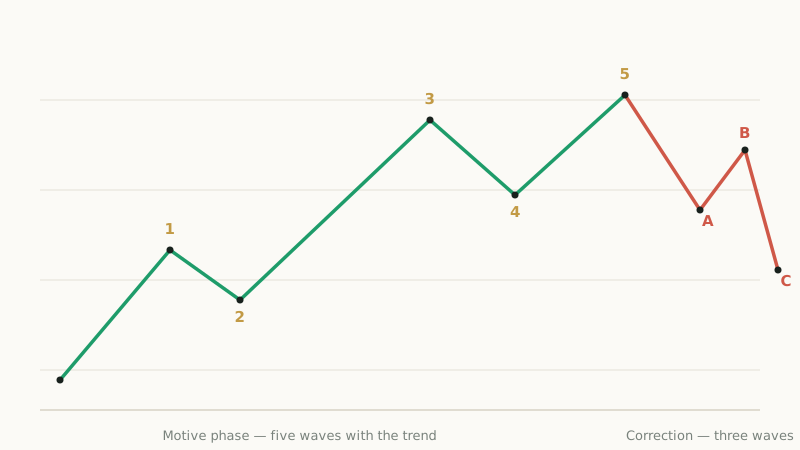
In its simplest form, a correction unfolds in three waves labelled A, B and C. Waves A and C travel in the direction of the correction — against the larger trend — while wave B is a partial bounce back toward the trend. After a five-wave advance, for instance, the ABC correction pulls price down in wave A, recovers part of that loss in wave B, then declines again in wave C. The net effect is to retrace a portion of the prior impulse before the larger trend, if it is still intact, resumes.
The reason corrections are three-wave rather than five-wave structures is the same reason impulses are five: it is a matter of net progress. A trend needs five waves to advance more than it pulls back; a correction, which only needs to partially unwind that advance, requires just three. This three-against-five asymmetry is the structural signature that distinguishes a correction from a new impulse, and reading it correctly is the skill at the centre of the whole framework, as discussed in impulse versus corrective waves.
The three simple forms
An ABC correction is not a single shape — it is a family. The three simple corrective forms each express the A-B-C structure differently, and telling them apart is the practical core of corrective analysis:
- Zigzag — a sharp, deep, directional correction that subdivides 5-3-5, with a shallow B wave. It is the most reversal-like of the three and most common in the wave 2 position. Covered in full in the zigzag pattern.
- Flat — a sideways, choppy correction that subdivides 3-3-5, with a deep B wave that returns near the start of A. The expanded flat, where B overshoots before C reverses, is especially common. Covered in the flat correction.
- Triangle — a sideways, converging correction of five overlapping legs (A-B-C-D-E), usually appearing just before the final move of a larger structure. Covered in the triangle pattern.
The single fastest way to begin classifying which form is unfolding is to read the B wave. A shallow B that fails to return near the start of A points to a zigzag; a deep B that retraces almost all of A points to a flat; a series of overlapping, contracting swings points to a triangle. The B wave is the diagnostic that organises the entire corrective family.
Combinations: double and triple threes
Markets do not always resolve a correction in a single clean ABC. When more time or complexity is needed, two or three simple corrections can join together, connected by intervening linking waves labelled X. A double correction is labelled W-X-Y, and a triple correction W-X-Y-X-Z. Each of W, Y and Z is itself one of the simple forms — a zigzag, flat or triangle — and the X waves are the bridges between them.
These combinations are what give corrections their fearsome reputation for complexity. A correction that began as a simple zigzag can extend into a double or triple structure that occupies a long stretch of chart while going essentially sideways, exhausting traders who keep expecting it to finish. The practical defence is not to predict every sub-leg but to hold the corrective label loosely, recognise that a sideways, overlapping, drawn-out move is almost certainly a combination, and wait for the structure to resolve before committing to the next directional trade.
Read the B wave to classify a simple correction, but stay alert to combinations. If a correction is dragging on sideways far longer than a single ABC should, you are probably in a double or triple three — patience, not prediction, is the right response.
Where ABC corrections appear
ABC corrections occupy the corrective positions in any wave structure. Within an impulse, they form waves 2 and 4 — the two countertrend legs. At a larger scale, the entire corrective phase that follows a completed five-wave move is itself an ABC (or a combination) at the higher degree. Because the pattern is fractal, the same A-B-C logic governs the pullback after a five-minute impulse and the multi-month correction after a multi-year advance; only the degree changes.
The guideline of alternation adds useful predictive structure here. Corrections within a single impulse tend to differ in form: if wave 2 was a sharp zigzag, wave 4 is more likely to be a sideways flat or triangle, and vice versa. So identifying the form of one correction gives you a reasonable expectation for the character of the next — a small but genuine edge in anticipating how a developing structure will behave.
Trading ABC corrections on forex
For currency traders, the practical value of reading ABC corrections is twofold. First, it keeps you out of trouble: recognising that a sharp move against the trend is a corrective wave A or C — not a genuine reversal — stops you from fighting the dominant trend at exactly the wrong moment. Second, it creates opportunity: the completion of an ABC correction within an ongoing trend marks a high-probability point to rejoin that trend in the direction of the next impulse.
The cleanest approach is to wait for the correction to show signs of completing — wave C reaching a Fibonacci projection, the structure resolving into a recognisable form — rather than trying to trade in the middle of a choppy, ambiguous pullback. And as always, the read is held with a defined invalidation: a level beyond which the correction has gone too far to be what you thought, signalling that the structure is larger or different than your count assumed. With the simple forms and combinations understood, the corrective half of Elliott Wave becomes navigable rather than baffling.
The relationship between A and C
Within an ABC correction, the proportions between the legs are as useful as they are in an impulse, and the most important is the relationship between waves A and C. In the most common case, wave C is roughly equal to wave A — a 1:1 relationship that gives a clean first projection for where the correction is likely to end. Project the length of wave A from the end of wave B, and you have a reasoned target for the completion of C. When the correction is deeper or part of a stronger countertrend move, C can extend to around 1.272 or 1.618 times the length of A.
Wave B's retracement, meanwhile, is the diagnostic that tells you which corrective form you are in, and it has its own typical ranges: shallow (38.2–61.8% of A) in a zigzag, deep (near or beyond 100% of A) in a flat. Combining the B-wave depth with the A-to-C projection gives a surprisingly complete picture — the depth tells you the form, and the projection tells you the likely endpoint. When the projected end of C also coincides with a Fibonacci retracement of the larger impulse it is correcting (corrections frequently end near the prior wave 4, or at the 38.2–61.8% retracement of the whole move), the confluence makes the read considerably stronger.
Why corrections are harder than impulses
It is worth understanding why the corrective half of the theory is so much more difficult than the motive half, because the reason is not arbitrary. Impulses are driven by conviction — a crowd moving decisively in one direction — and conviction produces clean, directional, easily-counted structures. Corrections, by contrast, are periods of indecision: the prior trend's momentum is spent but a new direction has not yet asserted itself, so price mills about as buyers and sellers reach a temporary, uneasy balance. Indecision does not draw neat patterns; it draws messy, overlapping ones.
That psychological difference is why corrections take so many more forms than impulses, why they overlap, and why they so often extend into drawn-out combinations that test a trader's patience. It is also why the single most valuable corrective skill is not prediction but restraint — the willingness to reduce conviction, widen the timeframe, and wait for the correction to resolve rather than forcing a count onto price that is, by its nature, undecided. Traders who accept that corrections are meant to be ambiguous handle them far better than those who demand the same clarity corrections never offer.
An ABC correction is the three-wave countertrend structure that follows every impulse, expressed as a zigzag, flat or triangle, and sometimes chained into combinations. Read the B wave to classify the form and project C from A (often 1:1) to estimate the end. Corrections are ambiguous by nature — patience beats prediction.