
Once you have an edge, a natural question follows: how much should you bet? Risk too little and you leave growth on the table; risk too much and you court ruin. The Kelly criterion is a famous mathematical answer — a formula that calculates the position size which maximises the long-term growth of your capital, given your edge. It is an elegant and powerful idea, but it comes with a stark warning: betting more than the Kelly amount does not just add risk, it actively destroys long-term growth and sharply raises the risk of ruin. This guide explains the Kelly criterion, why full Kelly is too aggressive for real trading, and why practitioners use "fractional Kelly." It is an advanced topic, to be approached with appropriate caution.
It is the mathematical extension of position sizing, built on the expectancy that defines your edge, and bounded by the risk of ruin.
Key takeaways
Q: What is the Kelly criterion?
A: The Kelly criterion is a mathematical formula for the position size that maximises the long-term growth of capital, given your edge. It calculates the optimal fraction of capital to risk per trade based on your win probability and your reward-to-risk ratio.
Q: Why is full Kelly too aggressive for trading?
A: Full Kelly maximises growth but produces very large drawdowns and high volatility, and it assumes you know your edge precisely — which traders never do. Overestimating your edge leads to overbetting, which sharply increases the risk of ruin, so most traders use a fraction of the Kelly amount.
Q: What is fractional Kelly?
A: Fractional Kelly means risking a fraction of the full Kelly amount — such as half-Kelly or quarter-Kelly. It sacrifices some theoretical growth in exchange for much smoother equity, smaller drawdowns and a large margin of safety against overestimating your edge, which is why most practitioners prefer it.
The core idea
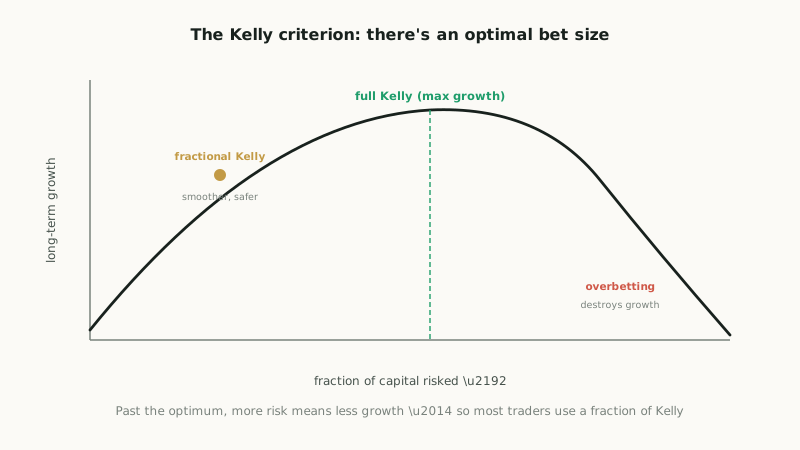
The Kelly criterion addresses a precise question: given an edge — a positive expectancy — what fraction of your capital should you risk per trade to maximise the long-term growth of that capital? The insight underlying it is that there is an optimal bet size: risk too little and your capital grows more slowly than it could; risk too much and, surprisingly, your growth also suffers (and your risk of ruin climbs). Somewhere in between lies the size that grows your capital fastest over the long run, and Kelly identifies it.
The formula, in a common trading form, is: Kelly % = W − [(1 − W) / R], where W is your win probability and R is your reward-to-risk ratio (average win divided by average loss). The result is the fraction of capital the criterion says to risk to maximise growth. The formula has intuitive properties: a bigger edge (higher win rate or higher reward-to-risk) prescribes a larger bet, while a smaller edge prescribes a smaller one, and a non-existent or negative edge prescribes betting nothing. This captures something fundamentally true — that the size of your bets should scale with the strength of your edge — and it connects directly to expectancy, since W and R are exactly the inputs that determine expectancy. Kelly is, in essence, the mathematical link between your edge and your optimal bet size.
The danger of overbetting
The most important and counterintuitive lesson of Kelly is what happens when you bet more than the optimal amount. One might assume that risking more always means faster growth (with more risk) — but this is false. Beyond the Kelly point, increasing your bet size actually reduces your long-term growth rate, even as it increases your volatility and risk of ruin. Overbetting is doubly bad: you get less growth and more risk. Push far enough beyond Kelly and the long-term growth rate turns negative — you are mathematically destined to lose money over time despite having a positive edge, purely because you are betting too much.
This is a profound result with direct relevance to the risk-of-ruin lesson. It provides a mathematical demonstration of why over-leveraging is so destructive: it is not merely "more risk for more reward," but a regime where excessive bet size actively harms long-term growth and courts ruin. The reason is the asymmetry of compounding — large losses hurt geometric growth disproportionately, because a big drawdown requires an even bigger gain to recover (the math-of-drawdowns lesson). Betting too large means the inevitable losing streaks inflict drawdowns from which recovery is mathematically punishing, dragging down the long-run growth rate. Kelly thus formalises the intuition behind conservative position sizing: there is a point beyond which more risk is simply self-defeating, and the over-leveraged trader is not being aggressive but irrational, sacrificing both growth and survival.
Why full Kelly is too aggressive
Given that Kelly maximises growth, why don't traders simply bet the full Kelly amount? Because full Kelly is, in practice, too aggressive for two important reasons. First, even at the optimal Kelly size, the volatility and drawdowns are severe — full Kelly maximises growth but produces wild swings and deep drawdowns that are psychologically unbearable and practically dangerous for most traders. The path to maximal growth is extremely bumpy, with drawdowns that would shake out all but the most iron-willed (and risk the account along the way).
Second, and more fundamentally, Kelly assumes you know your edge precisely — your exact win rate and reward-to-risk — which traders never do. Your real edge is uncertain, estimated from limited data, and may be weaker than you think (or may degrade as markets change). If you overestimate your edge and bet full Kelly based on that inflated estimate, you are actually overbetting relative to your true edge — landing in the destructive regime where growth suffers and ruin risk climbs. Since overestimating one's edge is extremely common (overconfidence being a documented trading bias), betting full Kelly on an uncertain, possibly-overestimated edge is genuinely dangerous. The combination of brutal drawdowns and sensitivity to edge-estimation error makes full Kelly unsuitable for real trading, however elegant the theory. This is why the practical application is always a fraction of Kelly.
Kelly's deepest lesson is that overbetting is self-defeating: past the optimum, more risk means less long-term growth and more ruin risk — a mathematical proof of why over-leveraging destroys traders. And because you never know your true edge precisely, betting full Kelly on an overestimated edge is overbetting. The safe response is fractional Kelly — a fraction of the theoretical optimum.
Fractional Kelly
The practical solution is fractional Kelly — risking only a fraction of the full Kelly amount, such as half-Kelly, quarter-Kelly, or less. Fractional Kelly sacrifices some of the theoretical maximum growth in exchange for benefits that matter enormously in practice: much smoother equity, far smaller drawdowns, and a large margin of safety against having overestimated your edge. The trade-off is highly favourable, because the growth sacrificed is modest while the reduction in volatility and ruin risk is dramatic — half-Kelly, for instance, captures most of the growth with a fraction of the drawdown.
This margin of safety is the key practical virtue. Because your true edge is uncertain, betting a fraction of Kelly means that even if you have overestimated your edge, you are likely still betting at or below the true optimum rather than overbetting into the destructive zone. Fractional Kelly builds in robustness against the inevitable error in your edge estimate. It also keeps drawdowns within bearable limits, which matters for the psychological discipline to keep following your strategy. The conservative position-sizing rules discussed elsewhere on this site — the familiar 1-2% risk per trade — are, for typical retail edges, generally well below even fractional Kelly, erring firmly on the side of caution and survival. This is no bad thing: for most traders, prioritising smooth equity, small drawdowns and near-zero risk of ruin over theoretical maximum growth is exactly the right choice, and it aligns with the survival-first philosophy that runs through all of risk management.
Using Kelly wisely
For most traders, the value of the Kelly criterion is more conceptual than literal — it teaches profound lessons even if you never compute it precisely. It demonstrates mathematically that bet size should scale with edge, that there is an optimal size beyond which more risk is counterproductive, and that overbetting destroys both growth and survival — reinforcing, with rigorous backing, the conservative position-sizing and risk-of-ruin lessons at the heart of risk management. These insights are valuable regardless of whether you ever use the formula directly.
If you do apply Kelly, do so with heavy caution: estimate your edge conservatively (assume it is weaker than your data suggests), use a fraction of the result (half-Kelly or less), and recognise that the standard 1-2% rule is a reasonable, robust default that for typical edges sits comfortably on the safe side. Never bet full Kelly on an uncertain edge, and treat any large position size the formula suggests with deep suspicion — it almost certainly reflects an overestimated edge. The deepest takeaway is the one that unites Kelly with the rest of this section: there is such a thing as betting too much, even with a winning edge, and the penalty is not just more risk but less growth and probable ruin. Sizing conservatively — a fraction of Kelly, the 1-2% rule, survival first — is not leaving money on the table; it is the mathematically and practically sound path to letting an edge compound over a long trading career.
The Kelly criterion gives the position size that maximises long-term capital growth: Kelly % = W − [(1 − W) / R], where W is win probability and R is reward-to-risk. Bet size should scale with edge — but betting more than Kelly reduces growth and raises ruin risk (a proof of why over-leveraging is destructive). Full Kelly is too aggressive: drawdowns are brutal, and since you never know your true edge, betting full Kelly on an overestimated edge means overbetting. Use fractional Kelly (half or less) for a margin of safety — and the conservative 1-2% rule is usually well within it.