Adding to a losing trade feels like buying a bargain: the price is even better now, your average entry drops, and you need only a small bounce to get back to break-even. It can even work — sometimes price reverses and you profit nicely from the lower average — and that intermittent success is exactly what makes averaging down one of the most seductive ways to blow up a trading account. Beneath the comforting logic lies a dangerous reality: you're betting more on a position the market is actively telling you is wrong. This guide explains averaging down: why it tempts, why it's so dangerous, how it differs from legitimate planned scaling, and how to avoid it.
The antidote is a stop-loss you actually honour; it's a close cousin of martingale betting, and it must be distinguished from planned scaling in and out.
Key takeaways
Q: What is averaging down?
A: Averaging down means adding to a losing position as price moves against you, which lowers your average entry price so that a smaller recovery returns you to break-even or profit. It feels like buying at a better price, but it increases your risk on a position the market is already signalling is wrong.
Q: Why is averaging down dangerous?
A: Because it grows a position that's already losing, violating the principle of cutting losses short. If price keeps moving against you — and trends can run far — the losses compound rapidly on a now-larger position, turning a small, manageable loss into a catastrophic, account-ending one. It's a classic cause of trading blow-ups.
Q: How is averaging down different from scaling in?
A: Planned scaling-in is a deliberate entry strategy where you build a position at predetermined levels with a defined total risk and a stop-loss — the 'averaging' is part of the plan and total risk is capped. Averaging down is reactive: adding to a loser simply because it's losing, with growing risk and no plan. The key difference is whether risk is planned and capped, or escalating uncontrolled.
The seduction
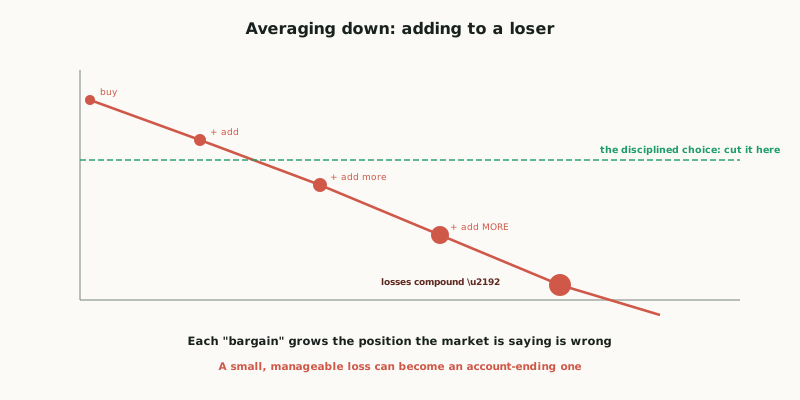
Averaging down means adding to a losing position as price moves against you, which lowers your average entry price. The arithmetic is real: if you bought at 100 and add at 90, your average is now 95, so price need only recover to 95 (not 100) for you to break even — a smaller bounce required. This is the seduction, and it comes wrapped in plausible-sounding reasoning: "the trade is even better value now," "I'm getting a great average price," "I only need a small move to get back to even." And crucially, it sometimes works — if price does reverse, the lower average turns what was a loss into a tidy profit, and the trader feels clever. This intermittent reinforcement is precisely what makes the behaviour so dangerous and so sticky: like any occasionally-rewarded bad habit, the wins that do come teach the brain to keep doing it, right up until the time it doesn't work — and that time can be ruinous.
Why it's an account-killer
Averaging down is dangerous because it increases your risk on a position that is already wrong. Price has moved against you — the market is, in effect, telling you your trade was mistaken — and your response is to bet more on it. This directly violates the cardinal rule to cut losses short: instead of cutting the loser, you're growing it. The fatal scenario is when the move continues against you, which it can do far and for long (trends persist; "the market can stay irrational longer than you can stay solvent"). As price keeps falling and you keep adding, your position grows larger precisely as it moves further offside — so your losses compound rapidly on an ever-bigger position. A small, manageable loss that a simple stop would have capped becomes a huge one, and in the classic blow-up, the trader averages down into a trend until the position is enormous and the loss is account-ending. Many of the most spectacular trading disasters — individual and institutional — are, at heart, stories of averaging down into a losing position that just kept going. The behaviour is a close cousin of martingale betting (adding to losers), and shares its fatal flaw: it works until the one time it catastrophically doesn't.
The psychology behind it is worth naming, because awareness is part of the defence. Averaging down is driven by loss aversion (the pain of realising a loss), by not wanting to admit being wrong (adding lets you avoid accepting the mistake), and by hope (clinging to the belief that price must come back). These are powerful, natural emotional pulls — which is exactly why averaging down feels so reasonable in the moment and why it requires deliberate discipline to resist.
Averaging down versus planned scaling
An important distinction prevents confusion: averaging down is not the same as legitimate, planned scaling-in. The difference is planning and capped risk. Planned scaling-in is a deliberate entry strategy in which you intend, from the outset, to build a position in tranches at predetermined levels, with a defined total risk and a stop-loss for the whole position — here the "averaging" is part of a considered plan, the total risk is known and capped in advance, and a stop still protects you (the scaling in and out approach). Averaging down, by contrast, is reactive: adding to a loser because it's losing, with no prior plan, growing (uncapped) risk, and often no stop — a panicked response to being offside rather than a strategy. The acid test is to ask: is this a planned entry with capped total risk and a stop, or a reactive doubling-down on a loser with escalating risk and no plan? The former can be legitimate (provided it respects your total risk limits); the latter is the account-killer. Note too that the opposite behaviour — adding to winners (pyramiding / anti-martingale) — is generally the sounder instinct, because it grows your position when the market is confirming you're right, not when it's telling you you're wrong.
Avoiding averaging down comes down to a few firm habits. Use a stop-loss and honour it — decide before you enter where you're wrong, and cut the loser there instead of adding to it (the stop-loss is the direct antidote). Define your total risk and position before entering, so you're never reactively adding to a loser outside a plan. Recognise the emotional pull (hope, not wanting to be wrong, loss aversion) and resist it deliberately, treating the urge to average down as a warning sign rather than an insight. And internalise the maxim: add to winners, not losers. The honest framing: averaging down (adding to a losing position to lower your average entry) feels smart and sometimes works — which is exactly why it's so dangerous; it increases risk on a position the market is already saying is wrong, violates "cut losses short," and can compound a small loss into an account-ending one if the move continues (the classic blow-up). It's distinct from planned scaling-in (a deliberate entry with capped total risk and a stop) — the danger is the reactive, unplanned doubling-down on a loser with growing risk. Avoid it by using and honouring a stop, defining total risk before entering, resisting the emotional pull, and adding to winners rather than losers. It's one of the most common account-killers in all of trading — respect the danger, and let your stop, not your hope, decide when a losing trade ends.
When might adding make sense?
In fairness, it's worth addressing the cases people raise to defend adding to a position that's down — and why they mostly don't rescue averaging down for the leveraged forex trader. The clearest legitimate case is the planned scaling-in already described: if, before entering, you intended to build your position across a zone of prices, you defined your total risk for the full position, and you have a stop for the whole thing, then adding at a lower price is executing a plan, not reacting to a loss — and your risk stays capped. That's a deliberate strategy, distinct from averaging down, and it can be perfectly sound provided the total risk respects your limits. The crucial discipline is that the plan and the capped risk must come first; "deciding" to scale in only after the trade goes against you is just averaging down wearing a disguise.
People also point to long-term investing, where averaging down (or "buying the dip" / dollar-cost averaging into a diversified, unleveraged portfolio you intend to hold for years) is a recognised and often reasonable approach. But this is a fundamentally different activity, and the distinction matters enormously. Investing of that kind is typically unleveraged, diversified, in assets with a long-term upward expectation (like a broad equity index), held over years with no stop and no margin call to force you out. Leveraged forex trading is none of those things: it's leveraged (so losses compound fast and a margin call can close you out at the worst moment), concentrated in a single position, in instruments with no inherent upward drift (a currency pair can trend against you indefinitely), and operated on far shorter horizons. In that environment, reactively averaging down into a losing, leveraged position is close to the worst thing you can do — the leverage and the lack of any "must come back" anchor turn the compounding-loss scenario from a risk into a near-inevitability if the move persists. So while "adding when lower" has its legitimate homes — planned, risk-capped scaling, and unleveraged long-term investing — for the leveraged forex trader holding a losing position, the honest answer is that adding almost always means taking the dangerous, reactive path. When in doubt, the discipline holds: let your stop, not your hope, decide when a losing trade ends, and reserve any "averaging" for genuine, pre-planned, risk-capped strategies.
Averaging down = adding to a losing position to lower your average entry (so a smaller bounce breaks you even). It's seductive — feels like a bargain, sometimes works — which is exactly why it's dangerous: it increases risk on a position the market is already saying is wrong, violates "cut losses short," and if the move continues, losses compound on an ever-larger position, turning a small loss into an account-ending one (the classic blow-up; a cousin of martingale). It's driven by loss aversion, not wanting to be wrong, and hope. It's distinct from planned scaling-in (a deliberate entry at preset levels with capped total risk and a stop) — the killer is the reactive, unplanned, uncapped doubling-down on a loser. Avoid it: use and honour a stop, define total risk before entering, resist the emotional pull, and add to winners, not losers. Let your stop, not your hope, end a losing trade.