
You don't have to enter or exit an entire position all at once. Scaling in lets you build a position in stages — notably by adding to a trade that is winning; scaling out lets you exit in stages — banking partial profit while letting the rest run. Done right, these are powerful trade-management techniques that manage risk and reward dynamically. Done wrong — specifically, scaling into losers by averaging down — scaling becomes one of the fastest ways to blow up an account. This guide explains how to scale in soundly (adding to winners, the anti-martingale way), how to scale out (taking partial profits), and the crucial distinction between adding to winners and the dangerous trap of averaging down.
It refines position sizing into staged management, supports the "let winners run" discipline (and its opposite, the dangerous averaging-down warned about in grid trading), and tests the patience the psychology section prizes.
Key takeaways
Q: What does scaling in and out mean?
A: Scaling in means entering a position in multiple parts rather than all at once — often adding to a winning position as it moves in your favour (pyramiding). Scaling out means exiting in parts — taking partial profits along the way while letting a portion of the position continue to run.
Q: What is the difference between adding to winners and averaging down?
A: Adding to winners (pyramiding) increases a position that is profitable — the sound, anti-martingale approach of pressing an advantage. Averaging down adds to a losing position to lower the average price — a dangerous, martingale-style behaviour that increases exposure to a trade already going wrong and can blow up an account.
Q: Why scale out of a position?
A: Scaling out (taking partial profits) locks in some gains and reduces risk, providing psychological comfort, while letting the remaining portion run for potentially larger profits. It's a balance between taking profit and letting winners run, at the cost of capping the gain on the portion closed early.
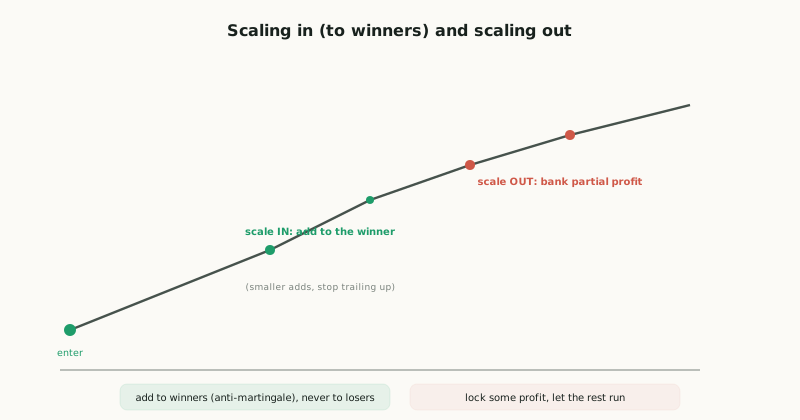
Scaling in: adding to winners
Scaling in means entering a position in multiple parts rather than committing the full size at once. It can serve different purposes, but the most powerful and sound use is pyramiding — adding to a position that is already winning, as it moves in your favour. Instead of taking your full position at entry, you start with part of it and add as the trade proves itself and moves into profit, building a larger position in a trend that is working. This lets you press an advantage: when a trade is going your way (especially in a strong trend), pyramiding increases your exposure to the move, potentially turning a good trade into a great one by having a larger position on as the trend extends.
Pyramiding is the anti-martingale approach — the sound opposite of the dangerous martingale logic (from the grid-trading guide). Where martingale increases size after losses (throwing more at a losing bet, a path to ruin), anti-martingale increases size after wins (adding to a winning position, pressing a working advantage). This aligns with the "let winners run" wisdom and with sound risk principles: you add risk when things are going well (the trade is proven, the trend is established), not when they're going badly. Done properly, pyramiding follows a few disciplines: each addition is typically smaller than the last (so the position is weighted toward the earlier, more-proven entries and isn't top-heavy), and stops are moved up (trailed) as you add, so that the growing position's risk stays controlled and earlier profits are protected — ideally, the combined position's stop is managed so that even after adding, you risk only an acceptable amount, and a reversal can't turn the whole built-up position into a large loss. Pyramiding into winners, with smaller adds and trailing stops, is a legitimate and powerful technique for maximising good trades — the constructive, anti-martingale way to scale in.
Scaling in must never become adding to a losing position to lower your average price ("averaging down"). That is martingale-style behaviour: throwing more money at a trade that is already going against you, increasing exposure to a bet proven wrong so far. It feels like getting a "better price," but it enlarges your loss if the trade keeps going against you, and it is a classic way accounts blow up. Adding to winners (pyramiding) is sound; adding to losers (averaging down) is dangerous. The difference is everything.
Scaling out: taking partial profits
Scaling out means exiting a position in multiple parts rather than closing it all at once — taking partial profits along the way. For example, you might close a third of the position at a first profit target, another third at a second target, and let the final third run further (or trail a stop on it). Rather than the binary choice of holding the entire position for a single exit, scaling out lets you realise some profit progressively while keeping some exposure to a continued move.
The benefit of scaling out is that it balances two competing goods: taking profit and letting winners run. By closing part of the position, you lock in some profit and reduce your risk (less remains exposed, and you've banked gains that can't now be given back) — which also provides real psychological comfort, easing the fear of watching profit evaporate and making it easier to hold the remainder calmly. By keeping part of the position open, you let a portion run for potentially larger gains, retaining exposure to a big move rather than cutting it all short. Scaling out thus captures some of the benefit of taking profit early (security, reduced risk, locked gains) and some of the benefit of letting winners run (capturing extended moves) — a middle path between the two. The trade-off is that scaling out caps the gain on the portion you close early: if the trade runs far, you'd have made more by holding the entire position to the end, so scaling out sacrifices some upside on the early-closed portion in exchange for the security and reduced risk it provides. This is a genuine, personal balance — there's no single right answer between "take profit early" and "let it all run," and scaling out is the flexible compromise. It is especially valuable psychologically: banking partial profit makes it far easier to hold the rest of a winner without the anxiety that causes traders to exit good trades too soon, so scaling out can actually help a trader let (part of) their winners run by removing the all-or-nothing pressure.
Using scaling well
Bringing it together, the two techniques and their key principles can be summarised: scaling in builds a position (soundly, by adding to winners); scaling out reduces it (by taking partial profits).
Scaling in and out at a glance
Used well, scaling is a flexible way to manage trades dynamically rather than treating each as a single all-or-nothing entry and exit. The governing principles are clear and important. For scaling in: add only to winners (the anti-martingale, pressing-an-advantage approach), never to losers (averaging down is the dangerous martingale trap), make additions smaller than the initial entry, and trail your stops up as you add so the growing position's risk stays controlled and profits are protected. For scaling out: take partial profits to lock in gains and reduce risk while letting a portion run, accepting the trade-off that you cap the upside on the early-closed part in exchange for security — and use the psychological benefit (banking some profit) to help yourself hold the remainder of a winner calmly. Throughout, manage risk as you scale: moving stops appropriately ensures that building or holding a position never lets your risk run beyond your limits (a pyramided position must not become an oversized, unstopped bet, and a held remainder should have a sensible trailing stop). These techniques connect to the broader risk and psychology themes: scaling in the right way embodies anti-martingale soundness and "add risk when winning," while scaling out embodies the balance between greed and fear and supports the patience to let winners run. The honest takeaway: scaling in and out are valuable trade-management tools — build into winners (never average down into losers), and bank partial profits while letting some run — that, used with disciplined stop management, let you manage trades more dynamically and skilfully than rigid single entries and exits. The cardinal rule, never to be forgotten, is the distinction at the heart of scaling in: add to winners, never to losers — the line between sound pyramiding and account-destroying averaging down.
When to scale (and when not)
Scaling is powerful but not always appropriate, and knowing when to use it matters. Scaling in (pyramiding) suits trending conditions and larger moves — situations where a trade, once proven, has room to run far, so adding to the winner can meaningfully amplify a big move. It fits trend-following and position trading naturally, where the aim is to ride extended trends. It is far less suited to range-bound conditions or small-target trades (scalping, tight range trades), where there isn't enough room for a built-up position to pay off, and the added complexity isn't worth it. Scaling out (partial profits) is broadly useful, especially when a trade has multiple plausible targets or when the psychological comfort of banking some profit helps you hold a winner — but on small, quick trades it can over-complicate, and taking profits too early on a strong trend forfeits the big moves that make trend trading worthwhile.
There is also a general caution: scaling adds complexity, and complexity can hurt. Managing staged entries and exits, tracking an evolving average price and a shifting stop, and making more decisions per trade all create more room for error and for emotional interference — and beginners in particular are usually better served by the discipline of simple, single entries and exits until they have mastered the basics. Scaling is an intermediate-to-advanced technique, best added once a trader can execute straightforward trades consistently. Used selectively — pyramiding into genuine trending winners, scaling out where multiple targets or psychology warrant it, and keeping things simple otherwise — scaling enhances trade management. Used indiscriminately, or before the fundamentals are solid, it adds complication and error without commensurate benefit. As with every technique on this site, the value lies in applying it deliberately and with discipline, in the situations that suit it, rather than reflexively on every trade.
Scaling lets you manage positions in stages. Scaling in: enter in parts, ideally pyramiding — adding to a winning position as it moves your way (the sound, anti-martingale approach), with smaller adds and stops trailed up to control risk. Crucially, never scale in by averaging down into a loser — the dangerous martingale trap that blows up accounts. Scaling out: take partial profits along the way — locking in gains, reducing risk and easing the psychology — while letting a portion run; the trade-off is capping upside on the early-closed part. Scaling in suits trending conditions and larger moves (not ranges or tiny targets); it adds complexity, so it's an intermediate-to-advanced technique best used selectively, not on every trade. Manage stops as you scale. The cardinal rule: add to winners, never to losers.