The most underrated skill in all of trading is the ability to do nothing. Not analysis, not entries, not clever strategies — but the plain, unglamorous capacity to wait: to sit patiently while the market offers nothing worth trading, resisting the constant urge to act, until a setup that genuinely matches your plan finally appears. Patience is an edge in itself, and it is one of the hardest skills to master, precisely because waiting is boring, feels unproductive, and runs against every instinct telling you to do something. This guide explains why patience is so valuable, what impatience costs, and why "sitting on your hands" is a skill worth cultivating above almost any other.
It is the positive counterpart to overtrading, a pillar of trading discipline, and the key to the selectivity that trading strategies depend on.
Key takeaways
Q: Why is patience important in trading?
A: Patience lets you wait for high-quality setups that match your strategy, rather than forcing mediocre trades. Since most of the time the market offers no good opportunity, the discipline to wait — and to do nothing in between — protects your capital and concentrates your trading on your best, highest-expectancy opportunities.
Q: What does 'the market pays you to wait' mean?
A: It means that patience is rewarded: by waiting for genuinely good setups rather than trading constantly, you take fewer but higher-quality trades, avoid the costs and poor expectancy of forced trades, and let your edge work. The profit comes from selectivity, which requires the patience to wait.
Q: Why is patience so hard in trading?
A: Because waiting is boring, feels unproductive, and triggers the fear of missing out. The urge to be active and to not miss moves is powerful, so doing nothing — sitting on your hands while the market moves — runs against natural instincts, making patience one of the hardest skills to develop.
Patience as an edge
It may seem strange to call waiting an edge, but it genuinely is one. The reason connects directly to the expectancy and selectivity ideas elsewhere on the site: your profit comes from taking high-quality, high-expectancy setups, and such setups are relatively rare. Most of the time, the market offers no good opportunity that matches your plan — it is choppy, unclear, or simply not presenting your setup. The trader who waits patiently for the genuine opportunities, and trades only those, concentrates their activity on their best edge; the trader who cannot wait dilutes that edge with mediocre trades taken in between.
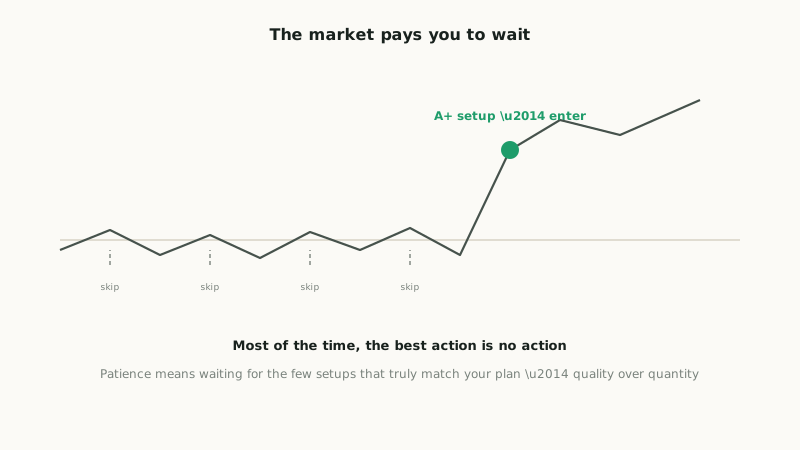
There is an old saying that captures this: "the market pays you to wait." It means that the reward in trading comes not from constant activity but from the patience to wait for the few setups worth taking. Patience is what enables selectivity — you can only be selective if you are willing to pass on everything that does not qualify, which requires the patience to do nothing while you wait for what does. In this sense, patience is not merely a virtue that helps you avoid mistakes; it is an active source of edge, because it ensures your capital and attention are deployed only on your best opportunities. The patient trader's results come from the quality of their few trades, made possible by the discipline of waiting through everything else.
The cost of impatience
The flip side of patience as an edge is that impatience is a cost — indeed, impatience is the root of much of what goes wrong for traders. Impatience leads directly to overtrading: unable to wait, the impatient trader takes mediocre setups, forces trades that are not really there, and chases moves out of a refusal to sit idle. As the overtrading guide details, this erodes the edge through costs, poor setups and fatigue. Impatience is, in effect, the emotional engine of overtrading.
Impatience shows up in other costly ways too. It causes traders to enter too early, before a setup is confirmed, jumping in prematurely rather than waiting for the trigger. It causes them to exit winners too soon, snatching small profits out of an impatient need to realise a gain, rather than letting the trade develop — the opposite of the "let winners run" discipline. And it causes chasing, entering a move that has already run because waiting for a proper entry felt unbearable. In each case, impatience degrades the quality of trading: worse entries, worse exits, worse setups. The common thread is the inability to wait — for the setup, for confirmation, for the trade to develop — and in each case the impatience extracts a real cost in expectancy. Recognising impatience as the source of these errors reframes patience not as passive idleness but as the active prevention of a whole family of costly mistakes.
Why patience is so hard
If patience is so valuable, why is it so rare and so difficult? Because waiting runs against powerful instincts. First, it is boring: sitting and watching the market without trading, sometimes for long stretches, lacks the stimulation and engagement that drew many people to trading in the first place. The restlessness that boredom breeds is a constant pressure to act. Second, doing nothing feels unproductive — we are conditioned to equate effort and activity with progress, so sitting idle feels like failing, like not working at trading, even though it is exactly the right thing to do.
Third, and most powerfully, patience triggers the fear of missing out: watching the market move — sometimes making big moves — without participating is psychologically painful, generating an intense urge to get involved so as not to "miss" the opportunity. This FOMO (explored in its own guide) is perhaps the greatest enemy of patience, because it makes waiting feel like loss. Together, boredom, the false equation of activity with productivity, and FOMO make patience genuinely difficult — it requires resisting deep instincts and tolerating discomfort. This is why patience, despite being conceptually simple, is one of the hardest skills to develop and maintain. Understanding why it is hard — that the difficulty is emotional and instinctual, not intellectual — helps, because it lets you recognise the boredom, restlessness and FOMO for what they are when they arise, and to hold steady against them.
Patience is hard because doing nothing feels like failing — boredom, the urge to be productive, and the fear of missing out all push you to act. But in trading, waiting is the productive act: it concentrates your edge on your few best setups. Reframe "doing nothing" as "actively waiting for quality," and idleness becomes discipline.
Cultivating patience
Patience can be cultivated with the right mindset and practices. The foundation, once again, is a clear trading plan with defined criteria: when you know exactly what your setup looks like, waiting becomes purposeful — you are not idly doing nothing, you are actively waiting for a specific thing, and you can dismiss everything that does not match without agonising. The plan converts vague restlessness into focused patience, giving you an objective standard that makes "this isn't my setup, so I wait" an easy, clear decision rather than a struggle of willpower.
A helpful mental reframe is to see waiting as a position in itself — being in cash, waiting for quality, is an active and valid choice, not a failure to act. The sniper analogy is apt: a sniper does not fire constantly; they wait, with discipline, for the one high-probability shot, and their effectiveness comes from that patience. Some traders find it helps to step away from the screen when no setup is present, removing the temptation that constant watching creates, and to fill the waiting with other productive trading work (reviewing the journal, studying, planning) rather than staring restlessly at charts. Above all, internalising that most of the time the best action is no action — that patience is the source of the selectivity that makes you profitable — transforms waiting from a frustrating chore into a respected, central part of the craft. The patient trader, who waits calmly for quality and acts only on their best opportunities, has an edge that the restless, impatient trader can never match, however hard the latter works at being active.
Patience beyond the entry
Most discussion of patience focuses on waiting for the entry — the patience to hold off until a quality setup appears. But patience matters throughout the entire life of a trade, not just at the start, and the impatient trader undermines themselves at every stage. Recognising the several places patience is required gives a fuller picture of this underrated skill.
First, patience is needed to wait for confirmation before entering, rather than jumping in prematurely on a setup that has not yet triggered — the impatient trader enters too early, before the conditions their plan requires are actually met, taking on trades that have not yet proven themselves. Second, and crucially, patience is needed to let a trade develop and let winners run. As the trend-following and expectancy guides stress, much of trading's profit comes from the occasional large winner ridden to its potential — but capturing those requires the patience to hold a winning trade through its fluctuations rather than snatching a small profit out of an impatient urge to realise the gain. Impatience at this stage — exiting winners too soon — caps the very profits that make a strategy work, perhaps the most expensive form of impatience there is.
Third, patience is needed to let your edge play out over many trades without abandoning your strategy during a normal drawdown or losing streak. The impatient trader, frustrated by a rough patch, jumps from strategy to strategy, never giving any approach the time and sample size it needs to express its edge — a kind of impatience operating on a longer timescale. Genuine patience, then, spans the whole journey: waiting for the setup, waiting for confirmation, letting winners run, and letting the edge compound over time. Each stage tests patience differently, and impatience at any of them leaks expectancy. The patient trader — calm at entry, calm while holding, calm through drawdowns — extracts the full value of their edge, while the impatient one bleeds it away at every turn. Patience is not a single act of waiting but a disposition maintained throughout.
Patience — waiting for the few setups that truly match your plan and doing nothing in between — is an edge, because profit comes from rare, high-expectancy trades. "The market pays you to wait." But patience spans the whole trade: waiting for the setup and for confirmation, letting winners run (not snatching small profits), and letting your edge compound over many trades without strategy-hopping. Impatience causes overtrading, early entries, premature exits and chasing. Cultivate patience with a clear plan, the mindset that "no trade" is a valid position, and stepping away when no setup is present.