
Grid trading can seem like a money-printing machine in a choppy market: a grid of orders that catches every wiggle of price, banking small profits as the market oscillates, with no need to predict direction. This apparent ability to profit from sideways chop is what draws traders to it. But grid trading carries a hidden, severe danger: the very same mechanism that captures small gains in a range accumulates catastrophic losses in a trend, and when combined with martingale position sizing, it becomes one of the most reliable ways to blow up a trading account. This guide explains how grid trading works, why it fails so badly in trends, and why the martingale variant is so dangerous — with the strong cautions this topic genuinely warrants.
It is a cautionary counterpart to range trading and mean reversion, and its dangers are best understood through risk of ruin.
Key takeaways
Q: What is grid trading?
A: Grid trading places a 'grid' of buy and sell orders at preset price intervals above and below the current price. As price oscillates, orders are triggered and small profits are captured from the up-and-down movement, without needing to predict direction. It aims to profit from volatility in a ranging market.
Q: Why is grid trading dangerous?
A: Grid trading works in ranging markets but fails catastrophically in strong trends. If price trends persistently in one direction, the grid keeps accumulating losing positions against the move with no stop-loss, and losses mount without limit. A single strong trend can wipe out gains made over many ranging periods — or the whole account.
Q: What is martingale and why does it make grid trading worse?
A: Martingale increases position size after losses to recover with one win. Combined with grid trading, it dramatically amplifies risk: a strong trend triggers ever-larger losing positions, and the exponentially growing exposure can blow up an account very quickly. Martingale mathematically guarantees eventual ruin given a long enough adverse move.
How grid trading works
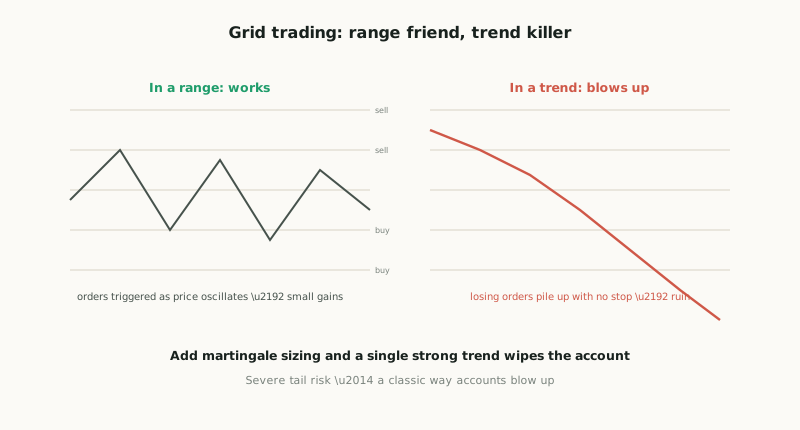
Grid trading places a grid of orders at preset price intervals above and below the current price — buy orders at intervals below, sell orders at intervals above (or variations on this). As price moves up and down, it triggers these orders, and the strategy captures small profits from the oscillation: as price rises through a level, a position is closed for a small gain; as it falls through another, an order opens, to be closed for a gain on the next bounce. The appeal is that grid trading does not require predicting direction — it simply profits from movement, capturing the up-and-down oscillation in a ranging market. In a market that chops sideways, bouncing within a range, a grid can repeatedly trigger and close orders for a steady stream of small profits, seeming to make money effortlessly from the noise that frustrates directional traders.
This is grid trading at its best: in a ranging market, the grid harvests the oscillation, and because price keeps returning through the grid levels, positions get closed profitably and the strategy accumulates small gains. It is, in essence, an automated mean-reversion approach (from the mean-reversion-vs-momentum framework) — it profits when price reverts back and forth around a level, betting implicitly that the range will hold. Often grid trading is automated (run by an algorithm or EA), since managing a grid of orders manually is cumbersome, and the "hands-off profit from a choppy market" pitch makes gridded EAs popular products. In the right conditions — a stable, oscillating range — grid trading genuinely can capture profit from movement without directional prediction, which is its real and only appeal. The fatal problem is what happens when the range doesn't hold.
Why it blows up in a trend
Grid trading's catastrophic flaw is what happens in a strong trend. The grid's whole logic depends on price oscillating back and forth so that opened positions get closed profitably on the return. But if price trends persistently in one direction instead of oscillating, this breaks down disastrously. Consider a buy grid (buy orders at intervals below price) when the market trends downward: as price falls, it triggers buy order after buy order — but price keeps falling, so none of these buys gets closed profitably; instead, they accumulate as losing positions, each deeper in loss as price continues down. The grid keeps buying into a falling market, piling up an ever-growing stack of losing trades, with the losses mounting as the trend extends.
Critically, a pure grid typically has no stop-loss — the strategy is designed to hold positions until price returns, so it does not cut the accumulating losers. In a strong, sustained trend, this means losses grow without limit as price moves ever further against the accumulated positions, the account's used margin balloons, and — if the trend is strong enough — the account is wiped out by the mounting unrealised losses or a margin call. This is the brutal asymmetry of grid trading: it makes small, frequent profits in ranges but suffers large, occasional, potentially total losses in trends. A single strong trend can erase the gains accumulated over many ranging periods — or destroy the account entirely. The strategy that seemed to "always make money" in choppy conditions reveals itself to have severe tail risk: it works until it catastrophically doesn't. This profile — frequent small wins masking a rare devastating loss — is exactly the kind of hidden risk that lures traders in (the run of small profits builds false confidence) and then ruins them (the eventual trend wipes them out). It is, in the mean-reversion-vs-momentum framing, the fatal error of applying a mean-reversion approach (grid) in a trending regime, where it "gets run over" — but mechanised and without a stop, so the damage is unlimited.
The martingale amplifier
Grid trading becomes far more dangerous still when combined with martingale position sizing, a pairing that is depressingly common (especially in EAs sold as money-printers). Martingale is the practice of increasing position size after losses — classically doubling the position after each loss — on the logic that a single eventual win will recover all prior losses plus a profit. Applied to a grid, martingale means each deeper grid level (each losing position as price trends against the grid) is larger than the last, so the accumulating losing positions grow not just in number but exponentially in size.
Martingale bets that a win is "due" and sizes up to recover losses — but markets have no memory, and a long enough losing streak (or trend) is statistically certain eventually. When it comes, the exponentially growing positions exhaust your capital before the recovering win arrives. Martingale converts many small wins into one inevitable, total loss. It does not reduce risk — it concentrates and guarantees it. A grid plus martingale in a trending market is among the fastest ways to blow up an account.
The mathematics is unforgiving, and it ties directly to the risk-of-ruin lesson. Martingale's promise — that one win recovers everything — ignores that the doubling grows exposure exponentially, so a run of losses (or a sustained trend, which a grid faces directly) requires astronomically large positions to continue, rapidly exceeding any finite account. Since a long enough adverse run is statistically inevitable given enough trades, martingale mathematically guarantees eventual ruin: it produces a long string of small recoveries (which feel like success and build dangerous confidence) followed by one catastrophic, account-destroying loss when the inevitable adverse streak arrives. Combined with a grid in a trending market — where the grid is already accumulating losing positions and the martingale is making each one larger — the blow-up is swift and total. By contrast, anti-martingale (the opposite: increasing size after wins and decreasing after losses) is the sound approach, aligning with "let winners run, cut losers" and proper position sizing — it presses advantage when winning and reduces exposure when losing, the reverse of martingale's press-into-losses logic. The lesson is stark: martingale sizing, especially within a grid, is not a clever recovery method but a near-guaranteed path to ruin, and it should be avoided. The frequent small wins it produces are the bait; the inevitable catastrophic loss is the trap.
An honest verdict
The honest verdict on grid trading is one of strong caution. It is not a scam in itself — it is a real strategy that genuinely can profit from oscillation in ranging markets, and in stable range-bound conditions a carefully risk-controlled grid can work. But its risk profile is treacherous: it makes small, frequent, confidence-building profits in ranges while carrying severe, potentially account-destroying tail risk in trends, and that combination — reliable small wins hiding a rare devastating loss — is exactly what lures traders to their ruin. The strategy's apparent "it always makes money" behaviour in choppy markets is precisely what makes it dangerous, because it builds false confidence right up until a strong trend delivers the catastrophic loss.
If grid trading is to be used at all, it demands strict risk controls that its naive form lacks: an overall stop or maximum-loss limit on the entire grid (so a trend cannot cause unlimited losses), fixed (never martingale) position sizing, limits on the number and total size of positions, and full awareness that a strong trend will cause losses that must be capped. Even then, it remains a high-risk approach best suited to experienced traders who fully understand its dangers and have rigorously limited their downside — not the effortless money-printer it is marketed as. And the marketing is a real hazard: gridded and martingale EAs are frequently sold with promises of automatic, consistent profits (a category overlapping the common-forex-scams guide), showing off the strategy's run of small wins while hiding its inevitable blow-up risk — beginners are drawn in by the smooth-looking results and then wiped out. The core takeaways: grid trading profits from oscillation in ranges but blows up in trends because it accumulates unstopped losing positions; martingale sizing makes the blow-up near-certain and should be avoided entirely; any use requires strict overall risk limits and fixed sizing; and the "passive profit" grid/martingale products sold online deserve deep scepticism. As with the riskiest approaches throughout this site, the message is not "never" but "understand the real danger, respect risk of ruin, and never let frequent small wins blind you to a hidden catastrophic risk."
Grid trading places buy/sell orders at preset intervals, profiting from price oscillation in a range without predicting direction — an automated mean-reversion approach. Its fatal flaw: in a strong trend it accumulates losing positions against the move with no stop, so losses mount without limit and a single trend can wipe out the account. Adding martingale sizing (doubling after losses) amplifies this into near-certain ruin — the inevitable adverse streak exhausts capital before the recovering win comes; anti-martingale (size up on wins) is the sound opposite. Grid trading isn't a scam but carries severe tail risk hidden behind frequent small wins; if used at all, demand an overall stop, fixed (never martingale) sizing and strict limits — and be deeply sceptical of grid/martingale "money-printer" EAs.