Strip away the indicators, patterns and jargon, and almost every trading strategy reduces to one of two opposite bets: that a price move will continue (momentum), or that it will reverse (mean reversion). These are the two foundational families of trading strategy, the deep structure beneath the surface variety — and understanding the dichotomy clarifies the entire landscape of strategies, because each one is, at heart, either a momentum bet or a mean-reversion bet (or a deliberate combination). Crucially, the two are not just different but opposite, and which one works depends on the market regime: momentum in trends, mean reversion in ranges. This guide explains both families, why they are opposites, how regime decides between them, and how skilled traders combine them.
It is the conceptual foundation beneath trend-following (a momentum approach) and range trading (a mean-reversion one), with the ADX as a key tool for judging the regime.
Key takeaways
Q: What is the difference between momentum and mean reversion?
A: Momentum strategies bet that a price move will continue — trading in the direction of the trend (buying strength, selling weakness). Mean reversion strategies bet that price will return to an average after deviating — trading against extremes (buying when oversold, selling when overbought). They are opposite approaches.
Q: When does momentum work and when does mean reversion work?
A: Momentum works in trending markets, where moves persist and trends carry price further. Mean reversion works in ranging markets, where price oscillates around a level and extremes get corrected. The market regime — trending or ranging — determines which approach succeeds, which is why identifying the regime matters.
Q: Can you combine momentum and mean reversion?
A: Yes. A common combination uses momentum to determine direction (trade with the larger trend) and mean reversion to time entries (buy a pullback within an uptrend). This pairs a momentum bias with a mean-reversion entry, seeking the best of both — favourable entries in the direction of the prevailing move.
Momentum: betting moves continue
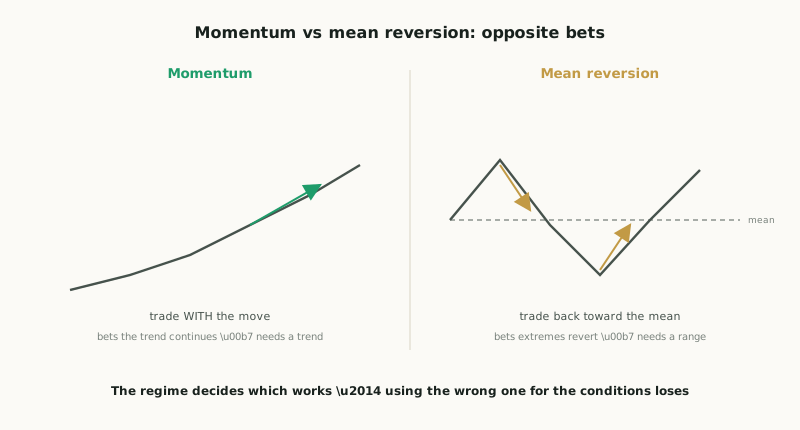
Momentum is the family of strategies that bet a price move will continue — that what is rising will keep rising, what is falling will keep falling. Momentum traders trade with the move: buying strength (assets that are going up) and selling weakness (assets going down), in the expectation that the move will carry further. The logic is that trends, once established, tend to persist, so aligning with the prevailing direction puts the odds in your favour. This is the principle behind trend-following and breakout strategies (covered in their own guides): both are momentum approaches that seek to join and ride an existing or emerging move.
Momentum has a genuine empirical basis. The momentum effect — the tendency for assets that have performed well to continue outperforming over certain horizons — is one of the most robust and widely-documented anomalies in finance, found across many markets and periods (and one of the clearest departures from a pure random walk, as the random-walk guide notes). It also has a behavioural rationale: herding (the human tendency to follow the crowd, from the behavioural-finance guide) drives trends, as buying begets buying and the crowd piles into moving markets, sustaining and extending the trend. So momentum is not merely a hopeful idea but a strategy family with both empirical support and a behavioural explanation. Its essential character: trade with the move, bet on continuation, profit when trends persist. Its essential requirement, as we will see, is a trending market — momentum needs a trend to work, and struggles when there isn't one.
Mean reversion: betting moves reverse
Mean reversion is the opposite family: strategies that bet price will return to an average (a "mean") after deviating from it — that extremes get corrected, that what has stretched too far will snap back. Mean-reversion traders trade against extremes: buying when price has fallen "too far" below its average (oversold) and selling when it has risen "too far" above (overbought), in the expectation that price will revert toward the mean. The logic is that price tends to oscillate around a central value, so betting on a return from the extremes puts the odds in your favour. This is the principle behind range-trading strategies and the use of oscillators (like the RSI and stochastic) to identify overbought and oversold extremes — all mean-reversion approaches.
Mean reversion, too, has empirical and behavioural support. Markets do exhibit mean-reverting behaviour over certain horizons (another departure from a pure random walk), and the behavioural rationale is overreaction: the tendency (from behavioural finance) for markets to overreact to news and push too far, creating extremes that then correct as the overreaction unwinds. So mean reversion, like momentum, is a strategy family grounded in real market tendencies and human psychology, not mere wishful thinking. Its essential character: trade against the extreme, bet on reversion, profit when price returns to the mean. Its essential requirement is a ranging market — mean reversion needs price to oscillate around a stable level, and fails catastrophically when price trends strongly instead (repeatedly fading a trend that keeps going, "catching a falling knife"). The table below sets the two families side by side.
The two families compared
| Aspect | Momentum | Mean reversion |
|---|---|---|
| The bet | The move continues | The move reverses |
| Trades | WITH the move (buy strength) | AGAINST extremes (buy weakness) |
| Works in | Trending markets | Ranging markets |
| Behavioural basis | Herding | Overreaction |
| Examples | Trend-following, breakouts | Range trading, fading extremes |
| Fails when | Market ranges (whipsaw) | Market trends (runs over you) |
Why they're opposites — and why regime decides
The crucial insight is that momentum and mean reversion are direct opposites, and this has a profound practical consequence. Faced with the same situation — say, a price that has risen sharply — the momentum trader buys (betting the rise continues) while the mean-reversion trader sells (betting it reverts). They take opposite sides. This means they cannot both be right in the same conditions: in any given market, one approach is suited and the other is not. The factor that decides which is right is the market regime — whether the market is trending or ranging.
In a trending market, momentum works (the trend persists, rewarding those who trade with it) and mean reversion fails (fading the trend means repeatedly betting against a move that keeps going, accumulating losses — the dangerous "catching a falling knife" of selling into strength or buying into weakness that doesn't revert). In a ranging market, mean reversion works (price oscillates around the mean, rewarding those who fade the extremes) and momentum fails (there is no sustained trend to ride, so trading with each move means getting whipsawed — buying near the top of the range just before it reverses, selling near the bottom). This is why identifying the regime is one of the most important skills in trading, and why tools like the ADX (which measures trend strength, distinguishing trending from ranging conditions) are so valuable: they help the trader determine which regime is in force and therefore which family of strategy to apply. Applying the wrong approach for the regime — momentum in a range, or mean reversion in a trend — is one of the most common and costly errors a trader can make, turning a sound strategy into a losing one simply by using it in the wrong conditions. The two families are not "good" or "bad" in themselves; each is right for its regime and wrong for the other, and matching the approach to the conditions is everything. This regime-dependence also illuminates the adaptive-market-hypothesis lesson: as conditions shift between trending and ranging, the effective approach shifts too, and a trader (or strategy) suited to one regime must adapt when the regime changes.
Momentum and mean reversion take opposite sides of the same move — one buys the breakout, the other fades it. So they can't both be right at once; the regime decides. Momentum needs a trend, mean reversion needs a range. The single most costly strategy error is using the wrong family for the conditions: fading a strong trend, or chasing momentum in a chop. Identifying the regime (e.g. with ADX) is what tells you which bet to make.
How traders combine them
Although momentum and mean reversion are opposites, skilled traders often combine them, using each for what it does best — and understanding how reveals the dichotomy's practical power. The most common and elegant combination uses momentum to choose the direction and mean reversion to time the entry. The trader first identifies the prevailing trend (a momentum judgement: which way is the larger move?), then waits for a pullback against that trend and enters as it ends (a mean-reversion-style entry: buying a temporary dip, a short-term reversion, within the larger uptrend). This "buy the dip in an uptrend" approach — central to much trend-following and swing trading — marries a momentum bias (trading with the larger trend) to a mean-reversion entry (buying a short-term pullback), seeking favourable entries in the direction of the prevailing move. It uses momentum where momentum is strong (the larger trend) and mean reversion where it is reliable (short-term pullbacks within that trend).
This combination is powerful because it aligns each family with its strength: the larger-timeframe trend provides the momentum edge (trade with the persistent move), while the short-term pullback provides a mean-reversion entry (a better price than chasing). It also manages the regime problem partially — by trading mean-reversion entries only in the direction of the larger trend, the trader avoids the fatal mean-reversion error of fading a strong trend outright. Other combinations exist (using regime indicators to switch between pure momentum and pure mean-reversion strategies as conditions change, for instance), but the direction-from-momentum, timing-from-mean-reversion pairing is the most widely used and instructive. The deeper takeaway is conceptual: once you understand that all strategies are momentum bets, mean-reversion bets, or combinations, and that regime decides which works, the entire landscape of trading strategies becomes clearer. You can classify any strategy you encounter (is this betting on continuation or reversion?), judge whether it suits current conditions (does the regime favour it?), and understand why it works or fails (right or wrong family for the regime). This dichotomy — momentum versus mean reversion, reconciled by regime — is one of the most clarifying frameworks in all of trading, and it underpins the trend-following, range-trading and regime-identification approaches covered across the site.
Almost every strategy is one of two opposite bets: momentum (the move continues — trade WITH it; trend-following, breakouts; needs a trend; behavioural basis = herding) or mean reversion (the move reverses — trade AGAINST extremes; range trading, fading overbought/oversold; needs a range; basis = overreaction). Both have real empirical support. Being opposites, they can't both be right at once — the market regime decides: momentum wins in trends, mean reversion in ranges, and using the wrong family for the conditions is a costly, common error (identify the regime, e.g. with ADX). Skilled traders combine them: momentum for direction (trade the larger trend), mean reversion for timing (buy the pullback). The framework clarifies the whole strategy landscape.