Are markets coldly efficient, as the EMH claims, or driven by irrational human psychology, as behavioural finance argues? The two views seem irreconcilable — yet both are backed by serious evidence (recall that Fama and Shiller shared a Nobel Prize). The Adaptive Market Hypothesis (AMH), proposed by economist Andrew Lo, offers an elegant resolution: both, depending on conditions. By reframing markets as evolving ecosystems rather than static systems, the AMH holds that efficiency is not all-or-nothing but varies over time, that biases create opportunities which competition then erodes, and that trading edges are real but temporary. For the working trader, it may be the most useful of all the market theories — it explains why strategies stop working, and why adaptation is the name of the game. This guide explains the AMH and what it means for trading.
It reconciles the Efficient Market Hypothesis with behavioural finance, and its lesson about decaying edges connects directly to expectancy and whether technical analysis works.
Key takeaways
Q: What is the Adaptive Market Hypothesis?
A: The Adaptive Market Hypothesis (AMH), proposed by Andrew Lo, reconciles the Efficient Market Hypothesis with behavioural finance using evolutionary principles. It holds that markets are not statically efficient or inefficient but evolve over time as participants adapt, so efficiency varies and trading edges are real but temporary.
Q: How does the AMH reconcile efficient markets and behavioural finance?
A: It treats efficiency as a dynamic, context-dependent property rather than an all-or-nothing state. Markets can be efficient at some times and inefficient at others; biases create opportunities, competition exploits and erodes them, and participants adapt. Both the efficient-market and behavioural views capture part of a changing reality.
Q: What does the AMH mean for traders?
A: It explains why trading strategies work for a while then stop working: edges are real but get competed away as others discover and exploit them. Traders must therefore keep adapting and innovating, expecting any edge to decay over time, rather than assuming a profitable strategy will work forever.
Reconciling the two views
The AMH's central achievement is reconciling the efficient-market and behavioural views, which had seemed to be in direct opposition. The EMH says markets are efficient and rational; behavioural finance says they are driven by systematic irrationality. Each has strong evidence, yet they appear to contradict each other — a genuine puzzle in financial theory (dramatised by Fama and Shiller sharing the Nobel). The AMH resolves the puzzle by rejecting the premise that markets must be either efficient or inefficient as a fixed state. Instead, it proposes that efficiency is a dynamic, context-dependent property that varies over time and conditions.
In this view, markets can be highly efficient at some times and notably inefficient at others; rational and behavioural forces both operate, with their relative influence shifting with circumstances. During calm, competitive conditions with many adapted participants, markets may be quite efficient (the EMH approximately holds); during periods of stress, novelty, or extreme emotion, behavioural forces may dominate and inefficiencies open up (behavioural finance describes it better). Neither view is wholly right or wrong; each captures the market's behaviour under certain conditions. The AMH thus absorbs both: the EMH's insight that competition drives markets toward efficiency, and behavioural finance's insight that human psychology creates systematic deviations — unified by the recognition that the balance between them is not fixed but evolves. This reframing dissolves the apparent contradiction: the debate was never about which theory is true, but about a market that is sometimes more like one and sometimes more like the other, depending on its current state. It is a more sophisticated, and more realistic, picture than either extreme alone.
Markets as evolving ecosystems
The AMH achieves this reconciliation by applying evolutionary and ecological principles to markets — the source of its name and its distinctive insights. It views the market as an ecosystem populated by different "species" of participants (various types of traders, investors, institutions, algorithms) who compete for limited profit opportunities, adapt their behaviour to changing conditions, and can thrive or go extinct depending on how well-suited their strategies are to the current environment. Just as biological species evolve through competition and adaptation in a changing environment, market participants and their strategies evolve through competition for profits in a changing market.
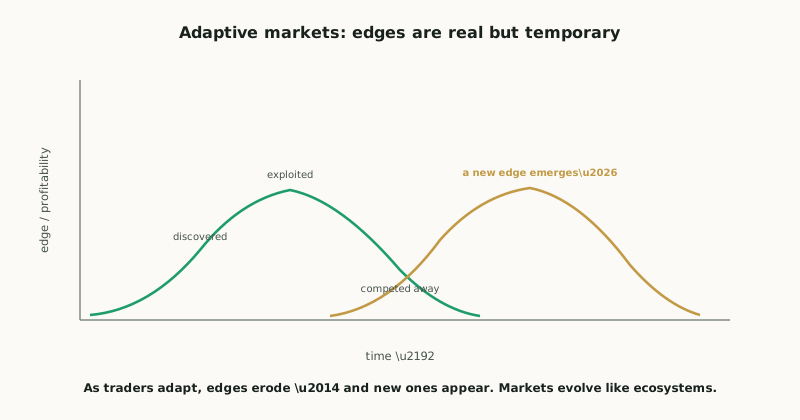
This ecological framing yields the AMH's key dynamics. Profit opportunities (edges) arise — perhaps from a behavioural bias, a structural quirk, or a new inefficiency — but they are competed away over time as participants discover and exploit them, just as an abundant food source in an ecosystem gets consumed as species adapt to feed on it. Strategies that work attract imitators, the crowding erodes the edge, and the opportunity diminishes or disappears. Meanwhile, new opportunities emerge as conditions change, new participants arrive, or old edges decay — so the ecosystem is in constant flux, with edges appearing, being exploited, decaying, and being replaced. Lo summarised the competitive, adaptive nature with the phrase "survival of the richest" — the market rewards those who adapt successfully and weeds out those who don't. This dynamic, evolutionary picture — a living ecosystem of competing, adapting participants chasing shifting opportunities — is what allows the AMH to explain how efficiency can vary: efficiency is high where competition has consumed the opportunities, lower where new or un-exploited inefficiencies exist, and always changing as the ecosystem evolves.
The AMH's reframe is liberating: stop asking "are markets efficient?" (a fixed yes/no) and start asking "how is this market evolving right now?" Edges aren't permanent features or illusions — they're food sources in an ecosystem, discovered, consumed by competition, and replaced. That single shift explains the EMH/behavioural debate and the lived experience of every strategy that worked until it didn't.
Edges are real but temporary
The AMH's most valuable lesson for the working trader is that edges are real but temporary — a proposition that rings true to anyone with trading experience and that neither the EMH nor behavioural finance captures so well alone. Against the strict EMH, the AMH says edges are real: genuine profit opportunities do exist, because markets are not perfectly efficient and inefficiencies arise. But against the naive hope that a good strategy works forever, the AMH says edges are temporary: as participants discover and exploit an edge, competition erodes it, and it decays over time. This explains one of the most common and frustrating experiences in trading — a strategy that works for a while and then stops working — which the AMH frames not as bad luck or a flaw in the trader, but as the natural lifecycle of an edge in a competitive, adapting market.
This connects directly to the site's themes about edge and expectancy. A trading edge (a positive expectancy) is, in AMH terms, an exploitable inefficiency — and like all such opportunities, it is subject to being competed away as others find it. The implication is that traders must keep adapting and innovating, treating their edges as perishable rather than permanent, monitoring whether a strategy's edge is holding or decaying (which is one more reason the trading journal and ongoing performance review matter), and being prepared to evolve as conditions change and old edges erode. The trader, in the AMH's ecological terms, is a species that must keep adapting to survive — a strategy that thrived in one environment may go "extinct" as the environment changes and competitors adapt. This is a realistic, even sobering, but ultimately constructive message: it neither denies that edges exist (as the strict EMH does) nor promises they last forever (as naive optimism does), but frames trading as an ongoing process of finding, exploiting, and then renewing edges in a perpetually evolving market. It is arguably the most practically useful framing of the market for a working trader, because it matches the lived reality of trading — edges found and lost, strategies that work then fade, the constant need to adapt — and turns it from a source of confusion into an expected feature of how markets actually behave.
Why it may be the most useful view
For all these reasons, the AMH is, for many working traders, the most useful of the market theories — not because it is provably "more correct" than the others (it is a framework rather than a precise, testable law), but because it best matches the practical reality of trading and offers the most constructive guidance. It validates the trader's belief that edges exist (against the EMH's denial) while instilling the humility and adaptability that long-term survival requires (against the false hope of permanent edges). It explains the puzzling experiences — strategies decaying, markets seeming efficient sometimes and irrational at others — that the static theories cannot. And it absorbs the genuine insights of both the EMH (competition drives efficiency) and behavioural finance (psychology creates inefficiency) into a single coherent picture.
The practical guidance that flows from the AMH is sound and actionable: expect your edges to decay, and monitor whether they are holding; keep adapting and innovating rather than assuming a strategy will work forever; understand that market conditions change, so an approach suited to one regime may fail in another (echoing the regime-awareness of the strategy and ADX discussions); and stay humble, recognising that you are one adapting participant in a competitive, evolving ecosystem, not the discoverer of a permanent secret. This framing aligns with the honest, no-hype philosophy of this entire site: edges are real but hard-won and temporary, success requires ongoing adaptation rather than a one-time discovery, and the market is a dynamic competitive arena that rewards the adaptable. The AMH does not tell you how to trade, but it tells you the nature of the game you are playing — and that understanding, realistic and constructive, is perhaps the most valuable thing the market theories can offer a working trader. It is the natural capstone of the efficiency debate, and the bridge to the practical question the next guide addresses: given all this, does technical analysis actually work?
The Adaptive Market Hypothesis (Andrew Lo) reconciles the EMH and behavioural finance by treating efficiency as dynamic, not fixed: markets are evolving ecosystems where participants compete, adapt, thrive or go extinct. Edges (inefficiencies) are real but temporary — discovered, exploited, then competed away as others adapt, while new edges emerge. This explains why strategies work then stop working, and why traders must keep adapting, expect edges to decay, and stay humble in a changing market. For working traders it may be the most useful view: it validates that edges exist while demanding the adaptability that survival requires — it tells you the nature of the game, even if not how to play it.