
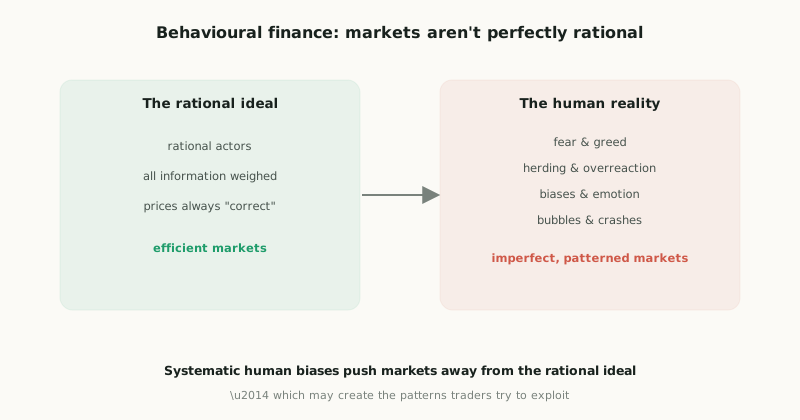
The Efficient Market Hypothesis assumes investors are coldly rational — weighing all information and pricing assets correctly. Behavioural finance studies the messy reality: humans are biased, emotional and prone to herding, and these systematic irrationalities shape their financial decisions and, in aggregate, the markets themselves. Where the EMH sees rational efficiency, behavioural finance sees fear and greed, overreaction and herding, bubbles and crashes — and argues that these are not mere noise but systematic deviations that may even create exploitable patterns. It is the principal intellectual challenge to the rational-market view, and it provides much of the theoretical basis for why behavioural and technical patterns might have some validity. This guide explains what behavioural finance claims, how biases operate at market scale, the key thinkers, and what it means for trading.
It is the market-scale counterpart to the individual cognitive biases covered in the psychology section, and the great challenger to the Efficient Market Hypothesis.
Key takeaways
Q: What is behavioural finance?
A: Behavioural finance is the study of how psychological biases and emotions affect the decisions of investors and the behaviour of markets. It challenges the assumption of perfectly rational actors underlying the Efficient Market Hypothesis, arguing that systematic human irrationality shapes prices and creates patterns like bubbles and crashes.
Q: How do biases affect markets at scale?
A: When many investors share the same biases, the effects aggregate: herding drives trends and bubbles, overreaction causes prices to overshoot and then reverse, and collective fear and greed produce boom-and-bust cycles. These market-scale effects are hard to reconcile with the idea of perfectly rational, efficient pricing.
Q: What does behavioural finance mean for trading?
A: It suggests markets are not perfectly efficient, and that systematic biases may create recurring, partly predictable patterns — a theoretical basis for why some technical and behavioural patterns might have validity. But exploiting these patterns consistently remains difficult, as biases are hard to time and arbitrage has limits.
The challenge to rational markets
Behavioural finance arose as a direct challenge to the assumption of perfect rationality that underlies classical finance and the EMH. The efficient-market view assumes that investors are rational actors who process information correctly and price assets accordingly — an assumption that makes the elegant mathematics of efficient markets work. Behavioural finance contends that this assumption is simply false: real investors are not coldly rational calculators but emotional human beings subject to systematic psychological biases, and these biases affect their decisions in predictable ways. If investors are systematically irrational, then the prices they set need not be perfectly rational or efficient — undermining the EMH at its foundation.
Crucially, behavioural finance does not merely claim that investors make random errors (which might cancel out and leave markets efficient on average). It claims the errors are systematic — that humans share common biases that push them in the same wrong directions at the same times, so the errors aggregate rather than cancel. This is the key to its market-level implications: if everyone tends to be overconfident, to herd, to overreact to dramatic news, and to be gripped by the same fear or greed, then these shared biases move the market as a whole, creating systematic deviations from efficient pricing. The table below contrasts the two views.
Two views of the market
| Dimension | Rational-market view (EMH) | Behavioural view |
|---|---|---|
| Investors | Rational, calculating | Biased, emotional |
| Errors | Random, cancel out | Systematic, aggregate |
| Prices | Always "fair" | Can overshoot & misprice |
| Bubbles/crashes | Hard to explain | Expected from herding |
Biases at market scale
The heart of behavioural finance for traders is how individual biases aggregate into market-scale effects. The same biases the cognitive-biases guide describes at the individual level — overconfidence, loss aversion, anchoring, recency, herding — operate across millions of participants, and when shared, they move markets. Herding is perhaps the most powerful: the human tendency to follow the crowd causes investors to pile into rising assets and flee falling ones together, amplifying moves into trends and, at the extreme, bubbles — self-reinforcing spirals where buying begets buying far beyond rational value. Overreaction causes markets to push too far on dramatic news, overshooting fair value, which then sets up a reversal as the overreaction corrects.
The grandest evidence is the cycle of bubbles and crashes that recurs throughout financial history — the dot-com bubble, the 2008 crisis, the historical manias. These episodes, in which prices detach wildly from any rational valuation and then collapse, are extremely difficult to explain under perfect rationality but are exactly what behavioural finance predicts: collective greed inflating bubbles, collective fear bursting them, herding amplifying both. The recurring fear and greed cycle — markets oscillating between euphoric greed (driving prices up) and panicked fear (driving them down) — is the behavioural signature written across market history. This is profoundly relevant to trading, because it suggests that markets are driven substantially by collective human psychology, not just information — and that this psychology, being systematic, may produce recurring, partly predictable patterns. The fear-and-greed dynamic the psychology section describes at the individual level becomes, at market scale, a driver of the trends, overreactions, bubbles and reversals that traders observe and attempt to trade. Behavioural finance thus provides a theoretical bridge from human psychology to market patterns.
The key thinkers
Behavioural finance is grounded in serious, Nobel-recognised research. Daniel Kahneman and Amos Tversky laid much of the foundation with their work on heuristics, biases and "prospect theory" — demonstrating experimentally that human decision-making under uncertainty systematically departs from rationality in predictable ways (such as loss aversion, where losses loom larger than equivalent gains). Kahneman received the Nobel Prize in Economics for this work, lending behavioural insights academic weight. Richard Thaler, also a Nobel laureate, helped build behavioural economics into a rigorous field and applied it to financial markets and decision-making.
Robert Shiller is especially relevant to markets: his work on market volatility, speculative bubbles and "irrational exuberance" argued that asset prices are far more volatile than rational models predict and are driven substantially by psychological and social factors — he famously warned of bubble conditions before major crashes. Tellingly, Shiller shared the 2013 Nobel Prize with Eugene Fama, the architect of the EMH — a striking acknowledgement that both the efficient-market view and its behavioural critique capture important truths, and that the relationship between them is more nuanced than a simple right-or-wrong (a tension the adaptive market hypothesis later sought to resolve). The involvement of such serious, recognised researchers means behavioural finance is not a fringe critique but a substantial, evidence-based body of work that any complete account of markets must reckon with. Its findings — that human biases are real, systematic, and consequential for markets — are well-established, even as debate continues about exactly how much they affect prices and how exploitable the resulting patterns are.
Behavioural finance's crucial claim isn't that investors err — it's that they err systematically, in the same directions at the same times. Random errors would cancel out and leave markets efficient; systematic, shared biases aggregate into herding, bubbles, overreaction and the fear-greed cycle. That's the bridge from individual psychology to the recurring market patterns traders try to read.
What it means for trading
For the trader, behavioural finance carries an encouraging implication and an important caution. The encouraging implication is that, if markets are driven substantially by systematic human biases, then they are not perfectly efficient, and the resulting patterns may be partly predictable and exploitable. This provides a theoretical basis — firmer than mere assertion — for why some technical and behavioural approaches might have genuine validity: if herding creates trends, then trend-following has a rationale; if overreaction creates overshoots and reversals, then mean-reversion approaches have one; if fear and greed drive recurring cycles, then sentiment and the price patterns that reflect it may carry real information. Behavioural finance is, in this sense, the intellectual counterweight to the EMH and random walk: where they say "you can't predict markets," behavioural finance says "markets are driven by systematic human psychology, which is at least partly predictable." It is a key part of the answer to whether technical analysis can work.
The important caution is that recognising biases is far easier than profitably exploiting them. Several obstacles stand between "markets are behaviourally driven" and "I can reliably profit from it." Biases are hard to time — knowing that a bubble is inflating does not tell you when it will burst (markets can stay irrational longer than you can stay solvent, as the saying goes), and many who correctly identified bubbles still lost money fighting them too early. Arbitrage has limits — even when prices are mispriced, the forces that should correct them can be weak, slow or risky to bet against. And the trader trying to exploit others' biases is subject to the very same biases themselves — you are not a rational observer of an irrational crowd, but a biased human among biased humans, prone to the same herding and emotion (which is why the trading psychology section matters so much). So behavioural finance, while it provides a genuine rationale for some predictability and a powerful corrective to the strict EMH, does not hand traders an easy edge. The honest synthesis, consistent with the rest of this cluster: markets are substantially but imperfectly efficient; systematic biases create real, partly-predictable patterns; but exploiting them consistently is difficult, requires discipline against one's own biases, and offers modest, hard-won edges rather than easy profits. Behavioural finance explains why edges can exist; it does not make them easy to capture.
Behavioural finance studies how systematic human biases and emotions affect investors and markets, challenging the EMH's rational-actor assumption. Its key claim: errors are systematic (shared, aggregating) not random (cancelling), so biases like herding, overreaction and the fear-greed cycle drive trends, bubbles and crashes at market scale. Grounded in Nobel-recognised work (Kahneman & Tversky, Thaler, Shiller — who shared the 2013 Nobel with Fama). It implies markets aren't perfectly efficient and that behaviourally-driven patterns may be partly predictable — a basis for why some technical/behavioural approaches can work. But exploiting biases is hard (timing, arbitrage limits, your own biases): it explains why edges exist, not how to capture them easily.