
It is the question every trader eventually asks, often after a string of losses or a run of luck: does technical analysis actually work? The answer you usually hear is one of two extremes — the confident "yes, here's my secret system" of the gurus, or the flat "no, it's astrology for men" of the strict academics. Both are wrong, or at least incomplete. The honest answer is more nuanced, and more useful, than either: technical analysis is neither a reliable crystal ball nor worthless noise-reading, but a fallible tool whose value is real but limited, and whose worth may lie as much in discipline and risk management as in pure prediction. This guide lays out the arguments for and against, the evidence, and a balanced verdict — the natural capstone to the market-theory cluster, and a synthesis of the honest stance this entire site has taken.
It brings together the EMH, random walk theory, behavioural finance and the adaptive market hypothesis to weigh the practical worth of the technical analysis covered across the site.
Key takeaways
Q: Does technical analysis actually work?
A: The honest answer is nuanced. Strict efficient-market and random-walk theory say it can't, and academic evidence is mixed, but markets aren't perfectly efficient and human behaviour creates some exploitable patterns. Technical analysis is best seen as a fallible tool with modest, decaying edges — valuable used with discipline and realistic expectations, not a reliable predictor.
Q: What are the strongest arguments for technical analysis?
A: That it can be self-fulfilling (when many traders act on the same levels and patterns), that it has a behavioural basis (markets are driven by systematic human biases that create recurring patterns), that markets aren't perfectly efficient, and that it provides a valuable framework for risk management and disciplined entries and exits, regardless of pure predictive power.
Q: What are the strongest arguments against technical analysis?
A: The Efficient Market Hypothesis (past prices are already priced in), random walk theory (price changes are unpredictable), the risk of data-mining false patterns, the subjectivity of pattern identification and hindsight bias, and mixed academic evidence that often finds technical rules don't beat buy-and-hold after costs.
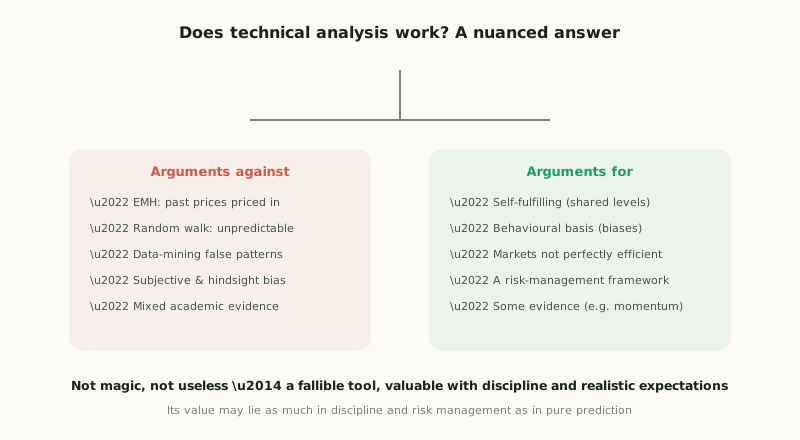
The case against
The arguments against technical analysis are serious and must be taken seriously — dismissing them is a mark of the naive enthusiast, not the thoughtful trader. The Efficient Market Hypothesis (weak form) says that past prices are already fully reflected in current prices, so studying them for an edge is futile — a direct theoretical refutation of technical analysis's premise. Random walk theory reaches the same conclusion from a statistical angle: if price changes are essentially random and unpredictable, then the patterns technical analysts see are largely illusory, and predicting future prices from past ones cannot work.
Beyond theory, there are practical objections. Data-mining is a powerful critique: with thousands of possible indicators, patterns and parameter combinations, some will appear to work brilliantly on historical data purely by chance — and a trader who tests many and keeps the winners has likely found noise, not signal, which then fails in live trading (the overfitting problem). Subjectivity undermines reliability: identifying patterns involves judgement, and in hindsight the human mind readily sees clear patterns in what was, at the time, ambiguous or random — confirmation bias and the pattern-seeking tendency (from the cognitive-biases guide) make technical analysis prone to self-deception, where traders see what they want to see and remember the hits while forgetting the misses. And the academic evidence is, at best, mixed: many rigorous studies find that technical trading rules do not reliably beat a simple buy-and-hold strategy after accounting for transaction costs, casting empirical doubt on technical analysis's profitability. Taken together, these arguments form a genuinely formidable case: strong theory says it shouldn't work, and much evidence suggests it often doesn't. Any honest defence of technical analysis must reckon with this, not wave it away.
The arguments weighed
| Against | For |
|---|---|
| EMH: past prices already priced in | Self-fulfilling when widely watched |
| Random walk: changes unpredictable | Behavioural basis (systematic biases) |
| Data-mining produces false patterns | Markets aren't perfectly efficient |
| Subjective & prone to hindsight bias | A framework for risk & discipline |
| Mixed academic evidence | Some evidence (e.g. momentum) |
The case for
The arguments for technical analysis are also substantial, and they explain why the practice persists and why many serious traders find value in it despite the theoretical objections. The first is the self-fulfilling effect: if a large number of traders watch the same levels and patterns and act on them, their collective action can make those patterns work. When many traders see the same support level and buy there, their buying creates the very bounce the pattern predicted; when many watch a popular moving average or a round number, price genuinely reacts there because of the orders clustered around it. To the extent technical levels are widely watched and acted upon, they acquire real predictive power through collective behaviour — not because of mystical properties, but because of the orders they concentrate.
The second, deeper argument is the behavioural basis: as the behavioural finance guide establishes, markets are driven substantially by systematic human psychology — herding, fear and greed, overreaction — which creates recurring, partly-predictable patterns. If markets reflect collective human behaviour, and that behaviour is systematically biased, then price patterns that capture these behavioural dynamics (trends from herding, reversals from overreaction, the structures fear and greed leave behind) may have a genuine, if imperfect, basis. This is the strongest theoretical foundation for technical analysis: it works to the extent that it reads the systematic psychology of the crowd. Third, markets are not perfectly efficient (as the EMH criticisms and the existence of documented effects like momentum show), leaving room for some exploitable structure that technical methods might capture. And fourth — importantly — technical analysis provides a framework for risk management and discipline regardless of its predictive power: it offers concrete, objective levels for placing stops, defining risk, timing entries and exits, and structuring trades, which has real value for disciplined trading even if the predictive element is modest. A trader using support/resistance to place a logical stop and define risk is benefiting from technical analysis as a risk framework, independent of whether the level "predicts" anything. These arguments — self-fulfilling effects, behavioural basis, imperfect efficiency, and the discipline framework — form a real case that technical analysis can have value, properly understood.
A balanced verdict
So, does technical analysis work? The honest, balanced verdict is: it is neither magic nor useless, but a fallible tool with real but limited value, best used with discipline and realistic expectations. The truth lies between the gurus' confident "yes" and the strict academics' flat "no," and it incorporates the genuine insights of both sides and of all the market theories in this cluster.
From the theories: strict efficiency and the random walk are right that markets are substantially efficient and largely unpredictable, so technical analysis is not a reliable predictor and most claimed patterns are noise — but they overstate the case, because markets are not perfectly efficient. Behavioural finance is right that systematic human psychology creates real, partly-predictable patterns, giving technical analysis a genuine basis — but exploiting them is hard. The adaptive market hypothesis ties it together best: technical edges are real but modest and temporary, existing because markets are imperfectly efficient and behaviourally driven, but decaying as they are discovered and exploited, requiring ongoing adaptation. The practical upshot, consistent with everything this site teaches: technical analysis can offer modest, hard-won, decaying edges; its patterns are probabilistic, not certain, and fail regularly; data-mining and subjectivity are real dangers demanding rigour and honesty; and much of its value lies in the discipline and risk-management framework it provides as much as in pure prediction. Used this way — with realistic expectations, strict risk management, awareness of its limits, and the humility the random walk and EMH counsel — technical analysis is a legitimate, useful tool. Used as a crystal ball promising reliable profits, it will disappoint and harm, exactly as the academics warn. This is precisely the stance this entire site has taken: every indicator and pattern presented as a fallible, probabilistic tool to be used with discipline and risk management, never as a magic signal. The deepest answer to "does technical analysis work?" is therefore: it can help, modestly, if you use it honestly and manage risk — and it will hurt you if you believe it can do more than it can. That nuanced truth, unglamorous as it is, serves a trader far better than either comforting extreme.
The useful question isn't "does TA work?" but "what does it actually do, and how should I use it?" It reads the crowd's systematic psychology (real but imperfect), it can be self-fulfilling (real but limited), and it provides a risk-and-discipline framework (valuable regardless of prediction). Treat its edges as modest, probabilistic and decaying — and much of its worth is in the discipline it imposes, not the future it foretells.
Honesty as the trader's edge
There is a final point worth making, because it underlies this whole cluster and this whole site. The willingness to ask "does technical analysis work?" honestly — and to accept a nuanced answer rather than a comforting extreme — is itself a mark of the kind of thinking that serves traders well. The gurus who promise that technical analysis reliably works are selling a fantasy that leads to overconfidence, over-leveraging and ruin; the cynics who insist it cannot possibly work miss the genuine, if modest, value it offers and the real role of discipline. The trader who holds the nuanced truth — edges are real but modest and decaying, patterns are probabilistic and fail often, much of the value is in discipline and risk management, and humility about prediction is essential — is far better equipped than either the true believer or the dismissive sceptic.
This honest, balanced stance is, in a sense, the through-line of everything on this site: the trading theories presented with their genuine logic and their limits; every indicator and pattern offered as a fallible tool, never a magic signal; the relentless emphasis on risk management, realistic expectations, and the psychology that defeats most traders. The market theories in this cluster — efficiency, the random walk, behavioural finance, adaptive markets — are not academic distractions but the deep foundation for this honesty: they explain why beating the market is hard, why edges are modest and temporary, why most who seek easy profits fail, and why discipline and risk management matter more than any pattern. A trader who internalises these truths — who treats markets as substantially efficient but imperfectly so, edges as real but hard-won and perishable, technical analysis as a useful but fallible tool, and their own mind as prone to the very biases that move markets — has the realistic, humble, disciplined foundation on which durable trading is built. In trading, honesty about what works and what doesn't is not a limitation; it is, perhaps, the closest thing to a genuine and lasting edge.
Does technical analysis work? Neither the gurus' "yes" nor the academics' "no" — the honest answer is nuanced. Against it: the EMH, random walk, data-mining, subjectivity and mixed evidence. For it: self-fulfilling effects, a behavioural basis (systematic biases create patterns), imperfect market efficiency, and its value as a risk-and-discipline framework. The verdict: technical analysis offers real but modest, probabilistic, decaying edges — it's a fallible tool, not a crystal ball, and much of its worth is in the discipline and risk management it imposes. Used honestly, with realistic expectations and strict risk control, it can help; treated as magic, it harms. Honesty about its limits is itself a trader's edge.