
The Efficient Market Hypothesis (EMH) makes a claim that strikes at the heart of everything traders try to do: that prices already reflect all available information, so no one can consistently beat the market by using that information. If true in its strongest form, it would mean that technical analysis, fundamental analysis and active trading are all futile — prices are always "fair," and any edge is illusory. Whether you accept, reject, or (most sensibly) qualify the EMH shapes how you think about every method on this site. This guide explains what the EMH claims, its three forms, what it implies for trading, and the substantial criticisms it faces. It is the natural starting point for the cluster of market theories that ask the deepest question in trading: can any of this actually work?
It opens the market-theory cluster, leading to random walk theory, its great challenger behavioural finance, and the practical question of whether technical analysis works.
Key takeaways
Q: What is the Efficient Market Hypothesis?
A: The Efficient Market Hypothesis (EMH) holds that asset prices reflect all available information, so prices are always 'fair' and it is impossible to consistently beat the market using that information. It implies that neither technical nor fundamental analysis can reliably produce excess risk-adjusted returns.
Q: What are the three forms of the EMH?
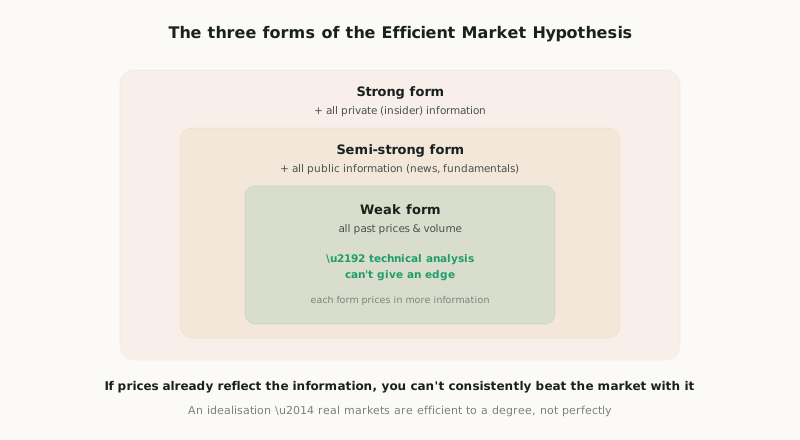
A: The weak form says prices reflect all past price and volume data (undermining technical analysis). The semi-strong form says prices also reflect all public information (undermining fundamental analysis on public data). The strong form says prices reflect all information including private/insider knowledge.
Q: Is the Efficient Market Hypothesis true?
A: It is debated. Markets are clearly efficient to a significant degree — information spreads fast and is largely priced in — but the strict hypothesis is challenged by market anomalies, bubbles and crashes, behavioural finance, and the existence of some consistently successful investors. It is best seen as a useful idealisation rather than an absolute truth.
The core claim
The central claim of the EMH, developed by economist Eugene Fama in the 1960s and 1970s, is that markets are informationally efficient — asset prices fully and rapidly reflect all available information. The logic is intuitive: in a market with many intelligent, profit-seeking participants, any piece of information that bears on a price is quickly discovered, acted upon, and thereby incorporated into the price. If good news emerges, buyers immediately bid the price up to reflect it; if bad news, sellers push it down. By the time you can act on information, the price has already adjusted to account for it. Prices, in this view, are always "correct" given what is known.
The profound implication is that you cannot consistently beat the market using information the market already has, because that information is already in the price. If prices already reflect everything known, then no analysis of that known information — charting past prices, studying public fundamentals — can give you a reliable edge, since you would only be acting on information already priced in. Any apparent outperformance, the EMH says, is either luck or compensation for taking extra risk, not genuine skill at finding mispricings. This is a deeply challenging idea for traders, because it suggests that the entire enterprise of analysis aimed at finding an edge is, at least in the strong version, futile. Understanding this core claim — prices reflect all available information, so you can't beat the market with it — is essential, even (perhaps especially) for traders who ultimately disagree with it, because it sets the bar that any claimed edge must clear: you must be acting on something not already in the price.
The three forms
The EMH comes in three forms, distinguished by how much information they claim is reflected in prices — a crucial distinction, because the three forms have very different implications for technical and fundamental analysis. The table below summarises them.
The three forms of market efficiency
| Form | Prices reflect… | Implication if true |
|---|---|---|
| Weak | All past prices & volume | Technical analysis can't give an edge |
| Semi-strong | + all public information | Public fundamental analysis can't either |
| Strong | + all private (insider) information | Even insider information can't |
The weak form claims prices reflect all past price and volume data. If true, technical analysis — which studies past prices to predict future ones — cannot provide an edge, because the past-price information it relies on is already fully priced in. The semi-strong form goes further: prices reflect all publicly available information (past prices plus public fundamentals, news, economic data). If true, fundamental analysis of public information cannot give an edge either, because prices instantly adjust to all public news; only genuinely private information could help. The strong form is the most extreme: prices reflect all information, public and private (including insider knowledge). If true, even insiders could not consistently beat the market — a claim widely regarded as too strong, since insider information demonstrably does confer advantage (which is precisely why insider trading is illegal). Most discussion centres on the weak and semi-strong forms, which directly challenge technical and fundamental analysis respectively. The three-form structure is the EMH's most useful contribution to a trader's thinking: it frames the question not as "are markets efficient?" but "how efficient, with respect to what information?" — a far more productive way to think about whether and how an edge might exist.
What it implies for trading
If the EMH holds, the implications for trading and investing are stark. Most directly, it implies that active trading and analysis cannot reliably beat the market after costs — since prices are always fair, attempts to find mispricings through analysis are futile, and any outperformance is luck or extra risk-taking, not skill. This is the intellectual foundation for passive investing: if you can't beat the market, the rational strategy is to simply match it cheaply (via index funds), avoiding the costs and effort of active management that, the EMH predicts, cannot consistently add value. The strong real-world performance of low-cost index investing, and the difficulty most active managers have in consistently beating their benchmarks after fees, are often cited as evidence broadly consistent with a substantial degree of market efficiency.
For the trader specifically, the EMH issues a serious challenge: if markets are efficient, then the technical and fundamental analysis covered across this site cannot work, and any edge is an illusion. This is not a comfortable message, but it is one a thoughtful trader must engage with rather than ignore. The honest response is not to dismiss the EMH (markets are substantially efficient — information does spread fast and get priced in quickly, and beating the market is genuinely hard) nor to accept it absolutely (as the criticisms below show, markets are not perfectly efficient). Rather, the EMH should sharpen how you think about edges: any genuine edge must come from something not fully reflected in prices — perhaps a behavioural inefficiency, a temporary mispricing, a structural factor, or superior risk management — not from public information the market has already digested. The EMH thus serves as a rigorous filter on claims of easy profits: it explains why beating the market is hard, why most who try fail, and why any real edge is likely to be modest, hard-won, and not based on information everyone already has. Far from being merely a counsel of despair, it is a valuable reality check that the rest of this cluster builds upon.
The EMH's real value to a trader isn't deciding whether it's "true" — it's the bar it sets. If prices reflect known information, then any genuine edge must come from something not already priced in. That reframes the question productively: not "are markets efficient?" but "how efficient, regarding what information, and where might the gaps be?"
The criticisms
The EMH, for all its influence, faces substantial criticisms, and few believe it holds in its strict, strong form. Market anomalies present persistent challenges: documented effects like momentum (past winners tending to keep winning), value and small-cap premia, and seasonal patterns suggest predictability that pure efficiency would forbid. Bubbles and crashes — the dot-com bubble, the 2008 financial crisis, historical manias — are hard to reconcile with the idea that prices are always rational and fair; markets sometimes appear wildly mispriced, driven by collective emotion rather than information. Behavioural finance (the subject of its own guide) provides extensive evidence that investors are systematically irrational, biased and emotional, contradicting the rational-actor assumption underlying efficiency.
There are also logical and empirical challenges. The Grossman-Stiglitz paradox notes that if markets were perfectly efficient, no one would have any incentive to gather information (since it couldn't be profited from), but then prices couldn't become efficient in the first place — so perfect efficiency is self-contradictory, and some inefficiency must exist to reward the information-gatherers who create efficiency. And the existence of a small number of investors who have consistently beaten the market over long periods (though rare, and debated) sits uncomfortably with strong efficiency. The fair conclusion, held by many thoughtful observers, is that markets are highly but not perfectly efficient: information does get priced in fast, beating the market is genuinely hard, and most active attempts fail — yet inefficiencies, anomalies and mispricings do exist, are exploited by some, and leave room (modest, hard-won, and not based on public information alone) for genuine edges. The EMH is best understood as a powerful idealisation that captures an important truth (markets are substantially efficient) without being literally and completely true. This nuanced view — efficient to a degree, not absolutely — sets up the rest of the cluster: random walk theory examines the related claim that prices are unpredictable, behavioural finance explores why markets deviate from efficiency, the adaptive market hypothesis reconciles the two, and the question of whether technical analysis works puts it all to the practical test.
The Efficient Market Hypothesis (Eugene Fama) holds that prices reflect all available information, so you can't consistently beat the market using it. Its three forms price in progressively more: weak (past prices — challenges technical analysis), semi-strong (+ public info — challenges fundamental analysis), strong (+ private info — widely seen as too strong). It implies active analysis can't reliably add value, supporting passive investing. But it faces serious criticism — anomalies, bubbles and crashes, behavioural finance, the Grossman-Stiglitz paradox — so it's best seen as an idealisation: markets are highly but not perfectly efficient. Its value is the bar it sets: a genuine edge must come from something not already priced in.