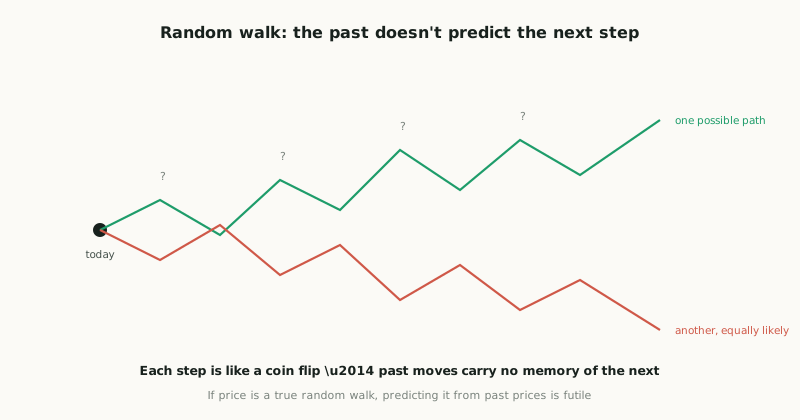
Imagine that each price change is like a coin flip — the next move up or down has no memory of the last, and the path price traces is essentially random. If that were true, then studying past prices to predict future ones would be as futile as studying past coin flips to predict the next. This is the claim of the random walk theory: that price changes are essentially random and unpredictable, so the market cannot be forecast from its own history. It is technical analysis's sharpest and most direct challenge, and a close companion to the Efficient Market Hypothesis. This guide explains what the random walk theory claims, how it relates to the EMH (they are connected but distinct), what it implies for trading, and the important ways real markets depart from a perfect random walk.
It is the statistical sibling of the Efficient Market Hypothesis, and a central consideration in whether technical analysis works.
Key takeaways
Q: What is the random walk theory?
A: The random walk theory holds that price changes are essentially random and unpredictable — future price movements cannot be reliably predicted from past movements, because prices have no 'memory.' Popularised by Burton Malkiel, it implies that trying to forecast prices from their history is futile.
Q: How is the random walk theory related to the EMH?
A: They are closely connected but distinct. The Efficient Market Hypothesis says prices reflect all information; the random walk theory describes the statistical consequence — that if prices only move on new, unpredictable information, then price changes themselves appear random and unpredictable. Efficiency implies a random walk.
Q: Does the random walk theory mean technical analysis is useless?
A: If prices were a perfect random walk, technical analysis (which predicts from past prices) could not work. However, evidence suggests markets are not perfectly random — some predictability exists, such as momentum and volatility clustering — so the strict random walk is an idealisation rather than a complete description of real markets.
The core claim
The random walk theory holds that price changes are random and unpredictable — that the future direction of prices cannot be reliably forecast from their past movements, because prices have no "memory." Each price change, in this view, is essentially independent of those before it, like a fresh coin flip: knowing that price has risen for several periods tells you nothing reliable about whether the next move is up or down. The path that price traces over time is therefore a "random walk," a sequence of unpredictable steps, however much it may appear, in hindsight, to contain patterns and trends.
The theory was popularised by economist Burton Malkiel in his influential 1973 book A Random Walk Down Wall Street, which argued (memorably) that a blindfolded monkey throwing darts at the financial pages could select a portfolio that would do as well as one chosen by experts — a vivid way of saying that predicting markets is beyond skill. The core message is that the apparent patterns traders see in price charts — the trends, the formations, the "signals" — may be largely illusory, the kind of meaningful-looking structures the human mind readily perceives in what is actually random data (a manifestation of the pattern-seeking bias the cognitive-biases guide describes). If price is a random walk, then the entire project of predicting it from its history — the foundation of technical analysis — rests on finding signal in what is essentially noise. This is a direct and serious challenge to chart-based trading, and like the EMH, it is one a thoughtful trader should engage with honestly rather than wave away.
Random walk versus the EMH
The random walk theory and the EMH are closely related but distinct, and understanding the connection clarifies both. They are connected because efficiency implies a random walk: if markets are efficient and prices already reflect all available information, then prices can only move when new information arrives — and since new information is, by definition, unpredictable (if it were predictable, it would already be priced in), prices move unpredictably, tracing a random walk. So the random walk is, in a sense, the statistical signature of an efficient market: efficiency is the cause, the random walk is the observable consequence. The two theories developed alongside each other and are often discussed together for this reason.
But they are distinct claims about different things. The EMH is about information — it says prices reflect all available information. The random walk theory is about statistics — it says price changes are unpredictable and independent. One is a claim about what determines prices (information), the other about the statistical behaviour of price changes (randomness). The distinction matters because the two can come apart: a market could exhibit some statistical predictability (departing from a strict random walk) while still being hard to beat after costs (broadly consistent with practical efficiency), or be efficient in pricing information yet show patterns from non-informational sources. Keeping the two separate — EMH as the information claim, random walk as the statistical claim — prevents the common conflation of them and allows a more precise discussion of what real markets actually do. For the trader, the random walk poses the specific, testable question: are price changes genuinely unpredictable, or is there exploitable structure in them? That empirical question, examined next, is where real markets prove more interesting than the pure theory.
What it implies for trading
Taken strictly, the random walk theory has a blunt implication for trading: technical analysis cannot work. Technical analysis is, at its core, the attempt to predict future prices from past prices and patterns — and if price changes are genuinely random and unpredictable, then there is no information in past prices to exploit, and any apparent predictive success is luck or illusion. Charts, indicators, patterns, trends — all of these would be, under a strict random walk, meaningless noise dressed up as signal. The theory thus directly attacks the foundation of chart-based trading, just as the weak-form EMH does (the two reach the same conclusion about technical analysis from their connected premises).
The random walk also reinforces the case for passive investing and humility about prediction: if you can't forecast prices, the rational approach is not to try, but to hold the market cheaply and accept its returns, rather than incurring the costs of futile prediction attempts. For the active trader, the random walk is a sobering challenge that demands an honest response. As with the EMH, the right response is neither dismissal nor surrender. The theory contains real truth — markets are substantially unpredictable, much of what looks like a pattern is noise, prediction is extremely hard, and the pattern-seeking human mind does readily fool itself — and any trader who ignores this is liable to mistake randomness for skill. But, as the next section shows, real markets are not perfectly random, which leaves a narrow but real opening. The random walk's enduring value for the trader is its insistence on humility and rigour: it forces you to ask whether your "edge" is real or just a story you have told yourself about noise, and it sets a high bar of evidence for any claim that the past predicts the future.
The random walk and EMH reach the same verdict on technical analysis but from different angles: EMH says past prices are already priced in (information), random walk says price changes are statistically unpredictable (statistics). Efficiency causes the random walk — prices move only on unpredictable new information. The trader's takeaway is humility: much of what looks like a pattern is noise, and the burden of proof for any real edge is high.
Where real markets depart from randomness
The strict random walk theory, like the strict EMH, is an idealisation that real markets do not perfectly match. Empirical research has found evidence that price changes are not entirely random — that some predictable structure exists, contradicting a pure random walk. The most robust example is momentum: the tendency for assets that have risen (or fallen) to continue doing so over certain horizons, a persistent effect documented across many markets that pure randomness cannot explain (and that the trend-following strategies on this site attempt to exploit). Mean reversion over other horizons, volatility clustering (large moves tending to follow large moves — volatility is predictable even if direction is harder), and various anomalies also represent departures from a strict random walk.
These departures matter because they mean the door to predictability is not entirely closed — there is some structure in price changes, leaving a narrow opening for approaches that exploit it. However, several cautions temper this. The predictable components are typically modest — markets are mostly random with only small pockets of predictability, so any edge from them is slim and easily overwhelmed by costs and noise. Apparent patterns are also easy to over-discover through data-mining (test enough patterns and some will appear predictive by pure chance), so claimed departures from randomness must clear a high bar of statistical rigour to be believed (a key theme in the does-technical-analysis-work discussion). The honest synthesis is that real markets lie between the extremes: not a perfect random walk (some predictability exists, notably momentum and volatility clustering), but far closer to random than most traders' confident pattern-reading assumes. This is the same nuanced conclusion the EMH reached — highly but not perfectly efficient, mostly but not entirely random — and it frames the trader's task realistically: any genuine edge from price behaviour is likely to be small, hard to find, easily faked by data-mining, and demanding of rigour and humility to distinguish from the dominant randomness. The random walk theory, even if not literally true, is therefore an indispensable corrective: it keeps the trader honest about how much of the chart is noise, and how high the bar must be for anything claimed to be signal.
The random walk theory (popularised by Burton Malkiel) holds that price changes are essentially random and unpredictable — prices have no memory, so the past can't forecast the future. It's connected to the EMH (efficiency causes a random walk, since prices move only on unpredictable new information) but distinct (EMH is about information, random walk about statistics). Taken strictly, it says technical analysis can't work and counsels humility about prediction. But real markets aren't perfectly random — momentum, mean reversion and volatility clustering show modest predictable structure — so the truth is "mostly but not entirely random." Its enduring value: keeping traders honest about how much of the chart is noise.