Before you choose a strategy, you should answer one question: is the market trending or ranging right now? That single distinction decides which approaches will work — trend-following thrives in trends and fails in ranges, while range trading does the opposite. The ADX indicator — Average Directional Index — is the tool built to answer exactly this question. Developed by J. Welles Wilder, the ADX measures not which way price is going, but how strongly it is trending at all. This makes it one of the most useful "meta" indicators: rather than generating buy/sell signals, it tells you what kind of market you are in, so you can pick the right strategy. This guide explains how ADX works, its companion +DI and -DI lines, and how to use it.
It is the indicator that answers the regime question behind trend-following and range-trading strategies, and it pairs naturally with oscillators like the stochastic.
Key takeaways
Q: What is the ADX indicator?
A: ADX, or Average Directional Index, measures the strength of a trend — not its direction. Developed by J. Welles Wilder, it ranges from 0 to 100, with higher values indicating a stronger trend and lower values a weak trend or ranging market. It is part of the Directional Movement System.
Q: Does ADX show trend direction?
A: No — ADX measures only trend strength, not direction. Direction is given by the accompanying +DI and -DI lines: when +DI is above -DI the trend is up, and when -DI is above +DI it is down. ADX itself tells you only how strong that trend is, regardless of which way it points.
Q: What ADX level indicates a trend?
A: A common guideline is that an ADX above 25 (some traders use 20) indicates a trending market with a meaningful trend, while an ADX below 20-25 indicates a weak trend or a ranging market. A rising ADX shows a strengthening trend; a falling ADX a weakening one.
Strength, not direction
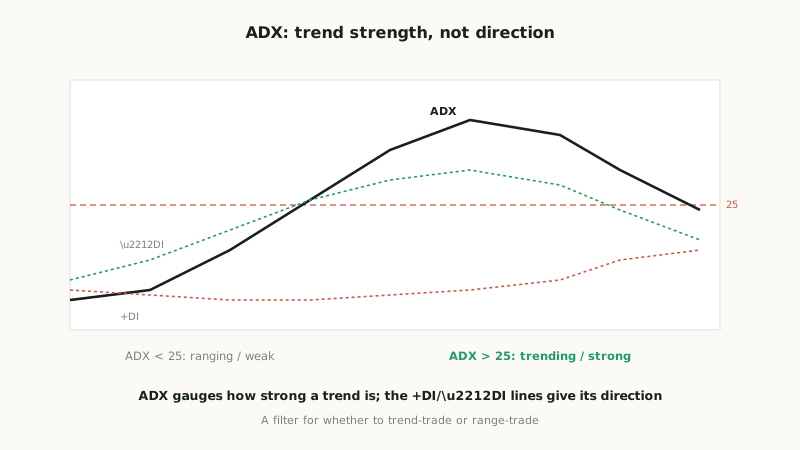
The defining characteristic of ADX — and the source of its usefulness and its common misunderstanding — is that it measures trend strength, not direction. The ADX line ranges from 0 to 100, and a higher value means a stronger trend, a lower value a weaker trend or a ranging market. Crucially, ADX does not tell you whether the trend is up or down — a strong uptrend and a strong downtrend both produce a high ADX, because both are strong trends. ADX answers "how strong is the trend?" not "which way is it going?"
This is exactly analogous to how ATR measures volatility rather than direction, and it places ADX (like ATR) in the category of indicators that characterise the market environment rather than predict price direction. The value of knowing trend strength independent of direction is considerable: it lets you assess whether a tradeable trend exists at all before worrying about how to trade it, and — as we will see — it lets you choose the appropriate strategy for the conditions. Many traders misread ADX by expecting it to signal direction; understanding from the outset that it measures only strength, with direction supplied separately by the +DI/-DI lines, is the key to using it correctly. A rising ADX indicates a strengthening trend (of whatever direction), and a falling ADX a weakening one — again, purely about strength.
The +DI and -DI lines
ADX is the headline line of a broader Directional Movement System, which includes two companion lines that do indicate direction: the +DI (Positive Directional Indicator) and -DI (Negative Directional Indicator). The +DI measures the strength of upward price movement, and the -DI the strength of downward movement. The ADX itself is derived from these two directional indicators — it essentially measures the degree of separation between them, capturing how strongly one direction dominates the other, which is what "trend strength" means.
The +DI and -DI lines supply the directional information that ADX omits. When +DI is above -DI, upward movement dominates — the trend direction is up; when -DI is above +DI, downward movement dominates — the trend is down. So the full picture comes from reading them together: the ADX tells you how strong the trend is, and the relationship between +DI and -DI tells you which way it points. Crossovers of the DI lines (+DI crossing above -DI, or vice versa) can serve as directional signals, indicating a potential shift in which direction is dominant. The complete system thus provides both dimensions: strength from ADX, direction from the DIs. In practice, many traders focus primarily on the ADX line for the strength/regime read (the most valuable use) while using the DI lines for directional context and confirmation. Understanding that the DIs carry the direction ADX lacks resolves the common confusion and unlocks the system's full value.
The 25 threshold
The practical interpretation of ADX centres on a key threshold, commonly set at 25 (some traders use 20). The guideline is straightforward: an ADX above 25 indicates a trending market — a meaningful trend is present and trend-based approaches are appropriate; an ADX below 25 (or 20) indicates a weak trend or ranging market — no strong trend, and range-based approaches may suit better. This single threshold turns ADX into a clear regime classifier: above it, you are in trending conditions; below it, in ranging or directionless conditions.
Refinements add nuance. A rising ADX (whatever its level) signals a strengthening trend, which is encouraging for trend trades, while a falling ADX signals a weakening trend, perhaps approaching exhaustion or transition to a range. Very high ADX readings (say above 40-50) indicate a very strong trend, though extremely high readings can sometimes precede exhaustion. The threshold and the direction of ADX's movement together give a read on the trend environment: is a strong trend present (high ADX), strengthening (rising) or weakening (falling), or is the market rangebound (low ADX)? This environmental read is ADX's core contribution — not a trade signal in itself, but a classification of the conditions that should govern how you trade. As with all such thresholds, 25 is a guideline rather than a magic line, and the ADX's level and trend are interpreted together rather than as a rigid binary.
ADX answers the question that comes before strategy selection: trend or range? Trend-following needs a trend (high ADX); range trading needs a range (low ADX); oscillators' overbought/oversold signals are reliable in ranges (low ADX) but traps in trends (high ADX). Used as a filter — trend-trade when ADX is high, range-trade when low — ADX matches your method to the market.
Using ADX to choose your strategy
The most powerful use of ADX flows directly from its nature as a trend-strength gauge: using it as a filter to choose the right strategy for current conditions. This addresses one of the most important practical problems in trading — that different strategies suit different market regimes, and applying the wrong one to the wrong conditions is a reliable way to lose. ADX provides an objective read on the regime, letting you match your approach to the environment.
The application is logical. When ADX indicates a trending market (above 25, ideally rising), favour trend-following approaches — trade in the trend direction (given by the DI lines), use pullback or breakout entries, and ride the trend, as the trend-following guide describes. When ADX indicates a ranging market (below 25), favour range-trading approaches — trade the oscillations between support and resistance, and treat oscillator overbought/oversold signals as reliable, since in a range they genuinely mark turning points. This neatly resolves the oscillator trap discussed in the stochastic and RSI guides: oscillator overbought/oversold signals work in ranging markets (low ADX) but fail in trending ones (high ADX), so ADX tells you when to trust them. Using ADX as a regime filter — trend-trade when it is high, range-trade when it is low, and trust oscillators only when it is low — is a genuinely valuable framework that aligns your strategy with the market's actual behaviour. ADX is not a standalone signal generator, and like all indicators it lags and can whipsaw at the margins, so it is best used as the context/filter tool it excels as, in combination with the directional and timing tools that then execute within the regime it identifies. Understood this way, ADX answers the crucial pre-strategy question — trend or range? — and few indicators are more useful for that.
Caveats and combining ADX
For all its usefulness, ADX has limitations to respect. Like all averaged indicators, it lags — it confirms that a trend has developed rather than predicting one in advance, so by the time ADX rises above 25 to confirm a trend, the trend is already underway. This makes ADX a confirming and filtering tool rather than an early-warning or timing one; it tells you the regime you are in, not the one about to begin. At the margins of its threshold, ADX can also whipsaw, hovering around 25 and flipping between "trending" and "ranging" reads in ambiguous conditions, so the threshold is best treated as a guide rather than a precise switch.
A subtle point concerns very high readings. A high ADX confirms a strong trend, but an extremely high and then falling ADX can signal trend exhaustion — the trend was very strong but is now losing momentum, possibly approaching a top or transition. So the direction of ADX's movement matters as much as its level: rising ADX (strengthening) supports staying with a trend, while falling ADX from a high level warns the trend may be tiring. Reading level and slope together gives a fuller picture than the threshold alone.
Because ADX gives strength but not direction or precise timing, it is best combined with other tools. The +DI and -DI lines supply direction; price action and support/resistance supply context and levels; and timing tools (a moving-average cross, a breakout, an oscillator signal) supply entries within the regime ADX identifies. A powerful, recurring combination across this site is ADX as the regime filter plus the appropriate execution tool: in a high-ADX trend, use trend-following entries and trailing stops (even the parabolic SAR, which needs a trend); in a low-ADX range, use oscillator reversals between levels. ADX's role is to tell you which game you are playing, after which other tools play it. Used as this context-setting filter — with awareness of its lag, its threshold fuzziness, and the exhaustion signal of a falling high ADX — it is one of the most useful indicators for aligning strategy with conditions, even though it generates few signals of its own.
ADX (Average Directional Index) measures trend strength, not direction, on a 0-100 scale: above 25 indicates trending, below 25 a weak trend or range; rising means strengthening, falling means weakening (and a falling high ADX can signal exhaustion). Direction comes from the +DI/-DI lines. Its best use is as a regime filter to choose your strategy: trend-follow when ADX is high, range-trade when low, and trust oscillator overbought/oversold only in low-ADX ranges. It lags and can whipsaw near its threshold, so combine it with the DI lines, price and timing tools — a context tool that tells you which game you're playing, not a standalone signal.