The stochastic oscillator measures momentum by asking a deceptively simple question: is price closing near the top or the bottom of its recent range? Developed by George Lane, it rests on the observation that in an uptrend prices tend to close near their highs, and in a downtrend near their lows — so where the close sits within the recent range reveals momentum. From this, the stochastic builds a 0-100 oscillator with overbought and oversold zones, crossover signals and divergence reads. It is one of the most popular momentum indicators, a close cousin of the RSI — and it carries the same trap that catches every oscillator in a trend. This guide explains how it works, how to read it, how it compares to RSI, and where it falls short.
It belongs to the oscillator family introduced in technical indicators explained, and is best understood alongside the RSI.
Key takeaways
Q: What is the stochastic oscillator?
A: The stochastic oscillator is a momentum indicator that compares a currency's closing price to its price range over a set period, on a 0-100 scale. It is based on the idea that in uptrends prices tend to close near their highs, and in downtrends near their lows, signalling momentum.
Q: What do %K and %D mean?
A: %K is the main stochastic line, measuring where the close sits within the recent high-low range. %D is a moving average of %K, acting as a slower signal line. Crossovers between %K and %D, and readings in the overbought (above 80) or oversold (below 20) zones, generate signals.
Q: How is the stochastic oscillator different from RSI?
A: Both are bounded momentum oscillators with overbought and oversold zones, but they calculate differently: RSI uses the ratio of average gains to losses, while the stochastic compares the close to the recent high-low range. The stochastic is often considered more sensitive and is favoured in ranging markets.
How it works
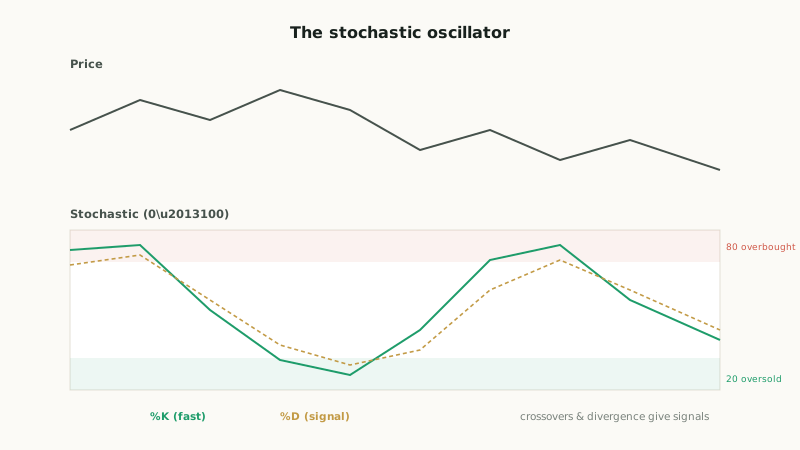
The stochastic oscillator is built on the relationship between the closing price and the high-low range over a chosen lookback period (commonly 14 periods). Its core line, %K, measures where the current close sits within that recent range: it is calculated as the close minus the period's lowest low, divided by the period's range (highest high minus lowest low), expressed as a percentage from 0 to 100. A %K near 100 means price is closing near the top of its recent range (strong upward momentum); a %K near 0 means it is closing near the bottom (strong downward momentum). This directly captures Lane's insight that closing position within the range reveals momentum.
The second line, %D, is a moving average of %K (typically a 3-period average), acting as a slower signal line that smooths %K's movements. The two lines together — the faster %K and the slower %D — generate the oscillator's signals through their crossovers and their positions. Because it is bounded between 0 and 100, the stochastic is a bounded oscillator like the RSI, with the scale's extremes defining overbought and oversold conditions. There are also "fast" and "slow" versions: the fast stochastic is more responsive (and noisier), while the slow stochastic applies additional smoothing for steadier, less jumpy signals — most traders prefer the slow version to reduce false signals. Understanding the construction — %K measuring close-within-range, %D smoothing it — is the foundation for interpreting the indicator.
Reading the signals
The stochastic generates several types of signal. The most basic are the overbought and oversold readings: a stochastic above 80 is considered overbought (price closing high in its range, possibly overextended), and below 20 oversold (price closing low, possibly oversold). These zones suggest momentum may be stretched and a reversal or pause could follow — though, crucially, an overbought reading is not an automatic sell signal (more on this trap below).
Crossovers between %K and %D provide more actionable signals: when the faster %K crosses above the slower %D, it suggests strengthening upward momentum (a potential buy signal), and when %K crosses below %D, weakening momentum (a potential sell signal). Crossovers occurring in the overbought or oversold zones are often considered more significant — for example, a %K crossing below %D from above the 80 level is a classic bearish signal. The third and often most valued signal is divergence: when price makes a new high but the stochastic makes a lower high (bearish divergence), or price makes a new low but the stochastic makes a higher low (bullish divergence), it signals weakening momentum that may precede a reversal — exactly the divergence concept that applies across oscillators like the RSI and MACD. Divergence is widely regarded as one of the stochastic's more reliable uses, flagging momentum shifts before price confirms them. As always, these signals are strongest when combined with other analysis rather than taken in isolation.
Stochastic versus RSI
The stochastic oscillator is frequently compared to the RSI, and understanding their relationship helps in using either. Both are bounded momentum oscillators on a 0-100 scale with overbought and oversold zones, both generate divergence signals, and both aim to measure momentum and identify potential reversals — so they share a family resemblance and a common purpose. The key difference lies in their calculation: the RSI is based on the ratio of average gains to average losses over the period, while the stochastic compares the close to the recent high-low range. They measure momentum through different lenses.
In practice, this gives them slightly different characters. The stochastic is often considered more sensitive and faster-moving than the RSI, generating more signals (and more potential false signals), which makes it popular for identifying shorter-term turning points and particularly favoured in ranging markets where its overbought/oversold swings align well with price oscillating between levels. The RSI is sometimes seen as a bit smoother and is widely used for both trend and range contexts. Neither is inherently better; they are different tools measuring the same underlying thing (momentum) in different ways. Some traders use one or the other by preference; some use both for confluence (a signal confirmed by both carrying more weight). The practical point is that the stochastic and RSI are complementary momentum oscillators, and understanding the stochastic's close-vs-range basis distinguishes it from the RSI's gain/loss-ratio basis, even as they serve similar analytical roles.
The stochastic's logic is intuitive: closing near the top of the range means buyers are in control (high reading), closing near the bottom means sellers are (low reading). But the same fact that makes it useful in ranges makes it a trap in trends — a strong trend keeps closing near its extreme, pinning the stochastic in overbought or oversold for a long time.
The trap in trends
The stochastic shares the defining limitation of every overbought/oversold oscillator: it can mislead badly in strong trends. In a powerful uptrend, price keeps closing near the top of its range day after day, which keeps the stochastic pinned in overbought territory (above 80) for extended periods — and a trader who naively sells every overbought reading, expecting a reversal, will fight the trend repeatedly and lose. The same applies in downtrends, where the stochastic can remain oversold while price grinds lower. This is the identical trap that catches RSI users, and it is the single most important caveat for the stochastic: overbought does not mean sell, and oversold does not mean buy, especially in a trending market.
The resolution is the same as for all oscillators: context and combination. The stochastic's overbought/oversold signals work best in ranging markets, where price genuinely oscillates between levels and extremes do tend to mark turning points — which is why the stochastic is favoured for range trading. In trending markets, the overbought/oversold readings should not be traded as reversal signals against the trend; instead, the indicator is better used to time entries in the direction of the trend (for example, buying when the stochastic dips to oversold during an uptrend, a pullback entry), or its signals should be filtered by trend context. This is precisely why a trend-strength tool like the ADX pairs so well with oscillators — it tells you whether you are in the ranging conditions where overbought/oversold signals are reliable, or the trending conditions where they are traps. As with every indicator on this site, the stochastic is a useful tool, not a magic signal generator: it must be understood (close-vs-range momentum), read for its signals (zones, crossovers, divergence), and — above all — applied with awareness of market context and in combination with other analysis, never as a standalone buy/sell machine.
Settings and practical use
The stochastic's standard settings are often written as something like 14, 3, 3 — a 14-period lookback for %K, a 3-period smoothing of %K, and a 3-period %D signal line — which produce the common "slow stochastic" most traders use. The fast stochastic uses less smoothing and is more responsive but noisier; the slow stochastic applies the extra smoothing for steadier, more reliable signals, which is why it is generally preferred. A shorter lookback makes the indicator more sensitive (more signals, more noise); a longer one makes it smoother and slower. As with all indicator settings, the defaults are a reasonable starting point rather than sacred numbers, and the right choice depends on your timeframe and how responsive you want the readings to be — but resist the temptation to endlessly tweak settings in search of a perfect configuration, which usually amounts to curve-fitting.
In practical use, the stochastic works best as one input among several rather than a standalone trigger. A productive workflow is to first establish the market regime (trending or ranging, using something like the ADX) and the trend direction, then use the stochastic within that context: in a range, trade its overbought/oversold reversals between the levels; in a trend, use oversold dips (in an uptrend) or overbought bounces (in a downtrend) to time entries in the trend's direction, rather than fighting the trend. Combining the stochastic's momentum read with support and resistance levels, trend context, and confirmation from price action turns it from a noisy signal generator into a useful timing tool.
Divergence deserves particular attention as the stochastic's higher-quality signal: a bearish divergence (price higher high, stochastic lower high) or bullish divergence (price lower low, stochastic higher low) flags weakening momentum that often precedes a turn, and is more reliable than raw overbought/oversold readings — especially when it occurs at a significant support or resistance level. Used this way — sensible settings, applied within trend and level context, with divergence as a key signal — the stochastic earns its place as a momentum tool, while always being combined with other analysis rather than trusted alone.
The stochastic oscillator measures momentum by comparing the close to the recent high-low range, on a 0-100 scale: %K is the main line, %D its smoothed signal (common settings 14,3,3; the smoother "slow" version is preferred). Signals come from overbought (above 80) and oversold (below 20) zones, %K/%D crossovers, and divergence (the higher-quality signal). Like the RSI, it shares the oscillator trap: in strong trends it stays pinned overbought or oversold, so those aren't reversal signals. It works best in ranging markets and for timing trend-direction entries — use it with trend context (e.g. ADX), at key levels, and with other analysis, never alone.