
Doubling your bet after every loss feels like a system that can't lose — you'll always win it back eventually, plus a profit. This is the martingale, and it's the most seductive route to ruin in all of trading. It works beautifully... right up until the losing streak that always eventually comes, which destroys you completely. Its opposite, anti-martingale, is far less exciting and far more sensible — indeed, it's simply sound risk management in another name. This guide explains both: why martingale is so tempting and so dangerous, why anti-martingale aligns with sound trading, and the one lesson that underlies it all — never increase risk to chase losses.
It's a direct illustration of risk of ruin and the dangers of overleverage, and a caution relevant to grid trading (which can carry martingale-like risks).
Key takeaways
Q: What is the martingale strategy?
A: Martingale is a position-sizing system where you increase — typically double — your position after each loss, aiming to recover all prior losses plus a profit with the next win. It originated as a casino betting system. In trading, it means doubling the next trade's size after a loss, or adding ever-larger amounts to a losing position.
Q: Why is martingale dangerous?
A: Because the rare but inevitable losing streak is catastrophic. Doubling after each loss makes position sizes grow exponentially, so a string of losses requires enormous bets — until you run out of capital or hit limits and suffer a massive loss that wipes out all prior small gains and more. Martingale trades many small wins for occasional total ruin.
Q: What is anti-martingale?
A: Anti-martingale is the opposite and far sounder approach: increase position size when winning and decrease it when losing. It aligns with good risk management — you risk more when things are going well (compounding) and less in a drawdown (preserving capital). Most sound percentage-based position sizing is inherently anti-martingale.
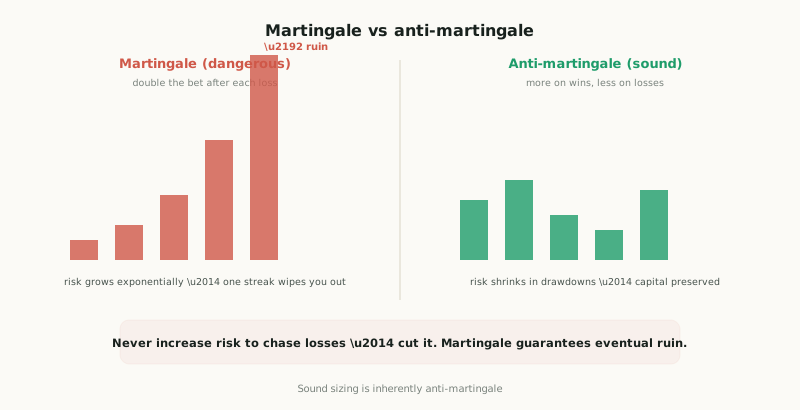
Martingale: the seductive trap
The martingale is a position-sizing (or betting) system in which you increase — typically double — your position after each loss, aiming to recover all your accumulated losses plus a profit with the next win. It originated as a casino betting system: bet on red/black at roulette, and after each loss, double your bet — so that whenever you finally win, you recoup everything lost plus your original stake. In trading, it takes forms like doubling the next trade's size after a loss, or adding ever-larger amounts to a losing position (averaging down aggressively) so that a modest recovery recoups the whole loss.
Its seduction is powerful and worth understanding, because it traps intelligent people. Martingale "works" most of the time: since a win eventually comes, and that win (on a doubled stake) recoups all prior losses plus a profit, you usually do recover — the system shows a very high win rate, churning out small, consistent gains. Trade after trade, week after week, it can look like a money machine that simply can't lose, lulling the trader into confidence (and often into increasing the stakes). The equity curve rises steadily and reliably... which is exactly what makes it so dangerous. The steady stream of small wins masks a hidden, building catastrophe — a textbook case of the fat-tailed "picking up pennies in front of a steamroller" the tail-risk guide warns about.
Why it leads to ruin
The fatal flaw is the rare losing streak — and in markets, losing streaks are inevitable. Because martingale doubles the position after each loss, position sizes grow exponentially during a losing run: 1, 2, 4, 8, 16, 32, 64... A streak of just a handful of consecutive losses requires an enormous bet to continue the doubling, and a streak of several more would require a bet larger than any account could hold. So when a losing streak comes — and over a long enough horizon it will, because markets trend (a series of losses for a counter-trend martingale), shocks happen, and tail events strike — the martingale trader either runs out of capital or hits position limits mid-streak, suffering a massive, often account-destroying loss that wipes out all the small prior gains and far more. The arithmetic is merciless: martingale trades many small wins for the occasional total ruin. The accumulated pennies are obliterated by the steamroller, and then some.
This is why martingale is not a clever edge but a guaranteed path to ruin over a long enough horizon: the streak that destroys you is not a possibility to be managed but a certainty to be eventually encountered, and martingale ensures that when it arrives, it's catastrophic. No win rate, however high, compensates for a single loss that wipes out the account — and martingale's structure guarantees that single loss will come. It connects directly to risk of ruin (martingale maximises it) and to overleverage (the escalating bets are effectively explosive leverage). It's also worth noting that grid trading and aggressive averaging down (adding to losers) carry martingale-like risks: any approach that increases exposure as a position moves against you is on the same dangerous spectrum, accumulating risk precisely when it should be cutting it. The verdict is unambiguous: avoid martingale and its relatives. The seduction is real, but so is the ruin.
Anti-martingale: the sound opposite
The anti-martingale is the exact opposite — and it's the sound principle: increase your position size when you're winning, and decrease it when you're losing. Where martingale bets more after losses and less after wins, anti-martingale does the reverse: it presses winners (risking more when things are going well, often with "house money" from profits) and cuts back in drawdowns (risking less when losing, preserving capital). This aligns perfectly with sound risk management's core aim of capital preservation: you scale up risk when your edge appears to be working and conditions are favourable, and you scale down when you're in a losing run — protecting your capital exactly when it's most threatened, rather than escalating into the danger as martingale does. The table makes the contrast plain.
Martingale vs anti-martingale
| Aspect | Martingale | Anti-martingale |
|---|---|---|
| After a loss | Increase (double) size | Decrease size |
| After a win | Decrease size | Increase size |
| In a drawdown | Risk explodes | Risk shrinks |
| Outcome | Eventual ruin | Capital preserved |
Crucially, most sound position sizing is inherently anti-martingale. Risking a fixed percentage of equity per trade (the standard approach from the position-sizing guide) automatically means you bet more in absolute terms as your equity grows from wins (compounding), and less as it shrinks from losses (cutting risk in a drawdown) — anti-martingale by design. Pyramiding into a winning trend (adding to winners, the constructive form of scaling in) is an anti-martingale tactic. So the sound trader is, knowingly or not, practising anti-martingale: pressing what works, easing off what doesn't, always with capital preservation foremost.
The lesson that underlies it all, and the one to carry away, is simple and absolute: never increase your risk to "recover" losses — cut your risk when losing, not increase it. The urge to "win it back" by betting bigger after a loss is the martingale instinct, and it's also the psychology of revenge trading (chasing losses emotionally) — a classic, well-documented route to blowing up an account. Sound risk management does the opposite: in a losing streak, you reduce size, step back, and protect capital, never doubling down to chase. The honest, risk-first framing: martingale (and averaging aggressively into losers) is a seductive but guaranteed path to ruin — the rare, inevitable streak destroys you — so avoid it. Anti-martingale (more on wins, less on losses) aligns with sound capital preservation and is what good position sizing does naturally. Whenever you feel the pull to increase risk to recover a loss, recognise it as the martingale trap and the revenge-trading instinct, and do the opposite: cut risk, preserve capital, and live to trade another day. In risk management, surviving losing streaks — not chasing them — is everything.
Spotting disguised martingale
Martingale is dangerous partly because it often appears in disguise — dressed up so it doesn't look like the crude "double after every loss" casino system, which lets it trap traders who would never knowingly use martingale. The most common disguise is aggressive averaging down: adding more to a losing position as it falls (lowering your average entry), then adding still more if it falls further. It feels reasonable — "I liked it at 100, I love it at 90" — but if the position sizes escalate as the loss grows, it's martingale by another name: increasing exposure precisely as the trade moves against you, with the same exponential-risk, ruin-on-a-trend outcome. Adding to losers is one of the classic account-killers, and it's martingale wearing a respectable coat.
Other disguises abound. Grid systems that place ever-larger orders against a losing direction carry martingale-like risk (the grid-trading guide notes this). Automated "no-loss" or "recovery" expert advisors (EAs) frequently work by martingale or grid-martingale under the hood — they show a long, seductive run of small wins and a smooth equity curve, then one day give back everything and the account in a single streak; the smooth curve is the warning sign, not the reassurance. Even a discretionary trader can drift into martingale by revenge trading — increasing size after a loss to "win it back" — without ever calling it a system. How to spot the disguise: ask whether the approach increases exposure as a position or account moves against it, and whether it relies on the losing streak never reaching a certain length. If position size grows after losses, or the strategy can only fail catastrophically (many small wins, rare huge loss), it's on the martingale spectrum — however it's marketed. The defence is the same simple rule: never increase risk to recover losses; cut it. A smooth equity curve built on quietly escalating risk is not safety — it's the calm before the steamroller. Recognising disguised martingale for what it is, and refusing it in all its forms, is a core piece of survival.
Martingale means increasing — typically doubling — your position after each loss to recover it with the next win. It's seductive because it "works" most of the time (a high win rate, steady small gains), but it's a guaranteed path to ruin: doubling makes risk grow exponentially, so the inevitable losing streak forces enormous bets until you run out of capital and suffer a catastrophic, account-wiping loss — trading many small wins for eventual total ruin ("pennies in front of a steamroller"). Aggressive averaging down and some grid trading carry the same risk. Anti-martingale is the sound opposite: increase size on wins, decrease on losses — preserving capital in drawdowns. Most sound percentage-of-equity sizing is inherently anti-martingale. The absolute rule: never increase risk to chase losses (that's also revenge trading) — cut risk when losing. Survive streaks; don't chase them.