
Central banks are the most powerful players in the currency market. They set the interest rates that drive global capital flows, they steer the monetary conditions of entire economies, and when they speak, the forex market listens to every word. No scheduled events move currencies as forcefully as central bank decisions and communications, which is why understanding these institutions — their tools, their goals, and the language they use — is central to forex fundamental analysis. This guide explains who the major central banks are, how they conduct monetary policy, what "hawkish" and "dovish" mean, and why traders parse their statements so obsessively.
Central banks are the institutions that set the interest rates that dominate forex, making them the key actors in fundamental analysis.
Key takeaways
Q: How do central banks affect forex?
A: Central banks set interest rates and conduct monetary policy to manage inflation and growth. Because interest rates are the dominant currency driver, central bank decisions and communications are the most powerful scheduled events in forex, moving currencies sharply as they shift rate expectations.
Q: What does hawkish and dovish mean?
A: Hawkish describes a central bank inclined to raise interest rates or tighten policy, usually to fight inflation, which tends to strengthen its currency. Dovish describes a bank inclined to cut rates or ease policy to support growth, which tends to weaken its currency.
Q: What are the major central banks in forex?
A: The most important include the US Federal Reserve (Fed), the European Central Bank (ECB), the Bank of England (BoE), the Bank of Japan (BoJ), and others such as the Reserve Bank of Australia, Bank of Canada, Swiss National Bank and Reserve Bank of New Zealand.
What central banks do
A central bank is the institution responsible for a country's (or region's) monetary policy — managing the supply of money and the level of interest rates to achieve economic goals. Those goals are typically some combination of controlling inflation (keeping price rises stable and moderate, often around a 2% target) and supporting economic growth and employment. Different central banks have different precise mandates — some focus almost solely on price stability, others balance inflation against employment — but the broad task is the same: to keep the economy on an even keel through the levers of monetary policy.
This role makes central banks extraordinarily influential in forex, because their primary lever — the interest rate — is the dominant currency driver. When a central bank adjusts rates or signals its intentions, it is effectively moving the single most important factor for its currency. The central bank does not target the exchange rate directly (most major ones let their currencies float freely), but its decisions about rates and policy have powerful currency effects as a consequence. Traders watch central banks not because the banks are trying to move currencies, but because their economic decisions inevitably do.
The major central banks
A handful of central banks dominate forex, corresponding to the major currencies:
- The Federal Reserve (Fed) — the US central bank, the most influential of all given the dollar's central role in global finance.
- The European Central Bank (ECB) — sets policy for the eurozone.
- The Bank of England (BoE) — the UK's central bank, behind the pound.
- The Bank of Japan (BoJ) — long associated with very low rates, behind the yen.
- Others including the Reserve Bank of Australia (RBA), Bank of Canada (BoC), Swiss National Bank (SNB) and Reserve Bank of New Zealand (RBNZ), behind their respective currencies.
The Fed deserves special attention because of the US dollar's role as the world's primary reserve currency: Fed decisions ripple through virtually every currency pair, not just those involving the dollar directly, and shape global risk sentiment broadly. For any pair you trade, you are effectively watching two of these central banks and the relative direction of their policies — the rate-differential logic from the interest rates guide applied to the institutions that actually set the rates.
The tools of policy
Central banks have several tools, but the most important by far is the policy interest rate — the benchmark rate they set, which influences borrowing costs throughout the economy. Raising this rate (to cool an overheating economy or fight inflation) tends to strengthen the currency; cutting it (to stimulate a weak economy) tends to weaken it. Rate decisions, usually made at scheduled meetings, are the headline events traders watch.
Beyond rates, central banks use quantitative easing (QE) and tightening (QT) — buying assets to inject money and lower longer-term rates (easing, generally currency-negative) or reversing the process (tightening, generally currency-positive). They also use forward guidance: explicitly communicating their likely future policy to shape market expectations, which, given how much currencies move on expectations, is a powerful tool in itself. A central bank can move its currency simply by changing the tone of its guidance, without touching rates at all. These tools together let central banks manage not just current conditions but the market's expectations of the future — and since expectations drive currencies, managing expectations is half the job.
Hawkish and dovish
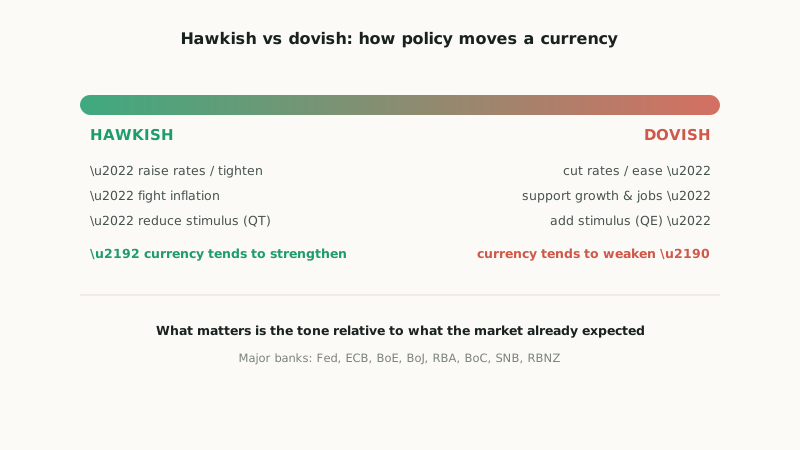
Two words dominate the language of central bank watching: hawkish and dovish. A hawkish stance is one inclined toward tighter policy — raising rates, reducing stimulus — typically to combat inflation. Because tighter policy means higher rates and yields, a hawkish central bank tends to strengthen its currency. A dovish stance is the opposite: inclined toward looser policy — cutting rates, adding stimulus — to support growth and employment, which tends to weaken the currency. The terms describe the bank's leaning along a spectrum from tight (hawkish) to loose (dovish).
Traders assess central bank communications precisely to gauge where on this spectrum the bank sits and, crucially, whether it is becoming more hawkish or dovish than expected. A central bank that sounds more hawkish than the market anticipated will often strengthen its currency even without changing rates, because it shifts expectations toward higher future rates; a surprisingly dovish tone weakens it. This is why every word of a central bank's statement, and every nuance in the tone of its leader's press conference, is scrutinised — traders are reading the hawkish-dovish balance relative to what was already expected, which is what actually moves the currency.
A central bank moves its currency through expectations as much as through actions. It can strengthen its currency by merely sounding more hawkish than the market expected — no rate change required — because traders immediately reprice the expected future path of rates. This is why tone matters as much as decisions.
Trading around central banks
Central bank events — rate decisions, policy meetings, the accompanying statements and press conferences, and speeches by central bank officials — are the highest-impact scheduled events in forex, regularly producing sharp, sudden moves. For the trader, this carries both opportunity and danger. The opportunity lies in the strong, fundamentally-driven trends that shifts in central bank policy can set in motion. The danger lies in the extreme, unpredictable volatility around the events themselves, when prices can whipsaw violently as the market digests the news and the tone.
Many traders therefore treat the immediate aftermath of major central bank announcements with great caution — the spreads widen, the moves are erratic, and being on the wrong side of a sudden spike is costly. A common, more disciplined approach is to let the initial volatility settle and then trade the clearer trend that emerges as the market settles on its interpretation. However you approach them, central bank events demand respect: they are when the dominant force in forex — interest rate policy — is actively set and signalled, and they reward traders who understand the hawkish-dovish framework and the all-important role of expectations. Keeping an eye on the scheduled meetings of the central banks behind your pairs is simply essential fundamental hygiene.
Intervention and managed currencies
So far we have assumed currencies float freely, with central banks influencing them only indirectly through interest rate policy. But some central banks act on their currencies more directly, and traders need to be aware of this. Currency intervention occurs when a central bank buys or sells its own currency in the market to influence its value — selling its currency to weaken it (often to support exporters) or buying it to prop it up (often to fight imported inflation or defend against a collapse). Intervention, or even the credible threat of it, can move a currency sharply and abruptly, sometimes against what the fundamentals would otherwise suggest.
More structurally, some currencies are pegged or managed rather than fully floating. A peg fixes a currency's value to another currency (or a basket), with the central bank committed to defending that level by buying or selling as needed; a managed float allows movement within limits the central bank polices. These arrangements change how a currency behaves entirely — a pegged currency may barely move until the peg comes under pressure, at which point it can break violently. A famous historical illustration of the power of these dynamics was the Swiss National Bank's period of capping the franc against the euro, and the dramatic move when that cap was abruptly abandoned — a reminder that managed-currency regimes can produce sudden, outsized moves when policy shifts.
For the trader, the practical points are to know whether a currency you trade is freely floating, managed, or pegged, and to be aware that central banks willing to intervene add a layer of unpredictability — a fundamentally "cheap" or "expensive" currency may be that way by deliberate policy, and betting against a determined central bank can be dangerous. Most major pairs (the ones beginners trade) involve freely-floating currencies where the indirect, interest-rate channel dominates, but awareness of intervention and pegs is important context, especially when straying toward less liquid or emerging-market currencies.
Central banks set interest rates and monetary policy to manage inflation and growth, making them the most powerful players in forex. Their main tool is the policy rate (raising strengthens, cutting weakens), supported by QE/QT and forward guidance. Hawkish (tightening) strengthens a currency, dovish (easing) weakens it — and tone versus expectations moves the market as much as decisions. Some banks also intervene directly or peg their currencies, which can cause sudden outsized moves. Their meetings are the highest-impact, most volatile events; trade them with caution.