
The economic calendar is the forex trader's diary of scheduled storms. At known dates and times, governments and agencies release data on inflation, employment, growth and more — and each release can shift the market's expectations of central bank policy and move currencies, sometimes violently. Knowing which indicators matter, what each one signals, and how the market actually reacts to them is essential fundamental knowledge. The single most important secret, which trips up nearly every newcomer, is this: markets move not on the data itself but on the surprise — the gap between the actual figure and what was expected. This guide covers the key indicators and how to read them.
These releases are the inputs that shape the rate expectations driving the interest rates and central bank decisions at the heart of fundamental analysis.
Key takeaways
Q: What economic indicators matter most for forex?
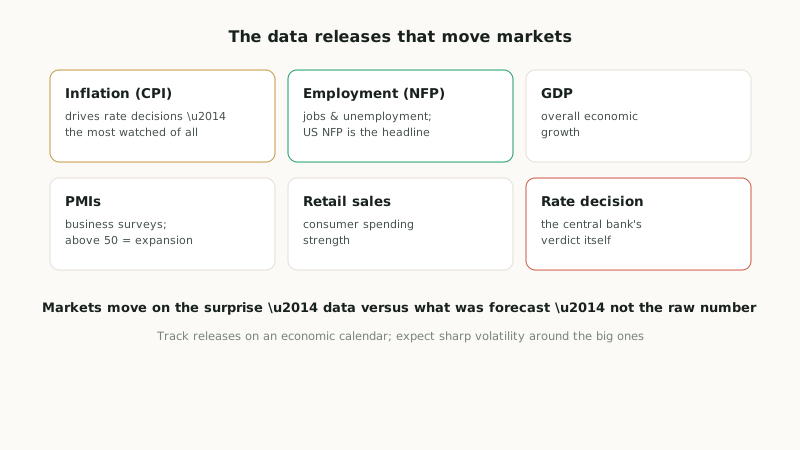
A: The most important are inflation (CPI), because it drives rate decisions; employment data such as the US Non-Farm Payrolls; GDP growth; business surveys (PMIs); retail sales; and central bank rate decisions themselves. These shape expectations of monetary policy and move currencies.
Q: Why do currencies move on the surprise, not the number?
A: Because markets price in expectations ahead of a release. The forecast is already reflected in the price, so what moves the currency is the difference between the actual figure and what was expected. A good number can even weaken a currency if the market expected better.
Q: What is an economic calendar?
A: An economic calendar lists scheduled economic data releases and events, with their dates, times, the previous figures, and market forecasts. Traders use it to anticipate volatility and to compare the actual results against expectations when the data is released.
It is the surprise that moves the market
Before listing the indicators, the governing principle must be understood, because it explains everything about how the data trades. Markets are forward-looking and price in expectations ahead of every scheduled release. Economists publish forecasts, traders position accordingly, and by the time the data is released, the expected outcome is already reflected in the price. As a result, what actually moves the currency is the deviation from the forecast — the surprise — not the raw number.
This is why a seemingly strong economic figure can cause a currency to fall: if the market had expected an even stronger number, the merely-good result is a disappointment relative to expectations, and the currency sells off. Conversely, a "bad" number that is less bad than feared can rally a currency. The actual figure matters only in relation to the forecast: a result above expectations is typically currency-positive (especially for growth and inflation data that supports higher rates), while a result below expectations is typically currency-negative. Internalising this — that you trade the surprise, not the number — is the key to making sense of how currencies react to data, and it is the most common source of confusion for those new to fundamental trading.
Inflation (CPI)
Of all the indicators, inflation data — most prominently the Consumer Price Index (CPI) — is often the most important, because it most directly drives central bank rate decisions. Since central banks adjust rates largely to keep inflation under control, an inflation reading is effectively a clue about what the central bank will do next: higher-than-expected inflation raises the prospect of rate hikes (or fewer cuts), which tends to strengthen the currency, while lower-than-expected inflation points toward easier policy and tends to weaken it.
This tight link between inflation and rate expectations makes CPI releases among the most market-moving events on the calendar, frequently producing sharp currency moves. Traders watch not just the headline figure but the underlying trend and the "core" measure (which strips out volatile food and energy prices) for a cleaner read on the inflation picture. Because inflation is the variable central banks care about most, and rates are what move currencies most, inflation data sits at the very centre of fundamental forex trading — a single release that can reshape the entire expected path of policy.
Employment (Non-Farm Payrolls)
Employment data is the other heavyweight, and in the US the monthly Non-Farm Payrolls (NFP) report is perhaps the single most watched release in all of forex. Employment matters because a strong labour market signals a healthy economy, supports consumer spending, and can contribute to inflation — all of which feed into rate expectations. Strong jobs data (more jobs created than expected, falling unemployment) generally supports the currency, while weak data tends to weaken it, through the now-familiar channel of what it implies for central bank policy.
NFP in particular is famous for the volatility it generates: released monthly, it routinely produces large, fast moves in the dollar and dollar pairs as the market digests the surprise against forecasts. The report includes several components — the headline jobs number, the unemployment rate, and wage growth (which links back to inflation) — and the market weighs all of them. Other countries have their own key employment releases, watched for the same reasons. Employment data, like inflation, matters chiefly for what it tells traders about the likely direction of monetary policy.
Growth, surveys and the rest
Several other indicators round out the picture. GDP (Gross Domestic Product) is the broadest measure of economic growth; strong growth supports a currency, weak or negative growth weakens it, though GDP is released less frequently and is somewhat backward-looking. PMIs (Purchasing Managers' Indexes) are timely business surveys of activity in manufacturing and services — a reading above 50 indicates expansion, below 50 contraction — and they are valued as forward-looking signals of where the economy is heading. Retail sales gauge consumer spending, a major component of most economies.
Beyond these, traders watch trade balances, consumer and business confidence surveys, housing data and more, each offering a piece of the economic picture. And of course the central bank rate decisions themselves — covered in the central banks guide — are the highest-impact scheduled events of all. No single indicator should be read in isolation; fundamental analysis builds a picture from the pattern across many releases, all interpreted through their implications for monetary policy and all judged against expectations. The skill is in synthesising the flow of data into a coherent view of an economy's direction relative to another's.
Almost every indicator matters for the same reason: what it implies about the central bank's next move. Inflation, jobs, growth and surveys are not ends in themselves — they are clues to future interest rates, which is the channel through which they move the currency. Read every release by asking: what does this mean for rates?
Trading the calendar
For the practical trader, the economic calendar is an essential tool — a schedule of upcoming releases with their dates, times, previous values and, crucially, the market forecasts against which the actual figures will be judged. The first discipline is simply awareness: knowing when high-impact data (inflation, employment, central bank decisions) is due for the currencies you trade, so you are never blindsided by a scheduled storm. Being caught in an open position when a major release hits, without realising it was coming, is an avoidable mistake.
Around the releases themselves, the same caution as with central bank events applies: volatility spikes, spreads widen, and prices can whipsaw sharply before settling. Many traders avoid holding positions through major releases, or avoid trading in the immediate, chaotic aftermath, preferring to let the dust settle and then trade the clearer move that emerges. Others use the calendar mainly as a risk-management tool — knowing when not to be exposed. However you use it, the economic calendar, combined with an understanding that the market trades the surprise and that every indicator ultimately points back to interest rate expectations, is fundamental to navigating the news-driven side of forex.
Reading the data in context
A common beginner error is treating each release as a standalone verdict — one strong number, buy; one weak number, sell. In reality, skilled fundamental reading is about context and pattern, and a few principles sharpen it. First, no single release is usually decisive. Fundamental pictures are built from the trend across many data points over time; one month's figure, especially a volatile one, can be noise. A single strong jobs report means little if the broader trend is weakening, and vice versa. The market weighs the accumulating pattern, not isolated prints.
Second, beware revisions. Many indicators are revised in later releases as more complete data arrives, and a strong initial figure that is later revised sharply down (or a weak one revised up) changes the picture. The headline reaction to the first print can reverse as revisions and subsequent data reframe it. Third, the initial market reaction to a release can fade or reverse within hours as traders digest the details beneath the headline — a knee-jerk move on the headline number often gives way to a more considered move once the components and implications are absorbed.
Fourth, and most importantly, every figure must be read relative to the other economy in the pair. Strong US data is only bullish for the dollar in a given pair if it is strong relative to the other currency's economy — and relative to what was expected for both. The whole exercise is comparative: you are constantly asking not "is this economy doing well?" but "is this economy doing better, relative to expectations, than the one it is paired against?" Reading data in this contextual, comparative, pattern-aware way — rather than reacting to each number in isolation — is what separates genuine fundamental analysis from headline-chasing.
Key indicators: inflation (CPI, the most important as it drives rates), employment (US Non-Farm Payrolls is the headline), GDP, PMIs (forward-looking, above 50 = expansion), retail sales, and central bank decisions. Markets move on the surprise — actual versus forecast — not the raw number. Read data in context: no single release is decisive, beware revisions, initial reactions can fade, and always judge a figure relative to the other economy in the pair. Use an economic calendar and trade the volatility with caution.