
Behind every currency stands an economy, and behind every exchange rate is, ultimately, a judgement about the relative health of two economies. Fundamental analysis is the discipline of reading that judgement — of looking beneath the price chart to the economic forces that drive a currency's value. Where technical analysis studies the price itself, fundamental analysis asks why a currency should strengthen or weaken, based on interest rates, inflation, growth, employment and the broader economic picture. This guide introduces the fundamental approach: what it is, the key forces that move currencies, and how it fits alongside the technical methods that make up most of this site.
This is the second great lens on the market introduced in what is forex trading — the complement to the technical analysis that runs through the rest of this site.
Key takeaways
Q: What is fundamental analysis in forex?
A: Fundamental analysis evaluates a currency's value based on the underlying economic, financial and political factors of its country, such as interest rates, inflation, growth and employment. Its premise is that an exchange rate ultimately reflects the relative health and outlook of the two economies behind the pair.
Q: What drives currency value in fundamental analysis?
A: The main drivers are interest rates (the most powerful), inflation, economic growth, employment, the trade balance, political stability and market risk sentiment. These forces shape the supply of and demand for a currency, which determines its value relative to others.
Q: Is fundamental or technical analysis better for forex?
A: Neither is universally better; they are complementary. Fundamental analysis is strongest for understanding why currencies move and their longer-term direction, while technical analysis excels at timing entries and reading price behaviour. Many traders combine the two.
What fundamental analysis is
Fundamental analysis evaluates a currency by examining the underlying economic, financial and political condition of the country or region behind it. Its core premise is that a currency's value is, in the long run, a reflection of its economy's health and prospects: a strong, growing economy with sound finances and attractive returns tends to support a strong currency, while a weak or troubled economy tends to weaken its currency. The fundamental trader therefore studies the economy to form a view on where the currency should be headed.
A defining feature of forex fundamentals is that everything is relative. Because currencies trade in pairs, you are never assessing one economy in isolation — you are always comparing two. EUR/USD is a judgement about the eurozone economy relative to the US economy; the euro can rise against the dollar either because the eurozone is strengthening or because the US is weakening. This comparative nature runs through all of forex fundamental analysis: every factor that matters — rates, inflation, growth — matters in terms of the difference between the two economies in a pair, not the absolute level of either alone.
The key forces
Several economic forces drive currency values, and while they interconnect, each plays a distinct role:
- Interest rates — the single most powerful driver. Higher rates attract capital seeking yield, increasing demand for the currency; the rate differential between two countries is central to a pair's direction.
- Inflation — crucial because it shapes interest rate decisions. Rising inflation tends to push a central bank toward higher rates, which can support the currency.
- Economic growth (GDP) — a strong, growing economy attracts investment and supports its currency, while a contracting one tends to weaken it.
- Employment — a healthy labour market signals economic strength and influences rate expectations; key releases like US payrolls move markets sharply.
- Political stability and risk sentiment — stable, predictable economies attract capital, while uncertainty repels it; broader risk appetite drives flows toward "safe haven" or higher-yielding currencies.
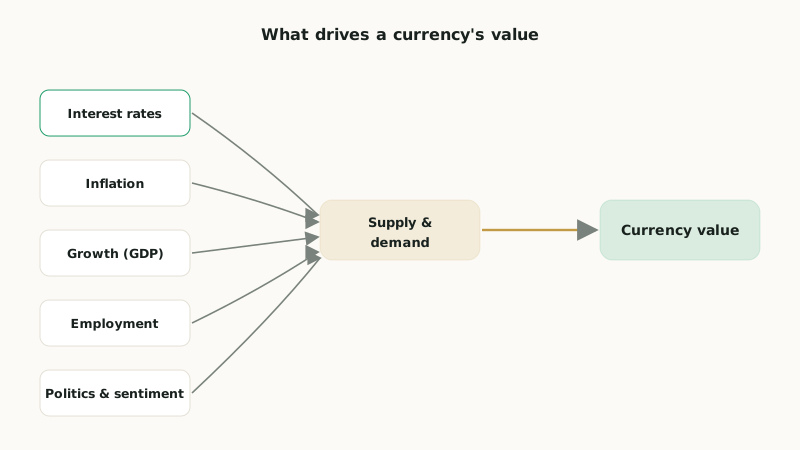
All of these ultimately operate through supply and demand: each force is, at bottom, a reason for participants to want to buy or sell a currency, and the exchange rate is the constantly-updating result of those collective decisions. The various detailed guides in this section examine the most important forces in turn — interest rates, the central banks that set them, and the economic indicators that shape expectations.
The central role of central banks
If one actor sits at the centre of forex fundamentals, it is the central bank. Central banks set interest rates and conduct monetary policy to manage their economies — chiefly to control inflation and support growth and employment — and because interest rates are the dominant currency driver, central bank decisions are the most powerful scheduled events in the forex market. Traders scrutinise not just the rate decisions themselves but every statement, speech and hint, parsing the tone for clues about future policy.
This is why so much fundamental analysis ultimately comes down to anticipating central bank behaviour. Inflation data matters largely because it influences what the central bank will do with rates; employment and growth data matter for the same reason. The whole web of economic indicators is, in a sense, a set of inputs that traders use to predict the central bank's next move — because that move, transmitted through interest rates, is what most powerfully drives the currency. Understanding central banks, covered in detail in central banks and monetary policy, is therefore close to the heart of forex fundamental analysis.
Most forex fundamentals reduce to one question: what will the central bank do with interest rates? Inflation, growth and employment data matter largely because they shape that decision — and the decision, working through rate differentials, is what most powerfully moves the currency.
It is all about expectations
A subtle but essential principle of fundamental analysis is that markets move on expectations, not just on facts. Currency prices already reflect what participants expect to happen — anticipated rate changes, forecast economic data — because traders position in advance. As a result, what moves the market when news arrives is usually the surprise: the difference between the actual outcome and what was expected. A rate hike that everyone anticipated may produce little reaction, because it was already priced in, while an unexpected hike (or even an unexpectedly hawkish tone alongside an expected decision) can move the currency sharply.
This "buy the rumour, sell the fact" dynamic frequently confuses newcomers, who see strong economic data released and are baffled when the currency falls. The explanation is almost always expectations: if the market had anticipated even stronger data, a merely-good number is a disappointment relative to what was priced in. Understanding that fundamental analysis is a game of actual versus expected, not of absolute numbers, is one of the most important insights in the discipline — and it is why economic releases are interpreted relative to their forecasts, as explored in the economic indicators guide.
Fundamental and technical together
Fundamental and technical analysis are often presented as rivals, but for most traders they are complementary, answering different questions. Fundamental analysis is strongest at explaining why currencies move and at forming a view on their longer-term direction — it tells you which currency has the stronger economic case. Technical analysis excels at the when and the how — reading price behaviour, identifying levels, and timing precise entries and exits. The two operate on different timescales and address different needs.
A common and powerful synthesis is to use fundamentals to determine direction and technicals to determine timing: form a fundamental view that, say, one currency should strengthen against another, then use technical analysis to find a well-timed, low-risk entry in that direction. The fundamentals give conviction about the destination; the technicals navigate the journey. Even traders who lean heavily on one approach benefit from awareness of the other — a technical trader who ignores a major central bank meeting can be blindsided, and a fundamental trader who ignores price levels can enter at terrible prices. The rest of this section builds out the fundamental side of that partnership, which the heavily technical remainder of the site complements.
The limits of fundamental analysis
For all its power, fundamental analysis has real limitations that every trader should understand. The most important is the timing problem: fundamentals can tell you that a currency should strengthen based on its economic case, but they say little about when. A currency can remain mispriced relative to its fundamentals for a very long time — markets can stay "irrational," or rather driven by other forces, far longer than a fundamentally-correct trader can comfortably wait. Being right about the destination is small comfort if the timing ruins you along the way, which is precisely why fundamentals alone make for difficult trading.
A second limitation is the sheer complexity and interconnection of the forces involved. Interest rates, inflation, growth, politics and sentiment all interact, sometimes pulling in opposite directions, and weighing them into a single clear view is genuinely hard. The same piece of data can be read as bullish or bearish depending on which factor the market chooses to focus on at that moment. Third, because the market trades on expectations, even a correct fundamental view can lose money if it was already priced in — you can be right about the economy and still be on the wrong side of the trade.
These limitations are not reasons to ignore fundamentals; they are reasons to use them appropriately. Fundamental analysis is best for forming a directional bias and understanding the forces at work, while technical analysis handles the timing that fundamentals cannot. The two together — fundamentals for the why and the direction, technicals for the when and the entry — address each other's weaknesses, which is why so many experienced traders refuse to rely on either alone.
Fundamental analysis reads the economic forces beneath the price — interest rates (the most powerful), inflation, growth, employment, and political and risk factors — all acting through supply and demand. Everything is relative: you compare the two economies in a pair. Central banks sit at the centre, and markets move on expectations (the surprise versus forecast), not raw numbers. Its weakness is timing — a currency can stay mispriced for ages — so pair fundamentals (direction) with technicals (timing).