
If a single force rules the currency market, it is interest rates. More than any other factor, rates determine where global capital flows, and capital flows determine currency values. The logic is as old as money itself: investors seek the best return on their money, and money moves toward where it is best rewarded. When one country offers higher interest rates than another, capital tends to flow toward it — and that flow strengthens its currency. This guide explains why interest rates dominate forex, how rate differentials move pairs, why expectations matter even more than current rates, and the distinction between real and nominal rates.
Interest rates are the most powerful of the forces introduced in fundamental analysis in forex, and they are set by the central banks covered in the next guide.
Key takeaways
Q: How do interest rates affect forex?
A: Higher interest rates tend to attract foreign capital seeking better returns, increasing demand for a currency and strengthening it. Lower rates tend to weaken a currency as capital seeks higher yields elsewhere. Interest rates are generally the most powerful single driver of currency value.
Q: What is an interest rate differential?
A: An interest rate differential is the difference between the interest rates of the two countries in a currency pair. It is more relevant than either rate alone, because forex is relative — capital flows toward the higher-yielding currency, so a widening differential tends to favour it.
Q: Why do currencies move before interest rates change?
A: Because markets price in expectations. Traders position in advance based on anticipated rate changes, so a currency often moves as expectations shift, well before the actual decision. The decision itself moves the market mainly to the extent it surprises against what was expected.
Why rates dominate
The reason interest rates are the most powerful currency driver comes down to the global search for yield. Capital is mobile and rational: large investors, institutions and funds constantly seek the best risk-adjusted returns for their money, and a country's interest rate is a direct measure of the return available on its currency (through its bonds, deposits and other interest-bearing instruments). When a country raises its rates, holding its currency becomes more rewarding, so capital flows in — and to invest in that country, foreign investors must buy its currency, increasing demand and pushing its value up.
The reverse is equally true: when a country cuts rates, the return on its currency falls, capital flows out toward higher-yielding alternatives, and the currency tends to weaken as it is sold. This relationship — higher rates tend to strengthen a currency, lower rates tend to weaken it — is the most reliable single principle in forex fundamentals. It is not absolute (other factors can override it, and the relationship works through expectations as we will see), but no other force moves currencies as consistently and powerfully as the pull of interest rates on global capital.
The rate differential
Because forex is always relative — every trade is a pair — what matters is not one country's interest rate in isolation but the differential between the two countries in the pair. A currency pair's behaviour is shaped by the gap between the two interest rates and, crucially, by how that gap is changing. If Country A offers 5% and Country B offers 1%, the 4% differential favours Country A's currency, drawing capital toward it.
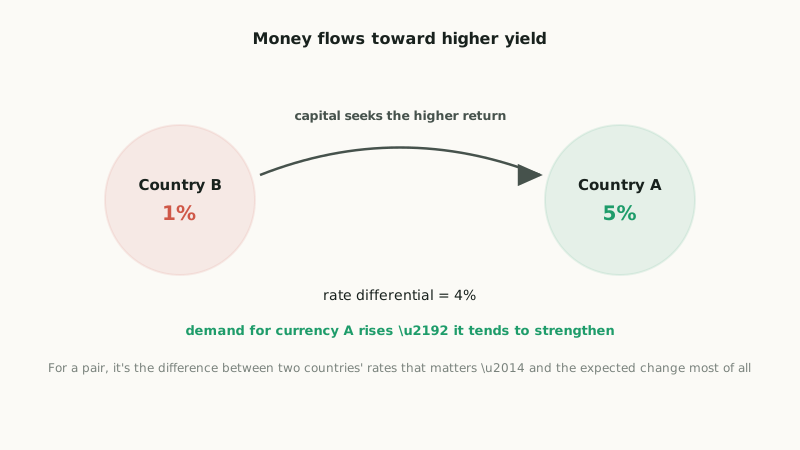
This is why a currency can strengthen even without its own central bank doing anything: if the other country in the pair cuts its rates, the differential widens in the first currency's favour, drawing capital toward it. Traders therefore watch the relative direction of monetary policy between two economies — which central bank is more inclined to raise rates and which to cut — because a widening differential tends to favour the higher-yielding currency, and a narrowing one works against it. The interest rate differential is also the entire basis of the carry trade, a strategy built on capturing the gap between a low-yield and a high-yield currency, covered in the carry trade explained.
Expectations matter most
The most important subtlety is that currencies respond more to expected rate changes than to current rates. Because markets are forward-looking, the current interest rate is already reflected in the price — it is old news. What moves a currency is a change in expectations about the future path of rates. If the market comes to expect a central bank to raise rates faster than previously thought, the currency tends to strengthen immediately, well before any actual hike, as traders position for the anticipated higher yield.
This forward-looking nature explains much of what otherwise puzzles newcomers. A central bank can raise rates and the currency can fall — because the hike was fully expected and already priced in, while the accompanying tone hinted at fewer hikes ahead than the market had assumed. The currency responds to the shift in the expected future path, not to the hike itself. This is why traders obsess over every nuance of central bank communication: they are constantly updating their expectations of the future rate path, and it is those expectations, more than current rates, that drive the currency. Interest rate analysis in forex is therefore really expectations analysis — anticipating where rates are heading relative to what is already priced in.
The current interest rate is already in the price — what moves a currency is a change in expectations about the future path of rates. This is why a currency can fall on a rate hike everyone expected, or rise on no rate change at all if the central bank merely sounds more hawkish than anticipated.
Real versus nominal rates
A more advanced but valuable distinction is between nominal and real interest rates. The nominal rate is the headline figure a central bank sets. The real rate is the nominal rate adjusted for inflation — roughly, the nominal rate minus the inflation rate — and it represents the true return an investor earns after the eroding effect of rising prices. A country with a 5% nominal rate but 4% inflation offers a real return of only about 1%, which is far less attractive than a country with a 3% nominal rate and 1% inflation, offering a 2% real return.
This matters because sophisticated capital cares about real returns, not just headline rates. A high nominal rate driven by runaway inflation may not attract capital and may even repel it, because the inflation erodes the real value of the returns and of the currency itself. This is part of why inflation is such an important fundamental factor in its own right — it determines how much of a nominal rate is "real" — and why high inflation can weaken a currency even alongside high nominal rates. For most everyday analysis the nominal rate and its expected path dominate, but understanding the real-rate concept explains cases where the simple "high rates = strong currency" rule appears to break down.
Trading with interest rates in mind
For the trader, the practical takeaways are clear. Keep track of the relative monetary policy stance of the two economies in any pair you trade — which central bank is leaning toward raising rates and which toward cutting — because the expected direction of the differential is a powerful guide to a pair's likely bias. Pay close attention to central bank communications and rate-related data (especially inflation), since these shift the rate expectations that move currencies. And remember the expectations principle: react to changes in the expected rate path, not to rate levels that are already priced in.
Interest rate analysis pairs naturally with technical analysis in the now-familiar way: a clear interest rate differential favouring one currency provides a fundamental directional bias, while technical analysis times the entries in that direction. A trader who understands that rates are the dominant force, that the differential and its expected change are what matter for a pair, and that expectations lead the actual decisions, holds the single most useful framework in forex fundamentals — the one that explains more currency movement than any other.
When the rate rule breaks down
The principle that higher rates strengthen a currency is the most reliable in forex fundamentals, but it is not absolute, and understanding when it breaks down deepens the picture. The clearest exception involves the real-rate problem already noted: when high nominal rates are driven by runaway inflation, the currency can weaken rather than strengthen, because the inflation erodes the real value of those returns and signals an economy in trouble. A country forced to hike rates aggressively to defend a collapsing currency is not attractive to capital despite its high rates — the high rates are a symptom of distress, not strength.
A second override is risk sentiment. In times of global fear ("risk-off"), capital flees toward safe-haven currencies regardless of their interest rates — the Japanese yen and Swiss franc have historically strengthened during crises despite offering very low yields, simply because investors prioritise safety over return. In such periods, the safe-haven flow can completely overwhelm the normal pull of rate differentials, and a low-yield safe haven can surge while a high-yield currency collapses. This is exactly the dynamic behind carry-trade unwinds.
A third consideration applies to emerging-market currencies, which often carry high interest rates precisely to compensate investors for higher risk — political instability, weaker institutions, currency volatility. The high yield is not a free lunch; it is a risk premium, and these currencies can depreciate sharply, overwhelming the rate advantage. The lesson is not that interest rates fail to matter — they remain the dominant driver most of the time — but that they operate within a broader context of real returns, risk sentiment and economic health. The disciplined fundamental trader watches rates first, but never in isolation from inflation and the prevailing risk environment.
Interest rates are the most powerful currency driver: higher rates attract capital and strengthen a currency, lower rates weaken it. For a pair, it's the rate differential and its expected direction that matter, and currencies move on expected changes, not current rates. But the rule has exceptions: high rates from runaway inflation can weaken a currency, safe-haven flows can override rates in risk-off panics, and emerging-market yields are a risk premium. Watch rates first — but never in isolation.