
Borrow where money is cheap, invest where it pays well, and pocket the difference. That is the essence of the carry trade, one of the oldest and most popular strategies in forex — a way of profiting not from a currency's movement but from the interest rate differential between two currencies. In stable conditions it can generate steady returns simply for holding a position. But the carry trade carries a sting in its tail: when market conditions turn, it can unwind with brutal speed, inflicting losses that dwarf the patient interest earned. This guide explains how the carry trade works, why it is profitable, and the serious risks that demand respect.
The carry trade is the most direct application of the interest rate differentials that drive forex, and it demands the discipline of risk management. Note that this guide is educational and not financial advice.
Key takeaways
Q: What is the carry trade in forex?
A: The carry trade is a strategy that profits from interest rate differentials. A trader borrows or sells a low-interest-rate currency and uses it to buy a high-interest-rate currency, earning the difference between the two rates (the carry) for as long as the position is held.
Q: How does the carry trade make money?
A: It earns the interest rate differential between the two currencies, received as a daily rollover or swap credit, plus any favourable movement in the exchange rate. The wider the rate gap and the more stable or favourable the currency move, the greater the return.
Q: What is the risk of the carry trade?
A: The main risk is that the high-yield currency falls against the funding currency, causing losses that can far exceed the interest earned. Carry trades are especially vulnerable to sudden 'unwinds' in risk-off markets, when many traders exit at once and cause sharp reversals.
How it works
The carry trade exploits the fact that different currencies carry different interest rates. The mechanism is straightforward: a trader borrows (or sells) a low-interest-rate currency — the "funding" currency — and uses the proceeds to buy (or invest in) a high-interest-rate currency. While the position is held, the trader pays the low interest rate on the borrowed currency and earns the high interest rate on the invested one, pocketing the difference between the two — known as the "carry." In effect, the trader is paid the interest rate differential for simply holding the position.
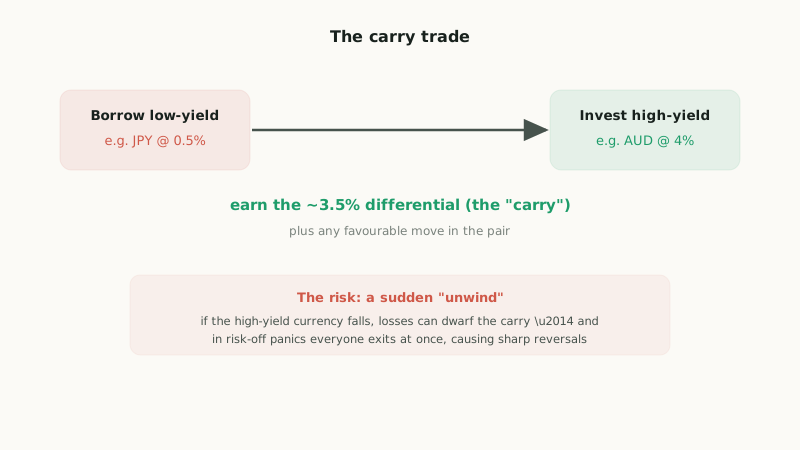
The classic historical example involved borrowing the Japanese yen — long associated with very low interest rates — to invest in higher-yielding currencies such as the Australian or New Zealand dollar, or various emerging-market currencies. In retail forex, this is achieved simply by going long a pair where the base currency has the higher rate and the quote currency the lower (or vice versa for a short), with the differential credited to the account daily as a rollover or swap. Hold a positive-carry position overnight and you receive a small interest credit; the carry trade is the strategy of deliberately seeking those credits by choosing pairs with a wide, favourable rate gap.
Where the profit comes from
The carry trade has two potential sources of profit. The first is the interest rate differential itself — the carry — earned continuously for as long as the position is held. If the high-yield currency pays 4% and the funding currency costs 1%, the trader earns roughly the 3% differential annually on the position, regardless of whether the exchange rate moves at all. This is the defining feature: a source of return that does not depend on price movement, accruing simply from holding.
The second potential source is favourable currency movement. If the high-yield currency also appreciates against the funding currency while the trade is held, the trader profits from that move on top of the carry. Indeed, carry trades can be self-reinforcing in stable times: as many traders pile into a high-yield currency to earn the carry, their buying pushes that currency up, adding capital gains to the interest income and attracting yet more carry traders. This virtuous cycle can sustain profitable carry trades for extended periods — which is precisely what lulls traders into underestimating the risk that builds beneath the surface.
The serious risk: the unwind
The carry trade's danger lies in its asymmetry: the interest is earned slowly and steadily, but losses can arrive suddenly and violently. The core risk is straightforward — if the high-yield currency falls against the funding currency, the trader suffers a capital loss on the position, and because the carry earned is relatively small, even a modest adverse currency move can wipe out months of accumulated interest and turn the trade into a substantial loss. The interest differential offers only a thin cushion against currency movement.
Worse is the phenomenon of the carry trade unwind. Carry trades thrive in calm, risk-seeking ("risk-on") markets, but they are acutely vulnerable to sudden shifts to fear ("risk-off"). When markets are gripped by fear — a crisis, a shock, a spike in volatility — traders rush to exit risky carry positions all at once, selling the high-yield currencies and buying back the funding currencies en masse. This synchronised exit causes the high-yield currencies to plunge and the funding currencies (often safe havens like the yen) to surge, producing sharp, fast reversals. Because so many traders are positioned the same way, and often with leverage, these unwinds can be savage — the accumulated profits of a long calm period erased in days or even hours. The carry trade's steady-as-she-goes character makes its periodic blow-ups all the more dangerous.
The carry trade earns pennies slowly and can lose pounds suddenly. The interest accrues drip by drip in calm markets, but in a risk-off panic everyone exits at once, the high-yield currency collapses, and a long position's gains vanish in a flash. Never mistake a long calm period for the absence of this risk — it is merely dormant.
A note on theory and reality
The carry trade sits in interesting tension with economic theory. A principle called interest rate parity holds that, in theory, the interest rate advantage of a high-yield currency should be exactly offset by a corresponding depreciation of that currency, so that no risk-free profit from rate differentials should be possible — the high-yield currency should fall by just enough to cancel the carry. If this held perfectly, the carry trade would not work.
In practice, it frequently does not hold over the timeframes carry traders care about: high-yield currencies often do not depreciate as the theory predicts, and may even appreciate, allowing carry traders to profit — sometimes for years. The carry trade is, in essence, a bet that interest rate parity will not hold in the short to medium term. But the theory has its revenge in the unwinds: the violent depreciations that periodically strike high-yield currencies can be seen as the market belatedly and brutally enforcing the parity the carry traders had been profitably betting against. The carry trade thus profits from a market inefficiency that mostly persists — until, abruptly and painfully, it corrects.
Approaching the carry trade
For the trader, the carry trade is a reminder that returns and risks are inseparable. Its appeal — earning interest simply for holding — is real, but it comes packaged with tail risk that has ruined many who treated the strategy as easy money. If approached at all, it demands the full discipline of risk management: modest position sizing (the leverage that magnifies the carry magnifies the unwind losses far more), an awareness of the broader risk environment (carry trades are most dangerous precisely when complacency is highest), and stops or exit plans for the sudden reversals that the strategy is prone to.
For most traders, the carry trade is best understood as an important concept — illuminating how interest rate differentials drive capital flows and currency values — rather than as a strategy to deploy naively. It demonstrates vividly why interest rates are the dominant force in forex, why risk sentiment matters so much, and why the steadiest-looking returns can harbour the sharpest risks. Whether or not one ever trades it directly, understanding the carry trade deepens one's grasp of the forces that move currencies, which is exactly why it belongs at the heart of forex fundamentals.
A worked example
Concrete numbers make the carry trade's appeal and its danger vivid. Imagine a trader goes long a pair where the high-yield currency pays 4% and the funding currency costs 1%, capturing a 3% annual carry. On a position with, say, $50,000 of exposure, that 3% differential amounts to roughly $1,500 per year in interest — credited in small daily rollover amounts — earned simply for holding the position, regardless of whether the exchange rate moves. In a calm, stable market, this can feel like a reliable, almost passive income stream, and if the high-yield currency also appreciates modestly, the trader earns capital gains on top.
Now consider the downside. That $50,000 position earns about $4 a day in carry. But currencies routinely move 1% or more in a single day, and 1% of a $50,000 position is $500. So a single adverse 1% move in the exchange rate — wiping out roughly 125 days of accumulated carry in one session — illustrates the brutal asymmetry: months of patient interest can vanish in a day. And in a genuine risk-off unwind, the high-yield currency might fall 5%, 10% or more in a matter of days as everyone exits at once, inflicting a loss of several thousand dollars that dwarfs an entire year's carry.
This is the carry trade in a nutshell: a small, steady, appealing return that accumulates slowly, sitting atop a large, sudden risk that can erase years of it in a single episode. The arithmetic is exactly why the strategy demands modest position sizing and respect for the risk environment — and why using heavy leverage to amplify that "passive" 3% is so dangerous, since the leverage amplifies the unwind losses far more than it amplifies the trickle of carry. The numbers make plain why the carry trade has both enriched traders in calm times and ruined them when the tide turned.
The carry trade profits from interest rate differentials: borrow/sell a low-yield currency, buy/hold a high-yield one, and earn the difference (the carry) as daily rollover, plus any favourable currency move. The danger is asymmetric — interest accrues slowly (a few dollars a day) but a single adverse move can erase months of it, and risk-off "unwinds" cause violent reversals that dwarf a year's carry. It bets against interest rate parity and works until it sharply doesn't. Treat it as a key concept and, if traded, with strict risk control. Not financial advice.