
You take three trades in three different pairs and feel comfortably diversified. But if those pairs all move together, you have not made three trades — you have made one big bet three times over. This is correlation risk: the hidden concentration that turns an apparently diversified book into a single, oversized position, and it catches traders out constantly. Because currency pairs are often strongly correlated, holding several can multiply your real exposure to a single driver without your realising it, so they all win or lose together. This guide explains how correlation creates hidden risk, why "diversifying" across similar pairs is concentration in disguise, and how to manage it — a crucial extension of position sizing and overall risk control.
It applies the currency correlations concept to risk, feeds directly into portfolio heat, and refines position sizing.
Key takeaways
Q: What is correlation risk in forex?
A: Correlation risk is the danger that multiple positions in correlated currency pairs amount to a larger, concentrated bet than you realise. Because correlated pairs move together (or exactly opposite), holding several can multiply your true exposure to a single driver, so they can all lose at once.
Q: Why is trading correlated pairs risky?
A: Because it concentrates risk while feeling like diversification. Going long two positively correlated pairs (say EUR/USD and GBP/USD) is effectively a doubled bet on the same theme — if it goes wrong, both lose together. What looks like two diversified trades is really one larger position.
Q: How do you manage correlation risk?
A: Be aware of which pairs are correlated, treat correlated positions as combined exposure when sizing (two correlated longs count closer to one larger position), avoid unintentionally stacking the same bet, and factor correlation into your total portfolio risk. Remember correlations shift over time, so they need monitoring.
How correlation creates hidden risk
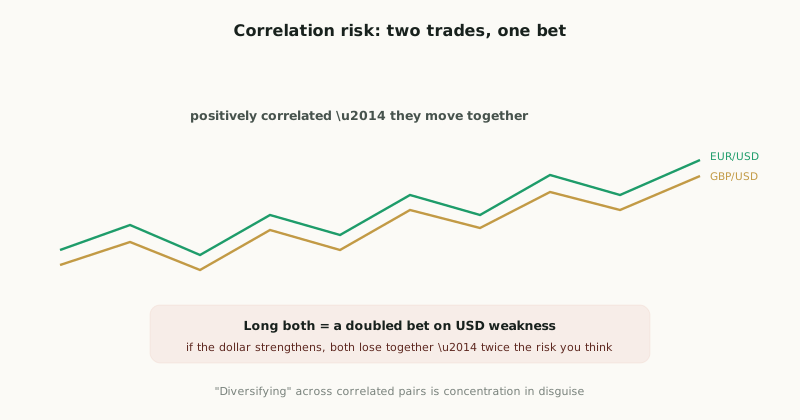
Currency pairs are frequently correlated — they tend to move together or in opposite directions — because pairs often share a common currency or are driven by the same underlying themes (the subject of the currency-correlations guide). The classic example: EUR/USD and GBP/USD are typically positively correlated, often rising and falling together, because both have the US dollar as the quote currency, so both reflect "dollar weakness" when they rise and "dollar strength" when they fall — they share the USD leg. When pairs are correlated like this, the risk is that multiple positions become a single concentrated bet.
Consider going long both EUR/USD and GBP/USD. These feel like two separate trades in two different pairs, but because the pairs are positively correlated, the position is effectively a doubled bet on the same theme — US dollar weakness. If the dollar strengthens, both positions lose together; if it weakens, both win together. You have not diversified; you have concentrated, taking twice the exposure to a single driver (the dollar) that each trade alone would carry. The risk you are actually running is roughly double what you would estimate by looking at each trade in isolation. The same applies in subtler ways: long EUR/USD and short USD/CHF is also a doubled dollar bet (since EUR/USD and USD/CHF are typically negatively correlated, being long one and short the other stacks the same directional exposure). The danger is that this concentration is hidden: the positions look diversified (different pairs, even different directions), so a trader can unknowingly build a large, concentrated bet while believing they are spreading risk. This is the essence of correlation risk — real exposure that is larger and more concentrated than it appears, because correlated positions move together.
Positive, negative and uncorrelated
Understanding correlation risk requires recognising the three basic relationships, summarised below.
Correlation and its risk effect
| Relationship | Example | Effect on combined risk |
|---|---|---|
| Positively correlated | EUR/USD & GBP/USD | Same-direction trades stack (concentrate) |
| Negatively correlated | EUR/USD & USD/CHF | Same-direction trades partly offset (hedge) |
| Uncorrelated | Unrelated pairs | Genuinely diversifying |
Positively correlated pairs move together, so taking the same direction in both stacks the exposure (two longs in correlated pairs = a concentrated double bet), while taking opposite directions partly offsets. Negatively correlated pairs move oppositely, so taking the same direction in both partly offsets (a hedge-like effect), while taking opposite directions stacks. Uncorrelated pairs move independently, so trading them genuinely diversifies — their risks are separate and don't all hit at once. The practical insight is that whether multiple positions concentrate or diversify your risk depends entirely on their correlations and directions: not all "multiple positions" are diversified, and not all "different pairs" are independent. Two longs in highly correlated pairs are barely more diversified than a single larger position, while positions in genuinely uncorrelated pairs do spread risk. Crucially, correlations are not fixed — they strengthen, weaken and even flip over time as market drivers change (pairs that are usually correlated can decouple, and vice versa), so they must be monitored rather than assumed constant. This is why a trader cannot simply count the number of positions as a measure of diversification; what matters is the correlation structure between them, which determines whether the positions truly spread risk or secretly concentrate it.
Managing correlation risk
Managing correlation risk comes down to accounting for correlations in your overall risk, rather than treating each trade as independent. The foundational step is awareness: know which of the pairs you trade are correlated (positively or negatively) and how strongly, so you can see when you are stacking the same bet. The most common and costly error is unintentional concentration — building a large bet on, say, the dollar across several "different" pairs without realising it — and simple awareness of the correlations prevents it.
Beyond awareness, the key discipline is to treat correlated positions as combined exposure when sizing. If you are long two highly correlated pairs, recognise that for risk purposes this is closer to one larger position than two independent ones, and size accordingly — so that the combined risk of correlated positions stays within your limits, rather than each being sized as if independent (which would double your true risk). In effect, count correlated positions as adding up toward a single concentrated exposure, and cap that combined exposure as you would a single trade. This connects directly to portfolio heat (the next concept): your total open risk must account for correlation, because correlated positions can all lose together, making them more dangerous in aggregate than uncorrelated ones. Practically: avoid unintentionally stacking correlated bets; if you do want exposure to a theme (say dollar weakness), do it deliberately and sized as the single concentrated bet it is, not spread across pairs in a way that disguises its true size; use genuinely uncorrelated pairs if you want real diversification; and be aware that negative-correlation positions can partly hedge each other (sometimes useful, sometimes just reducing your net exposure to little). And monitor correlations over time, since they shift. The honest, practical takeaway: diversification in forex is not about the number of pairs but their correlation structure — "diversifying" across correlated pairs is concentration in disguise, dangerous precisely because it is hidden. Manage it by being aware of correlations, treating correlated positions as the combined exposure they really are, and folding correlation into your total risk — so the risk you run matches the risk you intend, rather than secretly doubling behind a façade of diversification.
Correlation risk in practice
To see how easily this catches traders out, picture a trader who is bearish on the US dollar. Wanting to "spread the risk," they go long EUR/USD, long GBP/USD, and long AUD/USD — three different pairs, feeling nicely diversified across Europe, Britain and Australia. In reality, all three are dollar-quoted pairs that rise when the dollar falls, so they are strongly positively correlated: the trader hasn't made three diversified bets but one large, triple-sized bet on dollar weakness. If the dollar instead strengthens — on a strong jobs report or a hawkish central bank — all three positions lose together, in lockstep, delivering a loss roughly three times what the trader imagined they were risking on "one of three diversified trades." The diversification was an illusion; the risk was concentrated all along.
The same trap appears with mixed directions when negative correlation is involved. A trader long EUR/USD who also goes short USD/CHF (thinking these are unrelated trades) has actually doubled their dollar-weakness bet, since EUR/USD and USD/CHF are typically negatively correlated — being long one and short the other stacks the same exposure. Again, two "different" trades are really one larger bet. These scenarios are extremely common precisely because the concentration is hidden behind the appearance of trading different instruments.
The practical workflow to avoid this is straightforward. Before adding a position, ask: what is the real, underlying bet here, and do I already have it on? Check whether the new pair is correlated with positions you already hold — if you're already long several dollar-quoted pairs, another one is more of the same dollar bet, not diversification. Identify the dominant theme behind your open positions (often it's a single currency, frequently the dollar) and recognise how much total exposure you have to it. If you genuinely want a large bet on a theme, take it deliberately, sized as the single concentrated position it is, rather than letting it accumulate unnoticed across "different" pairs. And if you want real diversification, choose pairs that are genuinely uncorrelated, not merely different-looking. This simple habit — always asking what the underlying bet really is, and counting correlated positions as one — turns hidden correlation risk into a deliberate, controlled choice.
Correlation risk is the hidden concentration from holding positions in correlated pairs. Positively correlated pairs (e.g. EUR/USD, GBP/USD, AUD/USD, all dollar-quoted) move together, so same-direction trades stack into one large bet on a single driver — if it turns, they all lose together. Negatively correlated pairs (e.g. EUR/USD & USD/CHF) stack when traded in opposite directions; uncorrelated pairs genuinely diversify. So diversification depends on correlation structure, not the number of pairs — "diversifying" across correlated pairs is concentration in disguise. Manage it: before adding a position, ask what the real underlying bet is and whether you already hold it; treat correlated positions as combined exposure when sizing; take theme bets deliberately; use genuinely uncorrelated pairs for real diversification; and monitor correlations since they shift.