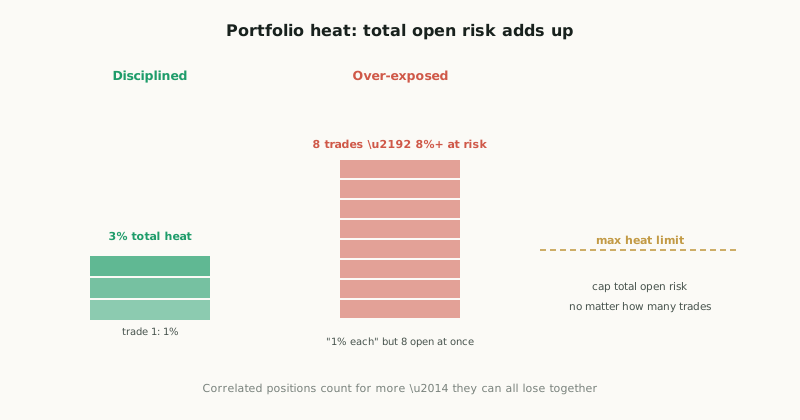
Risking just 1% per trade sounds safe — and it is, for one trade. But have ten trades open at once, and suddenly 10% of your account is on the line, all at the same time. This is the blind spot that portfolio heat addresses: your total open risk across all positions, not just the risk of each one individually. Controlling heat is what stops careful per-trade risk management from quietly adding up to a dangerous whole — the difference between a trader who is genuinely managing risk and one who merely thinks they are because each individual trade is small. This guide explains what portfolio heat is, why it matters as much as per-trade risk, how small risks accumulate (especially when correlated), and how to set a heat limit.
It is the portfolio-level extension of position sizing, works hand-in-hand with correlation risk, and is central to avoiding the risk of ruin.
Key takeaways
Q: What is portfolio heat?
A: Portfolio heat is the total amount of capital you have at risk across all your open positions at once — the sum of the risk on each trade if they all hit their stops. For example, five open trades each risking 1% give 5% total heat: the most you'd lose if all were stopped out.
Q: Why does portfolio heat matter?
A: Because per-trade risk alone doesn't bound your total exposure. Risking 1% per trade feels safe, but ten simultaneous positions put 10% at risk — and if they're correlated, they can all lose together. Controlling total heat prevents careful per-trade risk from quietly accumulating into a dangerous aggregate.
Q: How do you limit portfolio heat?
A: Set a maximum total heat limit — a cap on the combined risk of all open positions — so that no matter how many trades you have, aggregate risk stays bounded. Account for correlation (correlated positions count for more), and stop adding positions once the limit is reached.
What portfolio heat is
Portfolio heat is the total amount of capital you have at risk across all your open positions simultaneously — the sum of the potential loss on each open trade if every one of them were stopped out. If you have five trades open, each risking 1% of your account (to its stop-loss), your portfolio heat is 5%: that is the total you would lose if all five hit their stops at once. Heat aggregates the individual risks into a single, portfolio-level number that answers the crucial question: how much of my account is actually on the line right now, in total?
This is a different and broader question than per-trade risk. Per-trade risk (from the position-sizing guide) governs how much you risk on each individual trade — essential, but it only controls each trade in isolation. Portfolio heat governs your aggregate risk across everything open at once. The distinction matters because a trader can have impeccable per-trade discipline (risking a small, fixed percentage on each trade) yet still run dangerous total risk simply by having many trades open simultaneously. Per-trade risk controls the size of each bet; portfolio heat controls how many bets, in total, you have running. Both are necessary: per-trade risk ensures no single trade can hurt you much, while portfolio heat ensures the combination of all your trades can't hurt you much either. Focusing only on per-trade risk, while ignoring how it sums across positions, leaves a serious gap — and that gap is exactly where careful-seeming traders run into trouble.
How small risks add up
The danger portfolio heat guards against is the way many small risks accumulate into a large total. A trader diligently following a "1% per trade" rule feels safe — each trade can only cost 1% — and so may take more and more positions without concern, since each is "only 1%." But ten such positions open at once is 10% of the account at risk simultaneously; twenty is 20%. The per-trade discipline that feels so prudent has, through sheer accumulation, produced a large aggregate exposure. If a bad day or a market shock hits many positions at once, the trader can suffer a far larger drawdown than their "1% per trade" rule led them to expect — because the rule never bounded the total. This is a classic and under-appreciated way that careful traders get hurt: not by one big reckless bet, but by many small "safe" bets adding up.
The danger is dramatically amplified by correlation (the previous concept). If the multiple open positions are correlated — as they easily can be in forex, where many pairs share drivers — they don't behave as independent risks that might offset; they tend to move together, so they can all lose at once. Ten correlated positions each risking 1% are not ten independent small risks but effectively one large concentrated bet that can deliver a 10% loss in a single adverse move of the shared driver. This is where correlation risk and portfolio heat combine into real danger: a trader unknowingly stacks correlated positions (thinking they're diversified), each sized "safely," and a single move against the shared theme stops them all out together for a large, sudden loss. The accumulation of small risks is bad enough when positions are independent; when they are correlated, the aggregate risk is even greater than the simple sum suggests, because the positions are really one bet wearing several disguises. This is precisely why total heat must be controlled and why correlation must be factored into it — the combination of unchecked accumulation and hidden correlation is a recipe for a drawdown far larger than per-trade discipline alone would suggest.
Per-trade risk and portfolio heat answer two different questions: "how big is each bet?" and "how much is on the line in total?" You can ace the first and fail the second — ten "safe" 1% trades is 10% at risk, and if they're correlated, they can all go down together. Capping total heat is what stops careful per-trade sizing from quietly accumulating into a dangerous whole.
Setting a heat limit
The solution is to set a maximum portfolio heat limit — a cap on the combined risk of all open positions — and to respect it as a hard rule. By capping total heat at some chosen maximum (traders commonly use figures in the region of a few percent up to, say, five or six percent of the account as their total open risk — the specific number is a personal risk-tolerance choice, not a prescription), you ensure that no matter how many trades you have open, your aggregate risk stays bounded. Once your open positions' combined risk reaches the limit, you take no new trades until some are closed (or risk is reduced by moving stops), regardless of how attractive a new setup looks. This single rule transforms risk management from per-trade only to genuinely portfolio-wide, closing the accumulation gap.
Implementing a heat limit well involves a few refinements. Account for correlation: correlated positions should count for more toward your heat (since they can all lose together), so a heat limit should treat correlated positions as adding up closer to their combined directional exposure rather than as independent risks — in practice, be more conservative with heat when positions are correlated, or count correlated positions as a single larger exposure against the limit. Make the limit a firm rule, not a guideline to be stretched when a tempting setup appears — the discipline only works if the cap holds (the temptation to "just add one more" when at the limit is exactly when the rule matters most). Choose a limit suited to your risk tolerance and strategy — a lower limit is more conservative (less aggregate risk, smaller drawdowns, but less capital deployed), a higher one more aggressive; pick what lets you withstand a bad day without serious damage. The benefit of a heat limit is profound: it bounds your worst-case loss across everything open, protecting you from the death-by-accumulation and the correlated-cluster blowup that per-trade discipline alone cannot prevent, and it keeps your total exposure within levels that protect against the drawdowns and risk of ruin the other risk guides describe. The honest, practical takeaway: managing risk per trade is necessary but not sufficient — you must also manage your total open risk, your portfolio heat, by capping it with a firm limit that accounts for correlation. Doing so is the difference between truly controlling your risk and merely controlling each trade while your aggregate exposure quietly grows unchecked. Heat is the portfolio-level discipline that completes per-trade risk management, and it is essential for anyone holding more than one or two positions at a time.
Heat in a complete risk framework
A heat limit works best as part of a layered risk framework rather than in isolation. The layers nest naturally: per-trade risk caps how much any single trade can lose; portfolio heat caps how much all open trades can lose at once; and many traders add a third layer, a daily (or weekly) loss limit — a maximum amount they will allow themselves to lose in a single day before stopping trading entirely. Where heat bounds your simultaneous open risk, a daily loss limit bounds your cumulative losses over a session, protecting against the death-by-a-thousand-cuts of many sequential losing trades and against the tilt-driven spiral the psychology section warns about (where a bad run tempts revenge trading). Hitting the daily limit means stepping away — a circuit-breaker that prevents one bad day from becoming a catastrophic one.
Together these layers — per-trade risk, portfolio heat, and a daily loss limit — bound your risk on every dimension: each bet, all open bets at once, and your losses over time. They reinforce one another and close the gaps any single rule would leave. Heat, specifically, is the layer most traders overlook, because per-trade discipline feels like complete risk management — but as we've seen, careful per-trade sizing can still accumulate into dangerous aggregate exposure, especially with correlation. Adding a heat limit (and ideally a daily loss limit too) completes the framework, ensuring that your total risk — not just each trade's — stays within levels you can survive. This layered approach is how disciplined traders keep drawdowns contained and stay far from the risk of ruin: no single trade, no cluster of open trades, and no single session can do outsized damage, because each is independently capped. Portfolio heat is the crucial middle layer that turns per-trade discipline into genuine, portfolio-wide risk control.
Portfolio heat is your total open risk across all positions at once — the sum of what you'd lose if every open trade hit its stop (five trades at 1% each = 5% heat). It matters because per-trade risk alone doesn't bound your total: ten "safe" 1% trades is 10% at risk, and if correlated, they can all lose together for a large sudden drawdown. The fix: set a firm maximum heat limit, take no new trades once reached, and count correlated positions as adding up more. Best used in a layered framework — per-trade risk (each bet), portfolio heat (all open bets at once), and a daily loss limit (cumulative losses per session, a tilt circuit-breaker). Heat is the often-overlooked middle layer that turns per-trade discipline into genuine portfolio-wide risk control and keeps you far from the risk of ruin.