
Currency pairs are not independent islands — they move in relation to one another, sometimes in lockstep, sometimes in mirror image. EUR/USD and GBP/USD often rise and fall together; EUR/USD and USD/CHF tend to move in opposite directions. These currency correlations arise because pairs share currencies and economic drivers, and understanding them matters for a very practical reason: ignore correlations, and you can unknowingly double your risk by taking what you think are two separate trades but are really one big bet. This guide explains why correlations occur, the difference between positive and negative correlation, and how to use this knowledge to manage risk.
This connects the pairs covered in the major currency pairs directly to the risk management discipline.
Key takeaways
Q: What are currency correlations?
A: Currency correlations measure how the prices of two currency pairs move in relation to each other. A positive correlation means they tend to move in the same direction; a negative correlation means they tend to move in opposite directions, often because they share a common currency or economic drivers.
Q: Why are EUR/USD and USD/CHF negatively correlated?
A: Because the US dollar sits on opposite sides of the two pairs (the quote currency in one, the base in the other) and the Swiss and eurozone economies are closely linked. When the dollar weakens, EUR/USD tends to rise while USD/CHF tends to fall, producing a strong negative correlation.
Q: How do correlations affect trading risk?
A: Trading two strongly positively correlated pairs in the same direction effectively doubles your exposure to one bet, concentrating risk. Trading strongly negatively correlated pairs the same way can cancel out, hedging your position unintentionally. Awareness prevents both mistakes.
What correlation means
A correlation describes how two pairs tend to move relative to each other. A positive correlation means the two pairs tend to move in the same direction — when one rises, the other tends to rise too. A negative correlation means they tend to move in opposite directions — when one rises, the other tends to fall. Correlations are often expressed as a number between +1 (perfectly positively correlated, moving identically) and −1 (perfectly negatively correlated, moving exactly opposite), with 0 meaning no consistent relationship.
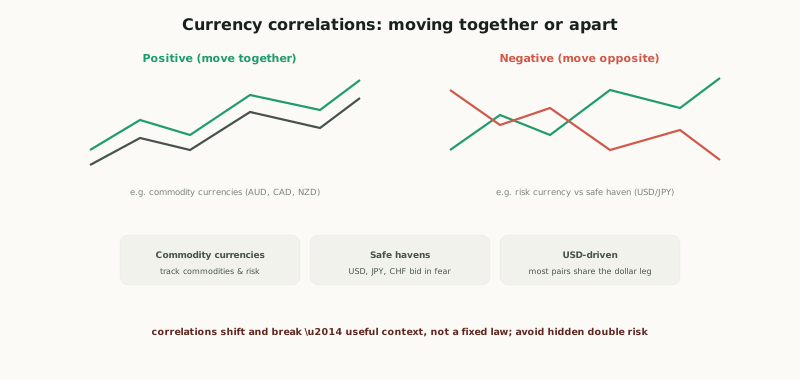
The strength of a correlation matters as much as its direction. Two pairs with a correlation near +1 move almost identically — trading both is much like trading one pair twice. Two pairs with a correlation near −1 move almost exactly opposite — a long in one is much like a short in the other. Pairs with weak correlations (near 0) move largely independently. These relationships are not fixed numbers carved in stone; they shift over time as economic conditions and market drivers change, sometimes strengthening, weakening or even reversing. But the major correlations are persistent enough to be genuinely useful — and genuinely dangerous to ignore.
Why pairs correlate
Correlations arise from shared currencies and shared economic drivers. The most direct cause is a shared currency. Consider EUR/USD and GBP/USD: both have the US dollar as the quote currency. When the dollar broadly weakens, both pairs tend to rise (it takes more dollars to buy a euro and to buy a pound), producing a positive correlation. The common dollar drives them together. Now consider EUR/USD and USD/CHF: here the dollar is the quote currency in one and the base currency in the other — it sits on opposite sides. So when the dollar weakens, EUR/USD rises but USD/CHF falls, producing a strong negative correlation.
Beyond the shared-currency effect, pairs correlate because of linked economies. The Swiss and eurozone economies are closely tied, reinforcing the EUR/USD and USD/CHF relationship. The commodity currencies (AUD, NZD, CAD) tend to correlate with one another because they respond similarly to global growth and commodity prices. The safe havens (JPY, CHF) tend to move together during risk events. Understanding these underlying causes — shared currencies and shared economic fortunes — lets you anticipate correlations rather than merely memorise them, and explains why they can shift when the underlying drivers change.
The risk of doubling up
The most important practical reason to understand correlations is risk management. The danger is subtle: a trader takes what feel like two separate, independent trades — say, long EUR/USD and long GBP/USD — believing they have diversified across two positions. But because these pairs are strongly positively correlated, the two trades are really one large bet on the same thing (dollar weakness). If that bet goes wrong, both positions lose together, and the trader has unknowingly taken double the intended risk on a single underlying view.
This silently undermines the position-sizing discipline that is the heart of risk management. A trader who carefully risks 1% per trade has, by taking two strongly correlated positions in the same direction, actually risked roughly 2% on one bet — violating their own risk rules without realising it. The reverse mistake is also possible: taking strongly negatively correlated positions in the same direction (long EUR/USD and long USD/CHF) can largely cancel out, hedging away your exposure and tying up capital in positions that work against each other. Either way, ignoring correlation means your real risk and exposure are not what you think they are — which defeats the entire purpose of careful position sizing.
Two strongly positively correlated pairs traded the same way are not two trades — they are one trade at double size. Your careful 1% risk per position becomes 2% on a single bet. Correlation is the hidden leak in position sizing: manage it, or your real risk is quietly larger than you intend.
Using correlations wisely
Armed with this understanding, you can use correlations rather than fall victim to them. The first and most important use is avoiding unintended concentration: before taking a second position, check whether it is strongly correlated with one you already hold. If you are long EUR/USD and considering long GBP/USD, recognise that you are really adding to a single dollar-bearish bet, and size accordingly — treating the combined exposure as one position for risk purposes, not two. This keeps your true risk in line with your intentions.
Correlations can also be used deliberately. Some traders use negatively correlated pairs to hedge, deliberately holding offsetting positions to reduce exposure. Others seek genuinely uncorrelated pairs to diversify, spreading risk across bets that will not all fail together. And correlations can serve as a confirmation or warning tool: if two normally-correlated pairs suddenly diverge, it can signal something noteworthy. The key throughout is awareness — knowing the correlations among the pairs you trade so that your actual risk and exposure match what you intend. Combined with disciplined position sizing, correlation awareness ensures that careful risk management is not quietly undone by hidden relationships between your positions.
Correlations change over time
A crucial caveat completes the picture: currency correlations are not fixed. They shift over time — sometimes gradually, sometimes abruptly — as the economic drivers behind them change. Two pairs strongly positively correlated this month may be only weakly correlated next month, and a relationship can even reverse. Treating any correlation as a permanent, fixed fact is a mistake; they are tendencies that hold over certain periods and under certain conditions, not laws of nature.
Correlations change because the drivers change. The EUR/USD and USD/CHF negative correlation is rooted in the shared dollar and the linked Swiss and eurozone economies — but if Swiss-specific factors (say, central bank intervention) come to dominate the franc, that relationship can weaken. Commodity-currency correlations strengthen when global growth and commodity prices are the dominant market theme and weaken when other factors take over. The USD/CAD link to oil tightens when oil is the big story and loosens when it is not. As the market's focus rotates between themes — interest rates, risk sentiment, commodities, regional politics — the correlations rooted in those themes wax and wane accordingly.
The practical implication is that you should check current correlations rather than rely on remembered rules of thumb, especially before depending on a correlation for risk or hedging decisions. Many platforms and tools provide live correlation data showing the recent strength of relationships between pairs. The broad, structural correlations (the shared-dollar effects especially) are reasonably persistent and worth knowing as a baseline, but the precise strength at any moment varies, and the looser, theme-driven correlations can change substantially. Use correlations as a current, checkable input to your risk thinking — not as fixed constants — and you avoid being caught out when a relationship you assumed was stable quietly shifts beneath you.
Putting correlation into practice
To make all this concrete, a simple routine keeps correlation working for you rather than against you. Before opening any position, glance at what you already hold and ask: is this new trade strongly correlated with an existing one? If you are long EUR/USD and about to go long GBP/USD, recognise that you are really increasing a single dollar-bearish bet, and either size the new position smaller or treat the two together as one position when applying your risk limit. If you are about to take a position that is strongly negatively correlated with one you hold — long EUR/USD and long USD/CHF, say — recognise that you may be hedging yourself into a near-flat net exposure, tying up margin for little net effect.
A useful mental model is to think in terms of net exposure to each currency rather than in terms of individual pairs. Long EUR/USD and long GBP/USD both amount to being short the dollar; together you are doubly short the dollar, whatever the two tickets suggest. Viewing your book through the lens of which currencies you are net long and short — rather than as a list of separate pair positions — reveals your true exposure and stops correlation from hiding it. This currency-level view is how more experienced traders think about a multi-position book, and it is the natural antidote to the doubling-up trap.
None of this requires complex calculation — just the habit of checking correlations and thinking in terms of underlying currency exposure before adding positions. Combined with the disciplined position sizing from the risk management section, this awareness ensures that the careful 1%-per-trade risk you set is the risk you actually carry, not a figure quietly inflated by hidden relationships between your trades. Correlation, understood and respected, becomes simply another input to sound risk management rather than a trap waiting to spring.
Currency pairs correlate because they share currencies and economic drivers: pairs with the dollar on the same side (EUR/USD, GBP/USD) move together (positive); pairs with the dollar on opposite sides (EUR/USD, USD/CHF) move opposite (negative). Trading strongly positively correlated pairs the same way doubles your bet and your risk. Correlations aren't fixed — check current ones. Think in terms of net exposure to each currency rather than separate pairs, so your true risk matches the 1% per trade you intend.