The forex market trades 24 hours a day, but it does not trade evenly. It is really four markets in sequence, following the sun around the globe: as Sydney winds down, Tokyo picks up; as Tokyo fades, London roars to life; as London eases off, New York takes over. Each of these trading sessions has its own character — its own typical volatility, its own active pairs, its own rhythm — and the points where sessions overlap are where trading activity concentrates most intensely. Understanding the session structure is key to knowing when conditions are best for trading. This guide explains the four sessions and how they shape the market.
The 24-hour structure introduced in what is forex trading is examined here in detail, and it leads directly into the best times to trade.
Key takeaways
Q: What are the four forex trading sessions?
A: The four major sessions are Sydney, Tokyo (the Asian session), London (the European session) and New York (the US session). As one closes the next opens, so the market follows the sun around the globe, trading continuously 24 hours a day on weekdays.
Q: Which forex session is the most active?
A: The London session is the highest-volume session, and the London-New York overlap — when both major financial centres are open simultaneously — is the most active and liquid period of the entire trading day, with the tightest spreads and the largest moves.
Q: Why do trading sessions matter?
A: Sessions determine when liquidity and volatility are highest, which affects spreads, the size of price moves, and which pairs are most active. Trading when the relevant session is open generally means better conditions than the quiet hours between sessions.
The four sessions
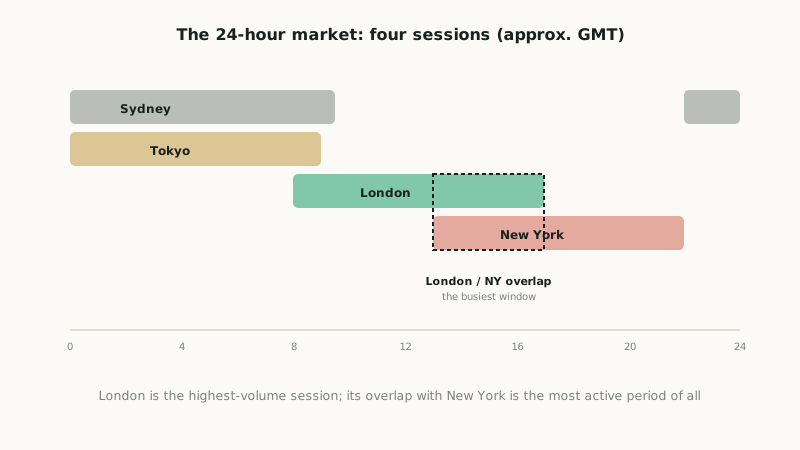
The trading day is conventionally divided into four sessions named for their major financial centres. The Sydney session opens the trading week (Sunday evening in Western terms) and the daily cycle, bringing the first liquidity as the Asia-Pacific region begins trading. The Tokyo session (the broader "Asian session") follows and overlaps with Sydney, anchoring Asian trading and bringing significant activity, especially in the yen and other Asia-Pacific currencies.
The London session (the "European session") is the heavyweight: London is the largest forex trading centre in the world, and its session sees the highest volume of the day, with major moves and trends frequently established here. Finally, the New York session (the "US session") brings the second great wave of activity, dominated by US economic data and dollar flows, and overlaps with the tail of the London session. As New York winds down, the cycle approaches its quietest point before Sydney begins again. This relay of sessions is what creates the continuous 24-hour market — not a single uniform market, but a sequence of regional ones handing off to each other.
The crucial overlaps
The most important concept in session trading is the overlap — the periods when two sessions are open simultaneously, and activity is at its peak. By far the most significant is the London/New York overlap, the window (roughly the early-to-mid afternoon GMT) when both of the two largest financial centres are open at once. This overlap is the most active, most liquid, and most volatile period of the entire trading day: spreads are tightest, volume is greatest, and the largest moves frequently occur. For many traders, especially those trading the majors, this overlap is the prime time to be at the screen.
There is also a smaller Tokyo/London overlap as the Asian session hands over to the European one, which brings a pickup in activity though less dramatic than the London/NY overlap. The key insight is that liquidity and volatility are not constant through the 24-hour day — they ebb and flow with the sessions, peaking during overlaps (especially London/NY) and falling away in the gaps between major sessions. Knowing where you are in this cycle tells you what kind of conditions to expect: tight spreads and movement during overlaps, wider spreads and quiet during the lulls.
Each session's character
The sessions differ not just in activity level but in character. The Asian session (Sydney and Tokyo) tends to be the quieter part of the day for the major European and dollar pairs, often characterised by smaller ranges and more subdued movement — though it is the active session for yen pairs and Asia-Pacific currencies like the Australian and New Zealand dollars, particularly around regional news. Ranges established overnight in Asia sometimes set the stage for the European session to break.
The London session is typically where the day's significant moves and trends are set, given its dominant volume — the European open often brings a surge of activity and direction. The New York session is highly active, especially in its earlier hours which overlap with London and which see the release of market-moving US economic data. The later New York hours, after London closes, tend to quieten as the day winds toward its lull. This means the same pair can behave quite differently depending on the session — EUR/USD may drift in a tight range during the Asian session and then move decisively when London opens. Matching your trading to the right session for your pairs and style is part of trading well.
Liquidity and volatility follow the sessions, peaking during the London/New York overlap and falling away in the gaps between major sessions. The same pair can be sleepy in the Asian session and explosive when London opens — so when you trade shapes the conditions as much as what you trade.
Sessions and your pairs
A practical consequence is that the best session to trade depends partly on which pairs you trade. The major European and dollar pairs (EUR/USD, GBP/USD and the like) are most active during the London and New York sessions and their overlap — the prime hours for these pairs. Yen pairs and the Asia-Pacific commodity currencies (AUD, NZD) see meaningful activity during the Asian session, when their home markets and news are live. Trading a pair during its active session generally means better liquidity, tighter spreads and more meaningful movement than trading it in its quiet hours.
A note on timing: the exact clock hours of each session shift with daylight-saving changes through the year, so rather than memorising precise times it is best to think in terms of the sequence and overlaps and to check current session times for your time zone (many tools display a live forex session clock). What remains constant is the structure: four sessions following the sun, the dominant London session, the peak London/NY overlap, and the quiet lulls between. Combine this with the guidance on the best times to trade, covered next, and you can align your trading with the hours that offer the conditions your strategy needs.
The trading week and the weekend
The session cycle repeats each day, but it also fits inside a larger weekly rhythm worth understanding. The forex trading week opens with the Sydney session on Sunday evening (in Western terms) and runs continuously, day and night, until the New York session closes on Friday evening. Across those five days the market never sleeps — the four sessions relay around the clock — but over the weekend, when the world's financial centres are closed, the market effectively shuts: you cannot open or close trades from late Friday until the Sunday open.
This weekend closure has an important practical consequence: the risk of gaps. Because the market is closed for roughly two days, any significant news that breaks over the weekend — political events, economic shocks, geopolitical developments — is not absorbed gradually but hits all at once when the market reopens. The result can be a gap: the Sunday open printing at a noticeably different price from the Friday close, with no opportunity to have traded the move in between. A position held over the weekend is exposed to this gap risk, and a stop loss offers no protection against a gap that jumps straight past it. Many traders therefore reduce or close positions before the weekend, or at least size them with gap risk in mind.
The start of the week also has its own character. The early Sunday/Monday hours, with only the Sydney and then Tokyo sessions active, tend to be relatively thin and quiet as the market gets going — liquidity builds as the week progresses toward the busier London and New York hours. The mid-week sessions, particularly when major data and central bank events cluster, often see the most significant activity. Understanding this weekly arc — a quiet start, building through the week, the crucial daily London/NY overlaps, and the weekend closure with its gap risk — complements the daily session structure and helps you plan not just which hours to trade but how to handle the week as a whole, especially the decision of what to hold over the weekend.
The 24-hour market is four sessions following the sun: Sydney, Tokyo (Asian), London (European) and New York (US). London is the highest-volume session, and the London/New York overlap is the most active, liquid and volatile window. The Asian session is quieter for European/dollar pairs but active for yen and Aussie/Kiwi. The week opens Sunday evening (Sydney) and closes Friday evening (New York); the weekend closure brings gap risk for positions held across it. Think in overlaps, not exact clock times.