Spend enough time with the major pairs and you start to notice that each has a personality — a characteristic rhythm, a particular set of drivers, even a nickname traders use affectionately. EUR/USD is the smooth, liquid workhorse; GBP/USD ("Cable") is livelier; the yen pairs lurch on risk sentiment; the "commodity currencies" rise and fall with global growth. Understanding these characters helps you choose what to trade and anticipate how a pair is likely to behave. This guide walks through the major pairs, their nicknames, and the important distinction between safe-haven and commodity currencies.
These are the majors introduced in forex pairs explained, examined here for their individual characters.
Key takeaways
Q: What are the major currency pairs?
A: The majors are EUR/USD, USD/JPY, GBP/USD, USD/CHF, AUD/USD, USD/CAD and NZD/USD — all pairing the US dollar with another major currency. EUR/USD is the most traded pair in the world, with the deepest liquidity and tightest spreads.
Q: What is a safe-haven currency?
A: A safe-haven currency tends to strengthen during times of market fear and uncertainty, as investors seek safety. The Japanese yen and Swiss franc are the classic forex safe havens, often rising when risk sentiment turns negative, regardless of interest rate considerations.
Q: What are commodity currencies?
A: Commodity currencies belong to economies heavily reliant on commodity exports, so their value tends to track commodity prices and global risk appetite. The Australian dollar, Canadian dollar and New Zealand dollar are the main commodity currencies among the majors.
EUR/USD — "the Fiber"
EUR/USD, the euro against the US dollar, is the most traded currency pair in the world by a wide margin, representing the two largest economies and earning the trader's nickname "the Fiber." Its dominance brings the deepest liquidity of any pair and, consequently, the tightest spreads — the lowest trading costs available anywhere in forex. It tends to move relatively smoothly and is the most analysed pair, with abundant commentary and research.
For all these reasons, EUR/USD is the natural home for most traders and the ideal starting point for beginners. It is driven by the relative monetary policy of the European Central Bank and the US Federal Reserve, the relative economic strength of the eurozone and the US, and broad dollar sentiment. Because the dollar sits on one side and the euro is itself a major global currency, EUR/USD also serves as a barometer for broad dollar strength or weakness. If you trade only one pair, EUR/USD is the one — liquid, well-behaved, low-cost and richly documented.
The safe havens: USD/JPY and USD/CHF
USD/JPY (the dollar against the Japanese yen, nicknamed "the Gopher") and USD/CHF (against the Swiss franc, "the Swissie") are both heavily influenced by the safe-haven status of the yen and franc. A safe-haven currency is one investors flock to in times of fear and uncertainty, seeking safety over return. When global markets are gripped by risk-off sentiment — a crisis, a shock, a spike in volatility — the yen and franc tend to strengthen as capital seeks refuge, often regardless of interest rate considerations.
This makes these pairs especially sensitive to risk sentiment and global events, not just to the usual interest rate and economic factors. USD/JPY in particular is watched as a gauge of risk appetite: it often falls (yen strengthening) when fear rises and climbs (yen weakening) when calm returns. The franc behaves similarly, and USD/CHF is notable for tending to move inversely to EUR/USD, given the close ties between the Swiss and eurozone economies and the dollar sitting on the opposite side. These safe-haven dynamics add a layer of behaviour beyond the rate differentials that drive other pairs, and they connect directly to the carry-trade unwinds discussed in the fundamental analysis section.
GBP/USD — "Cable"
GBP/USD, the British pound against the US dollar, carries the venerable nickname "Cable" — a reference to the transatlantic telegraph cable that once carried the quote between London and New York. It is one of the oldest and most-traded pairs, but it has a livelier character than EUR/USD: Cable tends to be more volatile, with larger and faster moves, making it attractive to traders who want movement but somewhat less forgiving for beginners than the steadier Fiber.
Cable is driven by the relative policy of the Bank of England and the Federal Reserve, UK versus US economic data, and broad dollar sentiment, with an added sensitivity to UK-specific political and economic developments that can produce sharp moves. Its greater volatility means wider typical ranges — more opportunity, but also more risk per trade and a need for appropriate position sizing. Many traders graduate to Cable after gaining comfort with EUR/USD, valuing its movement while respecting its tendency toward sudden swings.
The commodity currencies: AUD, CAD and NZD
AUD/USD ("the Aussie"), USD/CAD ("the Loonie") and NZD/USD ("the Kiwi") are the major commodity currencies — the currencies of economies heavily reliant on commodity exports. Australia and New Zealand export large quantities of raw materials and agricultural goods, and Canada is a major oil exporter, so their currencies tend to track commodity prices and the health of the global economy that demands those commodities.
This gives the commodity currencies a distinct character: they are risk-sensitive, tending to strengthen when the global economy and commodity prices are buoyant (risk-on) and weaken when growth fears and falling commodity prices take hold (risk-off) — broadly the opposite tendency to the safe havens. The Aussie and Kiwi are particularly sensitive to global growth sentiment and to the Chinese economy (a major commodity buyer), while the Loonie has a notable link to oil prices, often moving with them. These pairs also frequently feature in carry trades when their interest rates are relatively high. Understanding the commodity link helps explain moves that pure rate analysis would miss — a sharp drop in oil can weaken the Canadian dollar even with no change in interest rates.
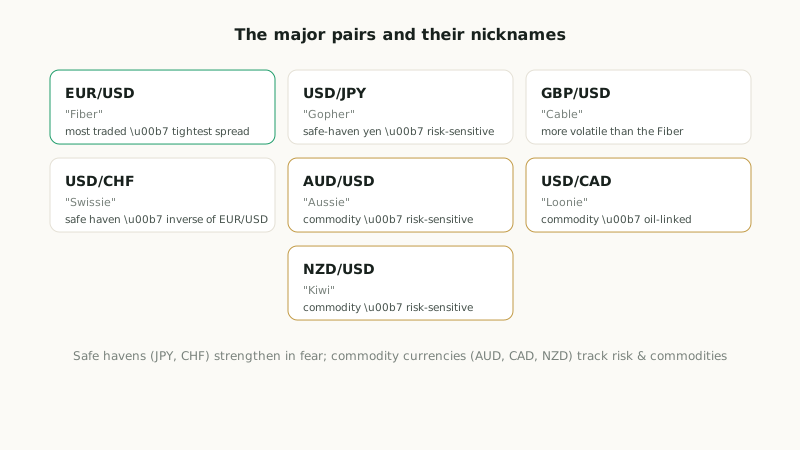
The majors split into broad character types: EUR/USD the liquid workhorse, the safe havens (JPY, CHF) that strengthen in fear, Cable the volatile veteran, and the commodity currencies (AUD, CAD, NZD) that track global growth and raw-material prices. Knowing a pair's type tells you what to watch — risk sentiment for the havens, commodities for the Aussie and Loonie.
Choosing your pairs
Understanding these characters helps you choose pairs that suit your style and the conditions you can follow. For a beginner, EUR/USD remains the clear recommendation: liquid, low-cost, well-documented and relatively smooth. As you develop, you might add a pair whose character or drivers you find easier to read or that is active during the hours you trade — perhaps Cable if you want more movement, a yen pair if you want to trade risk sentiment, or a commodity currency if you follow commodities and global growth.
A practical principle is to specialise rather than scatter your attention: trading one or two pairs deeply, learning their rhythms, drivers and typical behaviour, generally beats spreading thinly across many pairs you understand only superficially. Each major rewards familiarity — the more you watch a pair, the better you read its character and the news that moves it. Combine this knowledge of pair character with an understanding of the trading sessions (covered next) and of how pairs correlate with one another, and you have the practical framework for choosing not just what to trade but when, and how your positions relate to one another.
The dollar's central role
One fact unifies all the major pairs: the US dollar sits on one side of every single one. This is not a coincidence but a reflection of the dollar's role as the world's primary reserve currency and the centre of global finance. It has a profound practical consequence — broad movements in the dollar drive all the majors at once. When the dollar strengthens broadly, the dollar-quoted pairs (EUR/USD, GBP/USD, AUD/USD and so on) tend to fall together, while the dollar-base pairs (USD/JPY, USD/CHF, USD/CAD) tend to rise together. When the dollar weakens broadly, the reverse. Much of what moves the majors on any given day is simply the dollar's own strength or weakness.
This is why traders watch broad measures of the dollar, such as the dollar index (which tracks the dollar against a basket of major currencies), to gauge the overall dollar trend that influences every major pair. It also explains the correlations covered later in this section: pairs with the dollar on the same side move together, while pairs with the dollar on opposite sides move inversely. Understanding that a EUR/USD move might be driven not by anything specific to the euro but by a broad dollar move — visible across all the majors simultaneously — is a key insight that prevents misreading the cause of a price move.
The dollar's centrality also makes US developments — Federal Reserve policy, US economic data, US political events — disproportionately important to the entire forex market, not just to dollar pairs but to sentiment everywhere. And because the dollar is the world's safe-haven reserve currency, it often strengthens during global risk-off episodes (alongside the yen and franc), adding another layer to its behaviour. For a trader, the lesson is to always be aware of what the dollar as a whole is doing, because it is the single most important influence on the majors you are trading — the common thread running through every one of them.
The majors each have a character: EUR/USD ("Fiber") is the most liquid, tightest-spread workhorse and the beginner's pair; USD/JPY and USD/CHF are safe havens that strengthen in fear (the Swissie often inverse to EUR/USD); GBP/USD ("Cable") is more volatile; AUD, CAD and NZD are commodity currencies tracking global growth and commodities (CAD with oil). The US dollar sits on one side of every major, so broad dollar moves drive them all at once. Know a pair's type, watch the dollar, and specialise rather than scatter.