Not all currency pairs are created equal. The forex market lists dozens of tradeable pairs, but they fall into three clear categories — majors, minors and exotics — that differ enormously in how much they are traded, how much they cost to trade, and how they behave. Knowing which category a pair belongs to tells you a great deal before you even look at a chart: how tight the spread will be, how smoothly it tends to move, and how much risk it carries. This guide explains the three categories, the liquidity and cost differences between them, and which pairs are right for a beginner.
This builds on the pairs introduced in what is forex trading and leads into the detailed look at the majors and how pairs relate to one another.
Key takeaways
Q: What are the categories of forex pairs?
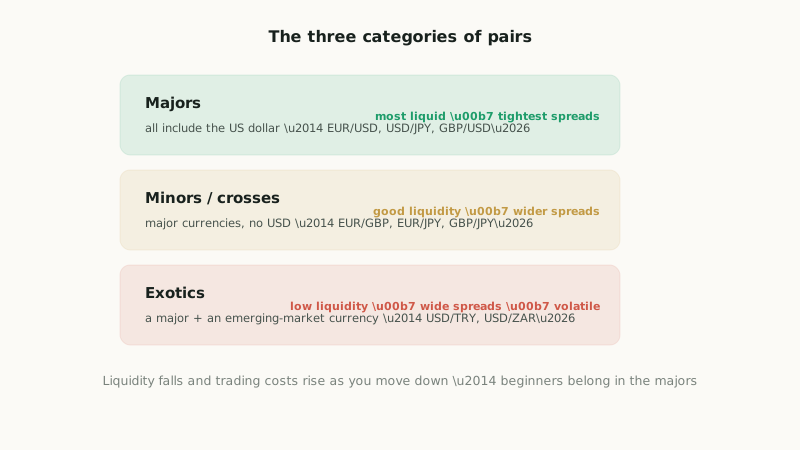
A: Forex pairs fall into three categories: majors (the most-traded pairs, all including the US dollar), minors or crosses (pairs of major currencies that do not include the dollar), and exotics (a major currency paired with one from a smaller or emerging economy).
Q: What are the major forex pairs?
A: The majors are the most heavily traded pairs, all involving the US dollar: EUR/USD, USD/JPY, GBP/USD, USD/CHF, AUD/USD, USD/CAD and NZD/USD. They have the deepest liquidity and the tightest spreads, making them the lowest-cost pairs to trade.
Q: Which forex pairs should beginners trade?
A: Beginners are best served by the major pairs, especially EUR/USD. They offer the deepest liquidity, the tightest spreads, the most stable behaviour and the most available analysis, all of which make them lower-cost and more forgiving than minors or exotics.
The majors
The majors are the most heavily traded currency pairs in the world, and they share one defining feature: every major pair includes the US dollar on one side, paired with another major global currency. The commonly cited majors are EUR/USD, USD/JPY, GBP/USD, USD/CHF, AUD/USD, USD/CAD and NZD/USD — the dollar against the euro, yen, pound, Swiss franc, Australian dollar, Canadian dollar and New Zealand dollar respectively.
Because they are so heavily traded, the majors have the deepest liquidity — there are always abundant buyers and sellers — and this liquidity brings several advantages. Spreads (the trading cost) are the tightest of any pairs, often a fraction of a pip to a pip or two on the most liquid. The pairs tend to move relatively smoothly and predictably, without the erratic jumps of thinner markets. And they are the most analysed and written-about pairs, so information and analysis are plentiful. For all these reasons, the majors — and EUR/USD above all — are where the vast bulk of trading happens, and where beginners belong. The majors are covered in detail in the major currency pairs.
The minors and crosses
The minors, also called crosses, are pairs made up of two major currencies that do not include the US dollar. Examples include EUR/GBP (euro against pound), EUR/JPY (euro against yen), GBP/JPY (pound against yen) and AUD/JPY (Australian dollar against yen). Historically, trading between two non-dollar currencies meant converting through the dollar, but today these crosses trade directly and are an established part of the market.
Crosses are still liquid and widely traded — just less so than the majors. As a result, their spreads are typically a little wider than the majors', and some crosses can be more volatile. GBP/JPY, for instance, is famous for large, fast moves, earning it a reputation as a volatile pair that experienced traders sometimes seek for its movement and beginners are wise to treat with respect. Crosses are useful for trading specific economic relationships directly (a view on the euro versus the pound, say, without dollar involvement), and for the currency-correlation considerations discussed later. They sit comfortably between the majors and exotics: very tradeable, but with slightly higher costs and, in some cases, more volatility than the majors.
The exotics
The exotics pair a major currency with the currency of a smaller or emerging-market economy — examples include USD/TRY (US dollar against Turkish lira), USD/ZAR (against South African rand), USD/MXN (against Mexican peso) and EUR/TRY. These pairs are far less traded than majors or crosses, and that thin liquidity drives all of their distinctive, and risky, characteristics.
Exotics have wide spreads — the cost to trade them is substantially higher than a major, sometimes dramatically so — because the lack of liquidity widens the gap between bid and ask. They are also typically far more volatile, prone to large, sudden, sometimes violent moves driven by the political and economic instability that often characterises emerging markets. This combination of high cost and high volatility makes exotics considerably riskier than majors or crosses. They can offer large moves and feature in strategies like the carry trade (many high-yielding currencies are exotics), but they are emphatically not for beginners. The wide spreads alone erode results, and the volatility can produce losses far faster than the steadier majors. Exotics are an advanced corner of the market, to be approached only with experience and caution.
The category tells you the cost and the character before you look at the chart. Majors: deep liquidity, tight spreads, smoother moves. Minors: good liquidity, slightly wider spreads, sometimes more volatile. Exotics: thin liquidity, wide spreads, high volatility, high risk. Liquidity is the thread connecting all three.
Why liquidity matters so much
The thread running through all three categories is liquidity — the depth of buyers and sellers in a pair — and understanding its effects explains why category matters. High liquidity (the majors) means tight spreads, so you pay less to trade; smoother price action, with fewer erratic jumps; and reliable execution, with less slippage even on larger orders. Low liquidity (the exotics) means the opposite on every count: wide spreads that cost you more, choppy and gap-prone price action, and worse execution.
This is why liquidity, far from being a dry technicality, directly shapes your trading experience and results. Every trade you make pays the spread, so trading low-liquidity pairs quietly bleeds money through higher costs on top of their greater risk. The smoother, more orderly behaviour of liquid pairs also makes technical analysis more reliable — patterns and levels work better when price moves continuously rather than gapping erratically. For these reasons, liquidity is one of the most important practical considerations in choosing what to trade, and it points strongly toward the majors for most traders most of the time.
Which pairs to trade
For a beginner, the guidance is clear: focus on the majors, and especially EUR/USD. They offer the lowest trading costs (tightest spreads), the most forgiving behaviour (smooth, liquid price action), the most available analysis and education, and the lowest risk of the violent surprises that thinner pairs can deliver. Mastering one or two majors thoroughly is far better than spreading attention thinly across many pairs, and the majors provide ample opportunity without the added hazards of crosses and exotics.
As experience grows, branching into the crosses is a natural next step — they open up more relationships to trade while remaining reasonably liquid — and some traders eventually trade exotics for their volatility or for carry strategies, though always with full awareness of the wider costs and greater risks. But the principle holds throughout a trading career: liquidity is your friend, costs compound, and the majors remain the core of most successful traders' activity. The detailed character of each major pair, and how pairs move in relation to one another, are covered in the rest of this section, alongside the trading sessions that determine when these pairs are most active.
How many pairs should you trade?
A question that follows naturally from understanding the categories is: how many pairs should you actually trade? The temptation, especially early on, is to watch many pairs at once, hunting for opportunities across the whole market. This is usually a mistake. Specialising in one or two pairs — learning their rhythms, their typical ranges, the news that moves them, the sessions in which they are active, how they behave around data releases — generally produces far better results than spreading your attention thinly across a dozen pairs you understand only superficially.
The reason is that each pair has its own character (as the next guide explores), and that character takes time and focused attention to learn. A trader who knows EUR/USD intimately — how it tends to move when London opens, how it reacts to US data, what a normal day's range looks like — has a real, hard-won edge in that pair. A trader spreading attention across many pairs never develops that depth in any of them, and is more likely to be caught out by behaviour they have not learned to anticipate. Depth beats breadth, particularly while you are still developing.
There is also a practical risk-management reason to limit your pairs, connected to the correlations covered later in this section: trading many pairs at once makes it easy to accumulate hidden, correlated exposure without realising it, undermining your position sizing. A focused trader watching one or two pairs has a much clearer view of their true risk. As you gain experience, you can gradually widen your repertoire, but the principle endures throughout a trading career: it is better to know a few pairs deeply than many pairs shallowly. For a beginner, one major — EUR/USD — is entirely enough to learn on.
Forex pairs come in three categories: majors (most traded, all include the US dollar — deepest liquidity, tightest spreads), minors/crosses (major currencies without the dollar — good liquidity, wider spreads, sometimes volatile), and exotics (a major plus an emerging-market currency — thin liquidity, wide spreads, high volatility and risk). Liquidity drives cost, smoothness and execution. Beginners should focus on the majors, especially EUR/USD — and specialise in one or two pairs deeply rather than scattering attention across many.