
The market does not care whether you are right — but your ego does, desperately. The need to be right, to protect one's self-image and avoid the sting of being wrong, is one of trading's quiet killers: it turns manageable losses into disasters (because taking the loss means admitting error), fuels revenge trading and overconfidence, and chains traders to opinions the market has already disproved. The hard truth is that the need to be right conflicts directly with the need to be profitable — and learning to detach ego from trades is, in large part, learning to choose money over pride. This guide explains how ego sabotages trading, why being right and making money pull in opposite directions, and how to detach the ego from your trades.
It underlies the overconfidence and revenge-trading problems, makes taking losses harder, and is a key obstacle to the trader's mindset.
Key takeaways
Q: How does ego hurt trading?
A: The ego's need to be right leads traders to refuse to take losses (because a loss means admitting they were wrong), to revenge-trade after losses, to become overconfident after wins, and to cling to predictions even when proven wrong. The need to be right conflicts directly with the need to be profitable.
Q: Why does the need to be right conflict with making money?
A: Because profitable trading requires taking losses readily (admitting you were wrong) and changing your view when the market disagrees — things the ego resists. A trader protecting their ego holds losers, fights the market, and seeks to prove themselves right rather than simply making money.
Q: How do you detach ego from trading?
A: Separate your self-worth from individual trades, accept being wrong as normal and necessary (cutting losses is admitting you were wrong, and that's fine), focus on making money rather than being right, stay objective, and hold your market opinions loosely so you can change them when the evidence does.
How ego sabotages trading
The ego — the part of us that needs to be right and to protect our self-image — sabotages trading in several recognisable ways, each flowing from the same root: the discomfort of being wrong. The most damaging is refusing to take losses. Cutting a loss means admitting you were wrong, which the ego resists, so the ego-driven trader holds losing positions far too long, moves or removes stop-losses to avoid crystallising the loss, and hopes the market will turn and "prove them right" — turning small, manageable losses into large, damaging ones (the disposition effect: holding losers because selling means admitting a mistake). This single ego-driven behaviour — not taking losses because it means admitting error — is one of the most destructive in all of trading, directly contradicting the cardinal rule of cutting losses short.
The ego sabotages in other ways too. Revenge trading (covered in its own guide) is often ego-driven: a loss wounds the ego, and the trader, feeling personally beaten by the market, tries to "get back at it" with impulsive trades to restore their bruised pride — a recipe for compounding losses. Overconfidence after wins is an inflated ego: a run of success swells the ego, the trader feels invincible and "right," and over-risks accordingly, setting up a fall (the overconfidence guide). Attachment to opinions and predictions is ego defending its judgements: having formed a market view (and perhaps stated it), the ego-driven trader becomes married to it, unable to change their mind even as evidence mounts that they are wrong, because changing would mean admitting error. And underlying all of these is the deeper distortion of trading to prove oneself right rather than to make money — the ego-driven trader's real goal subtly shifts from profit to vindication, from being profitable to being right, which leads to all the behaviours above. Each manifestation traces back to the ego's refusal to accept being wrong, and together they make ego one of the most pervasive and damaging forces in trading psychology, feeding into the loss-aversion, revenge and overconfidence problems the rest of the section describes.
Right versus profitable
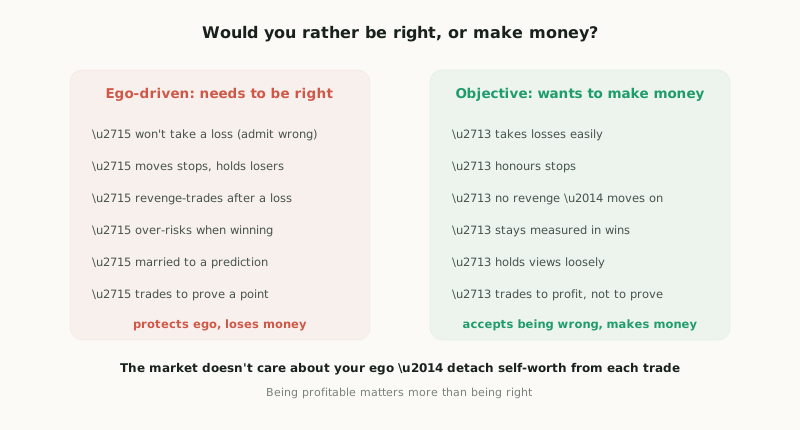
At the heart of the matter is a stark and crucial conflict: the need to be right conflicts with the need to be profitable. These two goals, which the ego conflates, are actually opposed in trading, and recognising their opposition is key. Profitable trading requires things the ego hates: it requires taking losses readily (cutting losers short means frequently admitting you were wrong — a good trader is wrong often and accepts it instantly), and it requires changing your view when the market disagrees (adapting to evidence rather than clinging to a prediction). A trader optimising for profit takes losses without hesitation, changes their mind freely, and feels no need to be vindicated — they just want to make money, and are perfectly happy to be "wrong" on many trades as long as the overall result is profitable.
A trader optimising for being right, by contrast, does the opposite: holds losers (to avoid being wrong), fights the market (to be proven right), clings to views (to protect their judgement), and seeks vindication over profit — all of which lose money. This is why the famous question cuts so deep: "Would you rather be right, or make money?" The ego wants to be right; the profitable trader wants to make money — and these lead to opposite behaviours. Indeed, profitable trading often involves being "wrong" frequently (many individual trades lose) while still making money overall (the winners outweigh the losers — the expectancy logic), so a trader who cannot tolerate being wrong cannot trade profitably, because profitability requires accepting frequent wrongness. The market, moreover, is utterly indifferent to your ego — it will not reward you for being clever or punish you for admitting error; it only responds to whether you cut losses and let profits run, regardless of how that feels to your pride. The trader who grasps that being right and making money are in conflict, and who consciously chooses money — accepting being wrong as the price of profitability — has overcome one of the deepest psychological obstacles in trading. The ego's demand to be right is, quite literally, a demand that conflicts with making money, and it must be subordinated to the goal of profit.
Ego-driven vs objective trading
| The ego-driven trader | The objective trader |
|---|---|
| Holds losers (won't admit wrong) | Cuts losses readily |
| Revenge-trades after a loss | Accepts the loss and moves on |
| Over-risks when winning | Stays measured in wins |
| Married to a prediction | Changes view when evidence does |
| Wants to be right | Wants to make money |
Detaching the ego
The solution is to detach the ego from your trades — to remove your self-image and pride from the equation, so you can trade objectively for profit rather than emotionally for vindication. This detachment rests on a few connected shifts. First, separate your self-worth from individual trades: a losing trade is not a personal failure or a verdict on your intelligence; it is simply one uncertain outcome in a probabilistic activity (the uncertainty and process-vs-outcome lessons). When your self-worth is not on the line with each trade, taking a loss no longer threatens your ego, so you can take it readily. Second, accept being wrong as normal and necessary: in trading, being wrong frequently is not just acceptable but required — cutting losses short means admitting wrong often, and the best traders do so constantly without any bruise to their ego. Reframe "taking a loss" from "admitting I'm a failure" to "doing the correct, professional thing," and being wrong loses its sting.
Third, focus relentlessly on making money rather than being right: make profit, not vindication, your explicit goal, and consciously let go of the need to be proven correct — ask yourself "would I rather be right or make money?" and choose money every time. Fourth, hold your opinions loosely: form market views as provisional probabilities, not personal commitments, so you can change them freely when the evidence changes, without the ego's resistance — a strong opinion weakly held, ready to be revised. Fifth, stay objective and humble: treat the market as an indifferent force to be navigated, not an opponent to be beaten or an audience to be impressed, and stay humble in wins (not letting success inflate the ego into overconfidence) as well as in losses. The result of detaching ego is the objective trader of the table: one who takes losses easily, doesn't revenge-trade, stays measured in wins, changes their view when wrong, and simply wants to make money. This egoless objectivity is profoundly freeing and profoundly profitable — it removes the largest source of the loss-aversion, revenge and overconfidence that sabotage trading, and it aligns the trader's behaviour with what actually makes money rather than what protects pride. The honest takeaway: the ego, with its need to be right, is one of trading's most destructive forces, conflicting directly with profitability; the antidote is to detach the ego — separate self-worth from trades, accept being wrong as normal, choose money over being right, hold views loosely, and stay objective and humble. The market does not care about your ego; the sooner you stop caring too, the better you will trade.
Signs your ego is trading
Because ego operates quietly — dressing itself up as conviction, prudence or analysis — it helps to know the warning signs that it, rather than your objective judgement, is making decisions. Catch these in the moment and you can interrupt the damage. You're letting ego trade when: you find yourself unwilling to take a loss that has hit your stop, looking for reasons to hold on or widening the stop "just a little"; when you feel a surge to win it back immediately after a loss, taking a trade you wouldn't otherwise take; when, after a winning run, you feel invincible and start sizing up beyond your rules; when you notice you're arguing with the market, insisting it's "wrong" and must come back to your level; when you feel a trade is about proving a point — to yourself, to someone who doubted you, or to the market itself; or when you catch yourself defending a prediction against mounting evidence simply because you committed to it.
Each of these is the ego, not your edge, in the driver's seat — and naming it as such is the first step to regaining control. A useful in-the-moment test is the question at the heart of this guide: am I doing this to make money, or to be right (or to feel better)? If the honest answer is the latter, that's the ego, and the disciplined move is to step back, return to your plan, and let the objective trader — who takes the loss, skips the revenge trade, sizes by the rules, and changes view with the evidence — take over. Many traders find it helps to physically pause (close the platform, walk away for a few minutes) when they notice these signs, breaking the ego's grip before it acts. The more readily you can spot ego at work — the reluctance to be wrong, the urge to retaliate, the inflation after wins, the attachment to a view — the more reliably you can subordinate it to the goal that actually matters: making money, not being right.
The ego's need to be right is a quiet killer in trading: it makes traders refuse losses (admitting wrong hurts — so they hold losers and move stops), revenge-trade to restore bruised pride, get overconfident after wins, and cling to predictions even when disproved — all because the real goal has shifted from profit to vindication. The core conflict: being right vs making money. Profitability requires taking losses readily (admitting wrong often) and changing your view when the market disagrees — exactly what the ego resists. "Would you rather be right or make money?" Detach the ego: separate self-worth from trades, accept being wrong as normal and necessary, focus on making money not being right, hold opinions loosely, and stay objective and humble. The market doesn't care about your ego — stop caring too, and trade better.