Give two traders the same strategy, the same signals, the same markets — and they will often get opposite results. One follows the plan, takes losses calmly, and lets the edge play out; the other panics, deviates, revenge-trades and blows up. The deciding factor isn't the strategy; it's the mindset. The trader's mindset is the mental framework that separates consistent traders from the rest, and it is arguably more important than any system or signal — because psychology, not strategy, is where most traders fail. This guide synthesises that mindset: its core components — probabilistic thinking, process focus, discipline, patience, acceptance of losses, and the long-term view — and the reassuring truth that it can be developed. It is the hub of the deeper psychology cluster, linking to dedicated guides on its key elements.
It synthesises and extends trading psychology, and leads into the deep-dives on process over outcome, uncertainty and discipline.
Key takeaways
Q: What is the trader's mindset?
A: The trader's mindset is the mental framework of consistently successful traders: thinking in probabilities, focusing on process over individual outcomes, maintaining discipline and patience, accepting losses as part of the business, and taking a long-term view. It is developed over time, not innate.
Q: Why does mindset matter more than strategy?
A: Because two traders with the same strategy can get opposite results depending on how they think and behave. A sound strategy fails if undermined by fear, greed, impatience or indiscipline, while the right mindset lets a modest edge play out consistently. Execution and psychology decide whether a strategy actually works.
Q: Can the trader's mindset be developed?
A: Yes — it is developed, not innate. Through experience, deliberate practice, self-awareness, journaling, sound risk management and the disciplines covered across trading psychology, traders cultivate probabilistic thinking, emotional control, patience and acceptance of losses over time. Few start with it; most build it.
Why mindset decides everything
The central truth of trading psychology, and the reason this mindset matters so much, is that psychology — not strategy — is where most traders fail. It is entirely possible to have a sound, positive-expectancy strategy and still lose money, because the mind undermines its execution: fear cuts winners short and avoids good trades, greed over-risks and overtrades, impatience forces poor setups, the ego refuses to take losses, and indiscipline abandons the plan at the worst moments. The strategy may be fine; the trader sabotages it. Conversely, a trader with even a modest edge but the right mindset — disciplined, patient, emotionally controlled — can let that edge play out consistently and profitably. This is why two traders with identical strategies get opposite results: the difference is entirely in how they think and behave, not in what they trade.
This makes the mindset arguably more important than the strategy, a conclusion that surprises beginners who obsess over finding the perfect system while neglecting their psychology. The hard reality, echoed throughout this site and confirmed by the experience of countless traders, is that the strategy is the easy part — sound approaches are well-known and freely available — while the execution, governed by mindset, is where the real difficulty and the real failure lie. The market relentlessly tests the trader's psychology: every loss tempts revenge, every win tempts overconfidence, every drawdown tests discipline, every uncertain moment tests composure. A trader without the right mindset is defeated by these tests regardless of strategy; a trader with it survives and prospers. Understanding this — that mindset is the deciding factor, that psychology trumps strategy — is itself the first step toward developing the mindset, because it directs attention to where it truly matters: not the next indicator, but the mind that uses it.
The components of the mindset
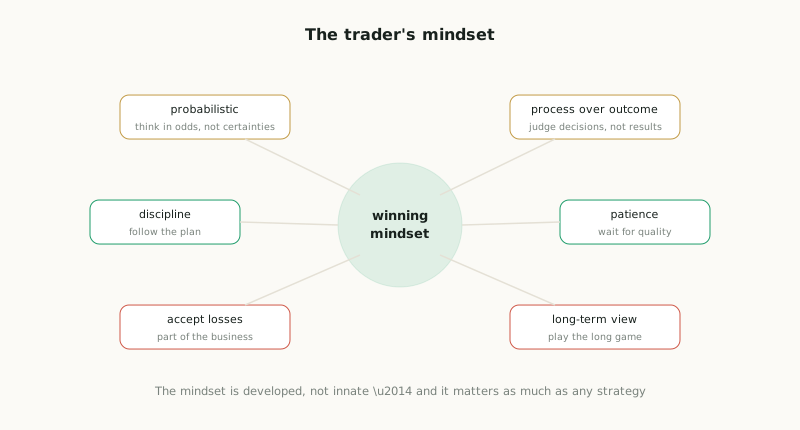
The trader's mindset is woven from several core components, each reinforcing the others and each addressed in depth across the psychology section. They are summarised below.
The winning mindset
Probabilistic thinking is foundational: the successful trader sees each trade as a bet with odds, not a prediction that must come true, accepting that no outcome is certain and that the edge plays out only over many trades (the subject of the uncertainty guide, and rooted in the market theories that show markets are substantially unpredictable). Process focus follows: judging oneself by the quality of decisions, not by individual results (the process-vs-outcome principle), since any single outcome is noise. Discipline — following the plan and controlling emotion rather than being ruled by fear and greed — is what lets the strategy actually be executed (the discipline guide). Patience — waiting for quality setups rather than forcing trades — keeps the trader from the overtrading that destroys edges. Acceptance of losses as a normal, necessary part of the business (not failures or personal affronts) is what allows losses to be taken calmly and small, rather than fought against by the ego (the handling-losses and ego guides). And the long-term view — thinking in terms of many trades and the long game rather than fixating on individual wins and losses — provides the perspective that holds all the others together. To these one might add humility and continuous learning (the markets always have more to teach, and overconfidence is dangerous) and responsibility (owning one's results rather than blaming the market). Together these components form a coherent mental framework: a probabilistic, process-focused, disciplined, patient, loss-accepting, long-term-oriented way of approaching the markets that lets an edge be executed consistently. Each is covered in depth elsewhere; the mindset is their synthesis.
The mindset can be developed
Perhaps the most important and encouraging truth about the trader's mindset is that it is developed, not innate. Very few traders begin with this mindset — it runs contrary to many natural human instincts (we crave certainty, fear losses, want to be right, seek quick rewards, and react emotionally), which is precisely why most traders struggle with psychology and why the mindset is rare. But it can be cultivated over time through deliberate effort, and the fact that it is learned rather than inborn means it is available to anyone willing to do the work — you are not simply "the wrong type" if you don't have it yet.
The mindset is built through the very practices the psychology and risk sections describe. Experience teaches it, as the trader lives through losses, drawdowns and the consequences of poor psychology, gradually internalising the lessons (though experience alone, without reflection, can also entrench bad habits). Self-awareness and reflection — honestly observing one's own emotional reactions and mistakes — are essential, which is why the trading journal (recording not just trades but the thinking and emotions behind them) is such a powerful tool for developing the mindset. Sound risk management supports it practically: when risk is properly controlled (small per-trade risk, sensible position sizing), losses are less threatening, making it far easier to stay calm, accept losses, and think long-term — good risk management and good psychology reinforce each other. Realistic expectations (understanding that losses and drawdowns are normal and inevitable) prevent the shock and emotional damage that unrealistic hopes cause. And deliberate practice of the disciplines — following a plan, waiting patiently, taking losses by the rules, focusing on process — gradually makes them habitual. The development is slow and ongoing; the mindset is strengthened over a trading career rather than acquired all at once, and even experienced traders must keep working at it. But the trajectory is clear and achievable: through experience, reflection, journaling, sound risk management, realistic expectations and deliberate practice, the natural human instincts that sabotage trading are gradually replaced by the probabilistic, process-focused, disciplined, patient, accepting, long-term mindset that lets a trader succeed. The strategy you can learn quickly; the mindset you build over time — and it is the building of that mindset, more than the search for any system, that is the real work of becoming a consistent trader.
The amateur and the professional mindset
The mindset becomes clearer by contrast. The typical amateur mindset — the natural, untrained way of thinking that most beginners bring — looks for certainty (seeking the perfect system that will tell them what will happen), judges by outcomes (elated by wins, devastated by losses, learning the wrong lessons from both), is ruled by emotion (fear and greed driving impulsive decisions), is impatient (forcing trades, chasing action, wanting quick riches), is ego-driven (needing to be right, refusing to take losses, revenge-trading), and fixates on individual trades (each one feeling enormously important). This mindset — certainty-seeking, outcome-focused, emotional, impatient, ego-driven, short-term — is exactly what the market punishes, which is why most who trade this way fail.
The professional mindset is the inverse on every count: it accepts uncertainty (thinking in probabilities, seeking favourable odds rather than impossible certainty), judges by process (evaluating decision quality, not single results), maintains emotional control (following the plan rather than feelings), is patient (waiting for quality, content to do nothing), is egoless (happy to be wrong often, taking losses instantly, seeking profit not vindication), and thinks long-term (any single trade is just one of thousands, mattering little). Laid side by side, the two mindsets are almost perfect opposites — and the journey from amateur to professional is the development of the trader's mindset described in this guide. The encouraging point is that this is a journey anyone can make: the professional mindset isn't a personality you either have or lack, but a set of attitudes that can be deliberately cultivated, gradually replacing the natural amateur instincts. Recognising which way you currently lean on each dimension — do you crave certainty or accept probability? judge by outcomes or process? trade on emotion or plan? — is a useful self-diagnostic, showing where your mindset most needs development. The work of trading, in large part, is making this shift, one attitude at a time.
The trader's mindset — not the strategy — is the deciding factor, because psychology is where most traders fail: a sound strategy is undone by fear, greed, impatience, ego and indiscipline, while the right mindset lets even a modest edge play out. Its components: probabilistic thinking, process focus, discipline, patience, acceptance of losses, and the long-term view — plus humility and responsibility. The amateur mindset (certainty-seeking, outcome-focused, emotional, impatient, ego-driven, short-term) is the near-perfect opposite of the professional one (accepts uncertainty, process-focused, controlled, patient, egoless, long-term) — and the journey between them is the work of trading. Crucially, the mindset is developed, not innate: built through experience, self-awareness and journaling, sound risk management, realistic expectations and deliberate practice. The strategy is the easy part; building the mindset is the real work.