You follow your plan perfectly, take a sound, positive-expectancy trade — and it loses. Meanwhile, a reckless gamble with no edge, taken on a whim, wins big. Which was the better decision? If you judge by the result, you'll learn exactly the wrong lesson: punish the good trade and celebrate the bad one. This is the trap that process vs outcome thinking guards against. In a probabilistic game like trading, a single outcome does not reveal whether a decision was sound — good decisions lose and bad ones win all the time — so judging yourself by results rather than by the quality of your process teaches the wrong lessons and corrodes good trading. This guide explains why outcomes mislead, the danger of outcome bias, and why judging decisions by process is essential.
It is a core pillar of the trader's mindset, rooted in the probabilistic nature explored in dealing with uncertainty and the expectancy that plays out over many trades.
Key takeaways
Q: What is process versus outcome thinking?
A: It is the principle of judging your trading decisions by the quality of the process behind them — whether they were sound, plan-following, positive-expectancy decisions — rather than by the individual outcome. Because trading is probabilistic, a good decision can lose and a bad one can win, so outcomes alone don't reveal decision quality.
Q: What is outcome bias?
A: Outcome bias is judging the quality of a decision by its result rather than by the reasoning behind it. In trading, it leads to punishing good decisions that happened to lose and rewarding bad decisions that happened to win — teaching the wrong lessons and reinforcing reckless behaviour that got lucky.
Q: Why focus on process rather than results?
A: Because any single result is largely noise in a probabilistic activity, while good process produces good results over many trades as the edge plays out. Focusing on process keeps you doing the right things regardless of short-term luck, and prevents you from abandoning a sound approach after unlucky losses or doubling down on a lucky but reckless one.
Why outcomes mislead
The root of the matter is that trading is probabilistic, which creates a fundamental disconnect between decision quality and individual outcome. Because any single trade's result depends heavily on chance (the market's unpredictable short-term movement), a good decision — a sound, well-reasoned, plan-following trade with positive expectancy — can still lose, simply through bad luck on that particular trade. And a bad decision — a reckless, no-edge gamble that violates the plan — can still win, through good luck. The outcome of any one trade is, to a large degree, noise: it reflects the random short-term outcome as much as (often more than) the quality of the decision behind it.
This is the same logic as in any probabilistic endeavour. A poker player who gets their money in with the best hand (a good decision) still loses sometimes when the opponent draws out (bad luck); a player who makes a terrible call still wins occasionally (good luck). The quality of the decision and the result of any single instance are only loosely connected — they align only on average, over many repetitions. In trading, this means you cannot read decision quality from a single result: a loss does not prove the decision was bad, and a win does not prove it was good. Over a large number of trades, good decisions (positive expectancy) do produce good results and bad ones produce bad results — the edge, or its absence, plays out (the expectancy lesson). But on any individual trade, luck dominates, and the outcome reveals little about the decision. Recognising this disconnect — that single outcomes are mostly noise, that good decisions lose and bad ones win, that decision quality and results align only over many trades — is the foundation of process thinking, and it directly contradicts the natural human tendency to judge decisions by how they turned out.
The danger of outcome bias
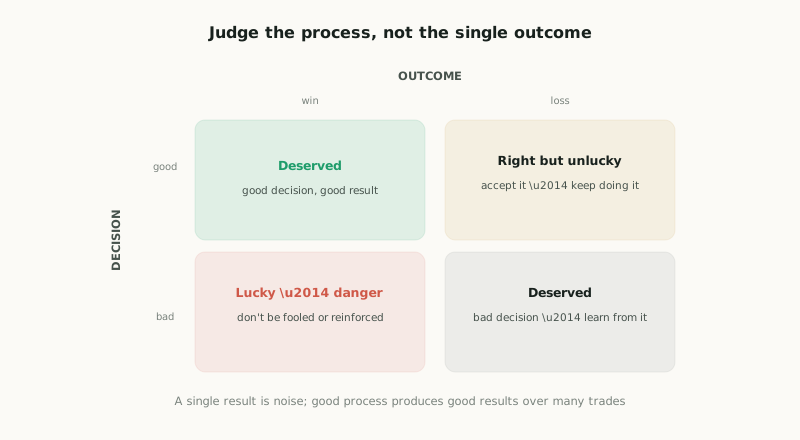
That natural tendency — judging a decision by its result — is a well-documented cognitive error called outcome bias (from the cognitive-biases guide), and in trading it is genuinely dangerous because it teaches precisely the wrong lessons. Consider the four cases in the matrix. When you judge by outcome, a good decision that lost (right but unlucky) gets punished — you conclude the decision was wrong, lose confidence in a sound approach, and may abandon a positive-expectancy strategy after a few unlucky losses, which is exactly backward. Meanwhile, a bad decision that won (lucky) gets rewarded — you conclude the reckless gamble was smart, feel reinforced, and are encouraged to repeat the dangerous behaviour, which is even more harmful.
This second case is the truly insidious one. When a reckless, no-edge trade wins, outcome bias makes the trader feel validated — "see, it worked!" — and reinforces the bad behaviour, encouraging more of it. The trader is being rewarded for recklessness by luck, and outcome thinking ensures they learn to do more of what will eventually ruin them. Many traders are destroyed by exactly this path: early reckless trades happen to win, outcome bias reinforces the recklessness, position sizes and risks grow, and then the luck inevitably turns and the accumulated bad habits cause catastrophic losses. The lucky win was worse than a loss would have been, because it taught the wrong lesson. Equally damaging, outcome bias causes traders to abandon good approaches after unlucky losing streaks — a sound strategy hits a normal run of losses (which any strategy does), the trader judges it by those outcomes, concludes it "doesn't work," and discards it just as it might have resumed winning. Outcome bias thus systematically corrupts learning in trading: it punishes sound process that got unlucky and rewards reckless process that got lucky, driving the trader toward worse decisions over time. It is one of the most destructive psychological errors in trading precisely because it operates through the natural, intuitive act of "learning from results" — which, in a probabilistic game, learns the wrong things.
Judging by process
The solution is to judge decisions by the quality of the process, not the individual outcome. After each trade, the question to ask is not "did it win or lose?" but "was it a good decision — a sound, plan-following, positive-expectancy trade, properly sized and managed?" A good trade is one made well, regardless of how it turned out; a bad trade is one made poorly, even if it won. The table below captures the right response to each case.
Process focus vs outcome focus
| Situation | Outcome thinking (wrong) | Process thinking (right) |
|---|---|---|
| Good trade, lost | "That was a mistake" | Right decision, unlucky — keep doing it |
| Bad trade, won | "That was smart" | Lucky — don't be fooled or repeat it |
| Good trade, won | "I'm a genius" | Deserved — stay measured |
| Bad trade, lost | "Bad luck" | Deserved — learn from the error |
This process focus has profound practical benefits. It keeps you doing the right things regardless of short-term luck — continuing a sound, positive-expectancy approach through unlucky losing streaks (because you judge the process as sound, not the unlucky results), and not being seduced into repeating reckless trades that happened to win (because you recognise them as bad process that got lucky). It lets the edge play out: since good process produces good results over many trades, focusing relentlessly on process quality is exactly what allows the long-run edge to materialise, while outcome-chasing sabotages it. It also protects your psychology: judging by process means an unlucky loss on a well-made trade is not a personal failure or cause for despair (you made a good decision; the outcome was noise), which supports the emotional resilience and loss-acceptance that sound trading requires. The practical tool for this is the trading journal: by recording the reasoning and process behind each trade (not just the profit and loss), you can review whether your decisions were sound independent of how they turned out, learning the right lessons — reinforcing good process and correcting bad, regardless of individual results. The honest, liberating takeaway: in a probabilistic activity, you cannot control or judge by individual outcomes, but you can control and judge your process — so focus there. Make good decisions consistently, judge yourself by their quality rather than their results, refuse to be fooled by lucky wins or shaken by unlucky losses, and let the law of large numbers turn good process into good results over time. This shift — from "did it win?" to "was it a good decision?" — is one of the most important in all of trading psychology, and it is central to the probabilistic mindset that consistent trading requires.
Reviewing trades by process
Process thinking becomes practical in how you review your trades — and this is where the trading journal earns its keep. Most traders review by profit and loss alone: green trades good, red trades bad. But that is pure outcome thinking, and it teaches the wrong lessons. Process-focused review instead asks, of each trade, a different set of questions: Did I follow my plan? Was the setup a valid, positive-expectancy one by my rules? Did I size the position correctly and place a proper stop? Did I manage the trade as intended, or did emotion interfere? These questions assess the decision, independent of how it turned out — and they let you sort your trades into the four matrix quadrants honestly.
This review reveals what raw P&L hides. A losing trade that followed the plan perfectly (a good decision, unlucky outcome) should be marked as well-traded and repeated — not punished. A winning trade taken on a whim, against the plan (a bad decision, lucky outcome), should be flagged as a warning — not celebrated — because the behaviour will eventually cost you even though it paid this time. Over many trades, this process-focused review separates luck from skill: it shows you whether your decisions are sound regardless of the noisy short-term results, lets you reinforce good process and correct bad, and stops you from drawing false lessons from individual outcomes. It also surfaces the gap between your strategy and your execution — if your decisions are sound but results poor over a large sample, perhaps you're genuinely in a normal drawdown (keep going); if your decisions are frequently poor (deviating, over-sizing, emotional), that's the real problem to fix, regardless of whether luck has masked it. Reviewing by process rather than outcome is how the principle becomes a concrete habit, and the journal is the tool that makes it possible — recording not just what you made or lost, but whether each trade was a good decision.
In a probabilistic game, a single outcome doesn't reveal decision quality: good decisions can lose through bad luck, and bad ones can win through good luck — any single result is mostly noise. Outcome bias — judging by results — teaches the wrong lessons: it punishes good trades that lost (so you abandon sound approaches) and rewards bad trades that won (reinforcing recklessness luck will eventually punish). The fix: judge decisions by the quality of the process — ask "was it a good decision?" not "did it win?" Review trades by process (did I follow the plan? valid setup? correct sizing?), using the journal to separate luck from skill, reinforce good process and flag lucky-but-reckless wins. This keeps you doing the right things through luck's swings and lets your edge play out over many trades. Shift from "did it win?" to "was it a good decision?"