You will never know what the next candle will do. No matter how much you analyse, how good your setup, how confident you feel — the outcome of any individual trade is fundamentally unknowable in advance. Trading is irreducibly uncertain, and this simple fact is the source of enormous psychological difficulty: the craving for certainty drives traders to chase "perfect" systems that don't exist, to freeze in hesitation, to agonise over every decision, and to feel anxiety that never resolves. Yet there is a liberating paradox at the heart of this guide: accepting uncertainty, rather than fighting it, is precisely what brings the calm to trade well. This guide explains why trading is inherently uncertain, why craving certainty hurts, and how accepting probabilistic uncertainty transforms a trader's psychology.
It rests on the same reality as random walk theory (markets are substantially unpredictable), underpins process thinking, and is central to the trader's mindset.
Key takeaways
Q: Why is trading inherently uncertain?
A: Because markets are substantially unpredictable — you can never know what price will do next, only the probabilities. No analysis removes this uncertainty; every trade is a bet under conditions of genuine not-knowing, where even a high-probability setup can fail and a poor one can work.
Q: Why does craving certainty hurt traders?
A: Because certainty is unattainable, so chasing it leads to endless searching for a 'perfect' system, hesitation and analysis paralysis, anxiety over every trade, and frustration when no approach removes the doubt. The craving for certainty fights the irreducible nature of the activity and undermines calm execution.
Q: How do you deal with uncertainty in trading?
A: By accepting that you operate in probabilities, not certainties — embracing that you can't know any single outcome, focusing on your edge over many trades rather than predicting each one, and detaching from the need to be right. Paradoxically, accepting you can't know brings the calm to execute well.
Why trading is irreducibly uncertain
Trading is inherently, irreducibly uncertain, and no amount of skill or analysis changes this. As the market theories establish, markets are substantially unpredictable — the random-walk and efficient-market discussions show that future price movements cannot be reliably forecast, that markets are mostly (though not perfectly) random, and that any edge is probabilistic and modest. This means you can never know what will happen next; you can only assess probabilities. Every trade, however well-analysed, is a bet placed under genuine uncertainty, where the outcome is not knowable in advance — even a high-probability setup can fail, and a poor one can work, because the future is not determined by your analysis.
This uncertainty is not a flaw in your method to be eliminated with better tools; it is the nature of the activity. No system, indicator, pattern or amount of study can remove it, because it stems from the fundamental unpredictability of markets, not from any deficiency in the trader. The best traders, with the best methods, still face complete uncertainty about any individual trade's outcome — their edge gives them favourable probabilities over many trades, not certainty on any one. This is a crucial realisation: the uncertainty you feel is real, permanent, and shared by everyone, including the most successful. It cannot be analysed away or conquered; it can only be accepted and worked with. Trading is, irreducibly, a probabilistic activity conducted under genuine uncertainty — and any approach to it that depends on removing the uncertainty is doomed, because the uncertainty cannot be removed. Recognising this is the starting point for dealing with it healthily, rather than fighting an unwinnable battle against the unknowable.
Why craving certainty hurts
The trouble is that humans crave certainty — we are deeply uncomfortable with not knowing, and we instinctively seek to resolve uncertainty into firm answers. In trading, this natural craving collides with the irreducible uncertainty of markets, and the collision causes real harm. The craving for certainty drives several damaging behaviours. It fuels the endless, fruitless search for a "perfect" system or signal — the holy-grail quest for an approach that will finally remove the doubt and tell the trader what will happen, which is doomed because no such certainty exists (and which often leads traders into the arms of those selling false certainty: the guru systems and robots the scams guide warns about). It causes hesitation and analysis paralysis — the trader, unable to achieve the certainty they crave, freezes, endlessly seeking more confirmation before acting, missing trades or entering too late. It generates anxiety — agonising over every trade, unable to feel settled because the desired certainty never comes. And it produces frustration and emotional turmoil when, inevitably, no approach delivers the certainty sought.
At its core, the craving for certainty is a fight against the very nature of the activity — and it is unwinnable, so it produces only suffering and poor decisions. A trader who needs to be sure before acting, who needs to know the outcome, who cannot tolerate not knowing, is in constant conflict with the irreducibly uncertain reality of markets. This conflict drains energy, clouds judgement, and undermines the calm execution that good trading requires. It also feeds the need to be right (the ego problem covered separately): craving certainty and needing to be right are close cousins, both reflecting a discomfort with the probabilistic, uncertain nature of trading. The craving for certainty, then, is not a harmless preference but an active source of the anxiety, paralysis, holy-grail-chasing and frustration that plague so many traders — and it stems from refusing to accept what trading fundamentally is. The harm comes not from the uncertainty itself, but from the refusal to accept it.
Accepting uncertainty — the liberating paradox
The resolution is as simple to state as it is hard to achieve: accept the uncertainty. Embrace that you operate in probabilities, not certainties; accept that you cannot know the outcome of any individual trade; and stop trying to. This acceptance contains a liberating paradox: once you accept that you can't know, you stop needing to — and the anxiety, paralysis and holy-grail-chasing that came from craving certainty fall away. The discomfort of uncertainty largely dissolves not by resolving the uncertainty (impossible) but by making peace with it. The trader who fully accepts that trading is uncertain can act calmly and decisively under that uncertainty, because they are no longer fighting it.
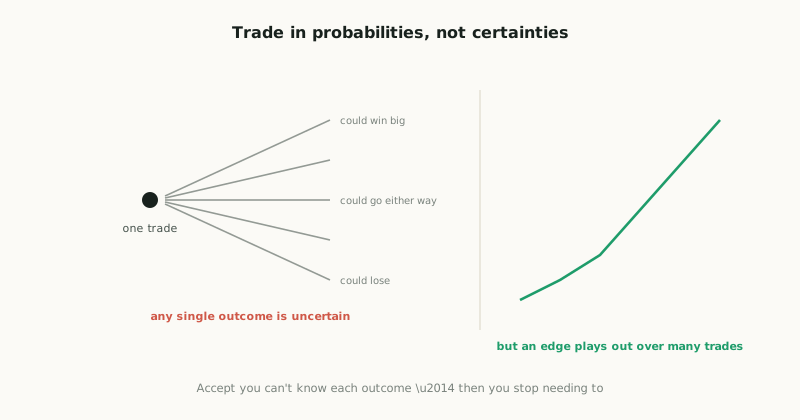
Practically, accepting uncertainty means adopting probabilistic thinking. Instead of asking "what will happen?" (an unanswerable question that breeds anxiety), the trader asks "what are the probabilities, and do they favour me?" — and then acts on a favourable-probability setup while fully accepting that this particular trade might still lose. The focus shifts from the unknowable individual outcome to the edge over many trades: as the diagram shows, while any single trade is uncertain, a genuine edge plays out reliably over a large sample, so the trader trusts the process and the edge across many trades rather than trying to predict or control each one (the link to process-vs-outcome thinking is direct). This is profoundly calming: you no longer need to be right on any trade, only to have an edge over many; you no longer need certainty, only favourable probabilities; you no longer agonise over outcomes you cannot control, but focus on decisions you can. Acceptance of uncertainty also brings emotional benefits: losses become easier to take (an uncertain activity will produce losses; a particular loss is just the uncertain outcome of a sound bet, not a failure), and the constant anxiety of needing to know subsides into the calm of working with probabilities. A brief, important note on wellbeing: if the uncertainty and pressure of trading ever generate anxiety that spills beyond the trading itself and begins to affect your broader wellbeing, that is a sign to step back, reduce your exposure or take a break, and — if it persists — to seek support; trading should never come at the cost of your mental health, and stepping away is always a valid choice. But for the normal discomfort of market uncertainty, the path is acceptance: embrace that trading is probabilistic and uncertain, think in probabilities, trust your edge over many trades, detach from the need to know any single outcome — and find, in that acceptance, the calm and clarity that the futile craving for certainty can never provide. Accepting that you cannot know is, paradoxically, what frees you to trade well.
The relief isn't in resolving the uncertainty — it can't be resolved — but in accepting it. Once you truly accept you can't know any single outcome, you stop needing to, and the anxiety, paralysis and holy-grail-chasing fall away. Ask "do the probabilities favour me?" not "what will happen?", act on a favourable edge while accepting this trade might lose, and trust the edge over many trades. Accepting you can't know is what frees you to trade calmly.
Practical habits for trading under uncertainty
Accepting uncertainty is a mindset, but a few concrete habits make it easier to live by. First, pre-define your risk on every trade: by setting your stop-loss and position size before you enter — deciding in advance exactly how much you can lose — you make the uncertain outcome bounded and survivable, which removes much of the anxiety. You can't control whether the trade wins, but you can control how much it costs if it loses, and knowing that in advance lets you accept the uncertain result calmly. Pre-defined risk is, in effect, how you make peace with not knowing: whatever happens, you've already accepted the worst case.
Second, think in terms of the next hundred trades, not the next one. Since any single trade is uncertain but an edge plays out over a large sample, deliberately shifting your frame from "this trade" to "my next hundred trades" reframes each individual result as one small, low-stakes sample in a long series — defusing the pressure and emotion attached to any one outcome. A single trade feels momentous; one of the next hundred feels trivial, which is closer to the truth. Third, focus on what you control — your analysis, your decision, your risk, your discipline — and consciously release what you don't (the outcome). This is the process focus again: directing your attention and sense of agency toward the controllable decision rather than the uncontrollable result. Fourth, keep a journal that records your reasoning, so you can confirm over time that sound decisions produce good results across many trades — building the experiential trust in your edge that makes accepting individual uncertainty far easier. These habits — pre-defining risk, thinking in large samples, focusing on the controllable, and journaling — turn the abstract acceptance of uncertainty into a concrete, livable practice, and together they replace the anxious craving for certainty with the calm confidence of a trader who knows they can't know, and is at peace with it.
Trading is irreducibly uncertain — markets are substantially unpredictable, so you can never know any single trade's outcome, only the probabilities; even the best traders face complete uncertainty on each trade (their edge is probabilistic, over many trades). Craving certainty hurts: it fuels the holy-grail search, hesitation and paralysis, anxiety, and frustration — an unwinnable fight against the activity's nature. The resolution is acceptance: think in probabilities (ask "do the odds favour me?", not "what will happen?"), act on a favourable edge while accepting any trade may lose, and trust your edge over many trades. Make it livable with concrete habits: pre-define your risk (so the worst case is bounded and accepted), think in terms of the next hundred trades not the next one, focus on what you control, and journal your reasoning. Accepting you can't know brings the calm to trade well. If trading's pressure ever harms your wider wellbeing, step back and seek support.