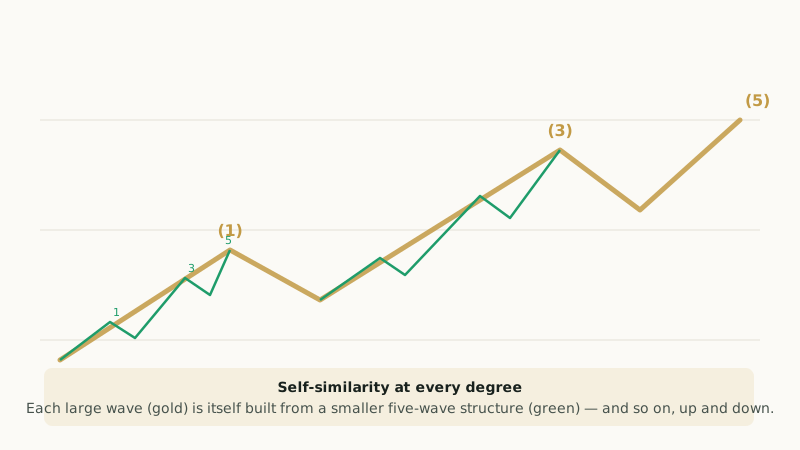
The most important idea in Elliott Wave is also the easiest to underestimate: the pattern is fractal. The same five-wave-then-three-wave structure that you see on a five-minute chart is also unfolding on the hourly, the daily, the weekly and the monthly — each nested inside the next like Russian dolls. To talk about this nesting coherently, Elliott gave each level a name. Those levels are called degrees, and understanding them is what stops a perfectly valid count from being the wrong size entirely — the single most common reason wave analysis goes wrong.
This guide expands on the fractal nature introduced in Elliott Wave theory explained, and it underpins the top-down method described in how to count Elliott waves.
Key takeaways
Q: What are Elliott Wave degrees?
A: Degrees are the levels in the fractal hierarchy of Elliott waves. Because the same five-three pattern repeats at every scale, each wave is classified by degree — from the largest, Grand Supercycle, down to the smallest, Subminuette — to describe which size of trend it belongs to.
Q: What are the Elliott Wave degrees in order?
A: From largest to smallest: Grand Supercycle, Supercycle, Cycle, Primary, Intermediate, Minor, Minute, Minuette and Subminuette. Each is one degree of the same repeating structure.
Q: Why do wave degrees matter for trading?
A: Degree provides context. A valid five-wave count on a 15-minute chart may be only a sub-wave of a much larger structure. Trading it without knowing its degree means misjudging both the likely size of the move and where the count is invalidated.
Why degrees exist
Because every wave is built from smaller waves of the same form, and is itself part of a larger wave of the same form, any point on a chart can be described at many scales at once. A single rally might be wave 3 of an Intermediate-degree impulse, which is itself wave 1 of a Primary-degree impulse, which is in turn wave 3 of a Cycle-degree advance. All of those statements can be true simultaneously — they simply describe the same price action at different magnifications.
Degrees are the vocabulary that lets an analyst be precise about which magnification they mean. Without that vocabulary, statements like "we're in wave 3" are meaningless, because wave 3 of what is the entire question. With it, you can say "we're in wave 3 of Minor degree, within wave 1 of Intermediate degree," and everyone knows exactly which trend, at which scale, you are talking about.
The full ladder of degrees
Elliott defined a sequence of named degrees spanning from the largest moves in market history down to the smallest intraday wiggles. From largest to smallest, the commonly used names are:
- Grand Supercycle — the largest degree, spanning many decades or centuries.
- Supercycle — multi-decade moves.
- Cycle — several years to decades.
- Primary — months to a few years; the degree most relevant to position traders.
- Intermediate — weeks to months.
- Minor — days to weeks.
- Minute — hours to days.
- Minuette — intraday.
- Subminuette — the smallest commonly labelled degree, minutes.
The names themselves are simply convenient labels; nothing magical happens at the boundary between, say, Minor and Minute. What matters is the relative hierarchy — that each degree is one step larger or smaller than its neighbours — not the precise duration any given degree "should" occupy. Time spans are loose guides, not rules, and the same degree can take very different amounts of time in different markets and conditions.
Labelling conventions
To keep counts legible, analysts use different notation for each degree so that, at a glance, you can see which scale a label refers to. Motive waves at larger degrees are typically marked with Roman numerals (I, II, III, IV, V), while smaller degrees use Arabic numerals (1, 2, 3, 4, 5), and corrective waves likewise shift between uppercase and lowercase letters (A, B, C versus a, b, c). Circled or bracketed labels are often used to denote particular degrees within a chart so that a Primary-degree wave 1 is visually distinct from a Minor-degree wave 1.
The exact scheme varies between analysts and software, and the specifics matter less than the principle: a consistent notation lets you nest counts without losing track of which degree each wave belongs to. The discipline of always labelling the degree, even informally, is what keeps a multi-timeframe count coherent.
Why getting the degree right is everything
Here is the practical heart of the matter. Suppose you identify a clean, valid five-wave advance on a 15-minute EUR/USD chart. Structurally it might be flawless — all three rules satisfied, the Fibonacci proportions textbook. But if that five-wave move is merely wave 1 of a larger Minor-degree impulse, then treating it as a completed trend and positioning for a major reversal would be a serious error: the larger structure has four more waves to go, and price is far more likely to continue than to reverse.
This is precisely why the count must be built from the higher timeframe down. The larger degree frames the smaller one and tells you what role your clean little five-wave move is actually playing. A five that is wave 1 of something bigger calls for a completely different stance than a five that completes a Cycle-degree advance. Same shape, same validity, opposite implications — and the only thing that distinguishes them is degree. Misjudging it is the root cause of a large share of failed wave trades, which is why experienced analysts treat establishing the degree as the first and most important step.
A wave count can be perfectly valid and still be useless if you have the degree wrong. Validity tells you the shape is legal; degree tells you what the shape means. Always establish the larger degree before acting on the smaller one.
Degrees in forex practice
For a currency trader, degrees map naturally onto timeframes. A position trader thinks in Primary and Intermediate degrees on the daily and weekly charts; a swing trader works in Minor and Minute degrees on the four-hour and hourly; an intraday trader operates down at Minuette and Subminuette. The crucial habit, regardless of style, is to anchor analysis at least one degree above the timeframe you intend to trade, so that every entry is taken with the larger structure in view.
That higher-degree anchor also provides the cleanest invalidation levels. The start of the larger-degree wave you are trading within is a natural, logical place for a stop, because a break of it means your read on the larger structure was wrong. Combined with the proportional targets from Fibonacci ratios, the degree framework turns a fractal, potentially bewildering market into something an analyst can navigate one scale at a time.
The degree errors that wreck counts
Most degree-related failures come down to three recurring mistakes, and recognising them is half the cure. The first and most damaging is trading a sub-wave as if it were the whole move. A trader spots a clean five-wave advance, declares the trend complete, and positions for a reversal — not realising that the five they counted is merely wave 1 of a larger-degree impulse with four waves still to come. The market continues, the "reversal" trade is run over, and the lesson — that validity without correct degree is worthless — is learned the hard way.
The second is jumping degrees mid-count: starting to label a structure at one degree and then, without noticing, slipping into a smaller or larger one partway through, so that the finished count mixes scales incoherently. This usually happens when an analyst zooms in to resolve a tricky section and forgets to zoom back out, ending up with sub-waves of one wave sitting alongside primary waves of another. The count looks plausible but is internally inconsistent, and any projection built on it inherits the confusion.
The third is inconsistent labelling — failing to use distinct notation for each degree, so that a Minor-degree wave 3 and a Primary-degree wave 3 look identical on the chart and become impossible to keep straight. The fix for all three is the same discipline emphasised throughout wave analysis: count strictly from the higher timeframe down, fix the degree of each wave before refining it, and label degrees distinctly so the hierarchy stays visible at a glance.
How many degrees should you track?
You do not need to label the market from Grand Supercycle down to Subminuette to trade it — that way lies paralysis. In practice, tracking three adjacent degrees is usually enough: the degree you intend to trade, one degree above it for context, and one degree below it for entry timing. A swing trader, for instance, might frame the trade at Minor degree, take context from the Intermediate-degree structure above, and refine entries using Minute-degree sub-waves below. That three-degree window keeps the larger trend in view without drowning the analysis in detail.
The principle behind this is simply that the degree immediately above governs the one you are trading, and the degree immediately below sharpens your timing within it. Degrees further out matter for very long-term positioning but add little to a given trade and a great deal of noise. Choosing a sensible three-degree window for your style, and labelling it consistently, is what makes the fractal hierarchy a practical tool rather than an overwhelming abstraction.
Degrees name the levels of the fractal hierarchy, from Grand Supercycle down to Subminuette. Establish the larger degree first; never trade a sub-wave as if it were the whole move; don't drift between degrees mid-count; and in practice track about three adjacent degrees — one to trade, one above for context, one below for timing.