
Not all currencies are free to roam. Some float on the open market, their value set moment to moment by supply and demand; others are pinned to a fixed rate by their central bank; and many sit somewhere in between. A currency's exchange rate regime tells you, more than almost anything else, how it will behave — whether it trends and swings like the majors traders love, or sits in a tight band until the rare, dramatic day a peg breaks. This guide explains exchange rate regimes: the spectrum from floating to fixed, why pegs break, the impossible trinity that governs the choice, and what it all means for forex traders.
It's the structural backdrop to currency intervention and monetary policy, and underpins how the currencies in forex actually move.
Key takeaways
Q: What is an exchange rate regime?
A: An exchange rate regime is the system a country uses to manage its currency's value, ranging from fully floating (set by the market) to fixed or pegged (held at a set rate by the central bank), with managed floats in between. The regime determines how the currency behaves — a floating currency is market-driven and volatile, while a pegged one stays stable until, occasionally, the peg breaks.
Q: Why do currency pegs break?
A: A peg requires the central bank to defend a set rate using reserves and policy, which becomes unsustainable if the fixed rate diverges too far from economic reality or comes under heavy speculative attack. When defending it costs more than the central bank can or will bear, the peg breaks — often suddenly and violently, as in the 1992 pound, the 1997 Asian crisis, or the 2015 removal of the Swiss franc floor.
Q: What is the impossible trinity?
A: The impossible trinity (or trilemma) is the principle that a country cannot simultaneously have a fixed exchange rate, free capital flows, and an independent monetary policy — it can only choose two of the three. It explains why countries make the regime trade-offs they do, and why pegs combined with open capital markets and policy independence eventually fail.
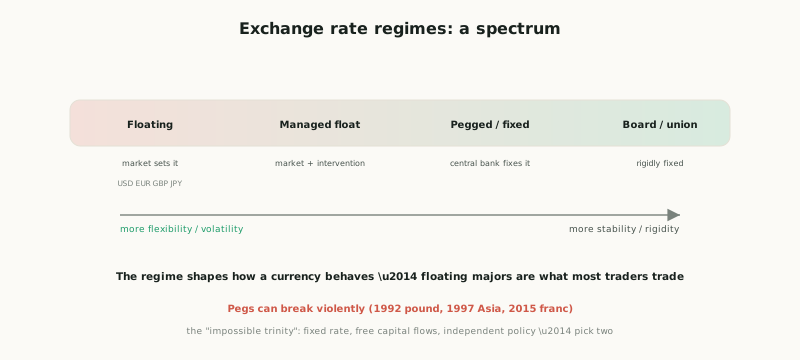
The spectrum of regimes
Exchange rate regimes form a spectrum from fully market-determined to rigidly fixed. The table sets out the main types.
The spectrum of regimes
| Regime | Who sets the rate | Character |
|---|---|---|
| Floating (free float) | The market (supply & demand) | Volatile; monetary independence; most majors |
| Managed float | Mostly market, with intervention | Market-driven but smoothed/steered |
| Pegged / fixed | Central bank, to a currency/basket | Stable — until it breaks |
| Currency board | Fixed, fully backed by reserves | Very rigid (e.g. Hong Kong) |
| Dollarization / union | Adopts another currency | No own currency (e.g. the euro) |
A floating (free-floating) currency has its value set by the FX market — supply and demand — with the central bank not targeting a particular rate (though it may intervene occasionally). Most majors (USD, EUR, GBP, JPY) float. The advantages are automatic adjustment to economic conditions and the freedom to run an independent monetary policy; the cost is volatility. A managed (or "dirty") float is mostly market-determined but with the central bank intervening to influence or smooth the rate — in truth, most "floating" currencies are managed floats to some degree. A pegged (fixed) regime ties the currency to another currency (or a basket) at a set rate, which the central bank maintains by buying and selling reserves and adjusting policy; the benefits are stability, an anti-inflation anchor and trade certainty, while the costs are the need for ample reserves, the loss of monetary independence, and vulnerability to speculative attack. Stricter forms include the currency board (a rigid peg fully backed by reserves, as in Hong Kong), and at the extreme, dollarization (adopting another country's currency outright) or a monetary union (sharing a currency, as with the euro), which abandon a national currency altogether. Along the spectrum, flexibility and volatility decrease while stability and rigidity increase.
Why pegs break, and what it means for traders
The most dramatic feature of fixed regimes is that pegs can break — sometimes spectacularly. Maintaining a peg requires the central bank to defend the fixed rate, and if that rate drifts too far from economic reality, or comes under sustained speculative attack, defending it can become impossible: reserves run down, or the cost in lost policy flexibility becomes unbearable, and the peg collapses, often producing enormous, sudden currency moves. History is studded with examples — the 1992 breaking of the British pound's ERM peg (where George Soros famously profited), the 1997 Asian financial crisis as regional pegs fell, and the 2015 removal of the Swiss National Bank's EUR/CHF floor, which sent the franc soaring violently in minutes. The principle underlying why pegs are so hard to sustain is the "impossible trinity" (or trilemma): a country cannot simultaneously have (1) a fixed exchange rate, (2) free capital flows, and (3) an independent monetary policy — it can pick only two. A country wanting a fixed rate and open capital markets must surrender control of its own monetary policy; one wanting policy independence and open capital must let the currency float. This trilemma explains both the regime choices countries make and why pegs combined with open capital and policy independence eventually fail.
For forex traders, the regime is fundamental to how a currency behaves, and therefore to how (and whether) you trade it. Floating majors are what most retail traders trade — they're liquid, they trend and range, and their volatility is the raw material of trading. Pegged currencies behave entirely differently: they sit in tight ranges (offering little to trade) right up until — if it ever happens — a peg break produces a violent, one-directional move that is simultaneously a massive opportunity and a catastrophic risk (gaps, slippage and broker issues during a peg break have wiped out accounts). Understanding a currency's regime, then, tells you what to expect: trend-and-range tradability from floaters, deceptive calm-then-chaos from pegs. The honest framing: exchange rate regimes are the systems countries use to manage their currency's value — from fully floating (market-set; most majors) through managed float (market-driven with intervention) to pegged/fixed (held by the central bank) and stricter forms (currency boards, dollarization, monetary unions). The regime determines how a currency behaves (floating = volatile and tradeable; pegged = stable until it breaks). Pegs can break dramatically (1992 pound, 1997 Asia, 2015 franc), and the impossible trinity explains why (you can't have a fixed rate, free capital flows and independent policy all at once — pick two). For forex, floating majors are what most traders trade; pegged currencies behave differently (tight ranges, then violent breaks). Understanding a currency's regime is essential to understanding how it moves — a structural fundamental, with peg breaks among the market's most dramatic and risky events.
What regimes mean for your trading
The practical upshot of all this is a simple but important guideline, especially for newer traders: stick to liquid, floating major currencies. The majors (and well-traded crosses) float freely, which is exactly what makes them tradeable — they trend, range, and move with fundamentals and sentiment in ways you can analyse, and they're deeply liquid with tight spreads and reliable execution. This is the natural home for most retail trading, and it's no accident that the strategies and analysis across this site are built around such currencies.
Trading pegged or heavily managed currencies (often emerging-market or "exotic" pairs) is a different and riskier proposition. A pegged currency typically sits in a tight, dull range — offering little to trade — lulling the unwary into thinking it's "stable" and safe, when in fact it carries a hidden, catastrophic tail risk: the peg break. When a peg snaps, the move is sudden and enormous, often gapping straight through stop-losses with little chance to exit at a sensible price; the 2015 Swiss franc shock famously moved so violently that stops were filled far away, negative balances resulted, and even brokers were imperiled. Combined with the wider spreads, thinner liquidity, higher carry costs and greater political risk of many pegged/exotic currencies, this makes them a poor and dangerous playground for most traders — the calm is deceptive and the break can be ruinous. Even managed floats require awareness: a central bank actively intervening (or threatening to) can abruptly reverse a move, so it pays to know whether the currency you're trading is subject to such intervention (see currency intervention). The honest, practical takeaway: identify the regime of any currency before trading it, because the regime tells you how it behaves and what risks it carries. Favour the liquid floating majors for tradeable, analysable movement; treat pegged and exotic currencies with great caution (deceptive calm, catastrophic break risk, poor conditions); and stay alert to intervention in managed floats. Understanding regimes isn't academic — it's a frontline part of choosing what to trade and managing the risks of how it can move.
Spotting the regime
How do you tell which regime a currency is in? A few tells make it straightforward. A floating currency moves continuously and freely — trending, ranging and reacting to news with normal volatility (all the majors behave this way). A pegged currency does the opposite: it sits in a conspicuously tight, flat range against its anchor currency, often for long stretches, with little of the natural wandering you'd expect — that unnatural flatness is the giveaway. A managed float mostly floats but shows occasional sharp, suspiciously well-timed reversals where a central bank appears to have stepped in. Official sources (central banks, the IMF) classify regimes explicitly, but you can usually infer it from the price behaviour alone. Making this quick check part of your routine before trading an unfamiliar currency — is it a free-floating major, a managed float, or a peg? — immediately tells you what to expect and what risks you're taking on, which is exactly why understanding regimes is such a practical, frontline piece of fundamental knowledge rather than mere economic theory.
Exchange rate regimes span a spectrum: floating (market-set — most majors: USD, EUR, GBP, JPY; volatile, with policy independence), managed float (market-driven but with central-bank intervention), pegged/fixed (central bank holds a set rate — stable, but needs reserves and surrenders policy independence), and stricter forms (currency boards, dollarization, monetary unions). Flexibility decreases and stability increases along the spectrum. Pegs can break violently when unsustainable or attacked (1992 pound, 1997 Asia, 2015 franc), and the impossible trinity explains why — you can't have a fixed rate, free capital flows and independent monetary policy at once; pick two. For traders: floating majors are what most trade (liquid, trending); pegged currencies sit in tight ranges then break violently (huge opportunity and risk). The regime tells you how a currency moves.