
Sometimes a central bank decides its currency has moved too far — too strong, hurting exporters, or too weak, stoking inflation — and steps directly into the market to push it back. This is currency intervention: deliberate action by a central bank or government to influence its currency's value. Intervention can cause sudden, sharp reversals that catch traders off guard, making it a real force to understand. But it has clear limits: a single central bank rarely beats strong fundamentals for long, as the dramatic 2015 Swiss franc shock proved. This guide explains how and why central banks intervene, the difference between verbal and direct intervention, its effectiveness and limits, and what it means for traders — completing the central-bank picture in fundamental analysis.
It is an extension of central-bank policy, especially relevant to currencies like the yen (and thus USD/JPY), and another source of the sudden moves discussed under geopolitical risk.
Key takeaways
Q: What is currency intervention?
A: Currency intervention is when a central bank or government deliberately acts to influence its currency's value — most directly by buying or selling its own currency in the foreign-exchange market. Selling its currency aims to weaken it; buying it (using foreign reserves) aims to strengthen or support it.
Q: What is the difference between verbal and direct intervention?
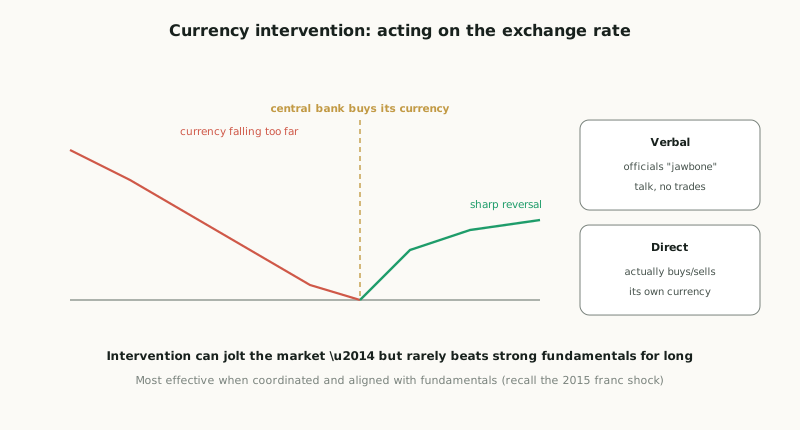
A: Direct (actual) intervention is the central bank actually buying or selling its currency in the market. Verbal intervention ('jawboning') is officials talking about the currency to influence it without making trades. Verbal intervention is cheaper and often a first resort, but its effect fades if not backed by action.
Q: Does currency intervention work?
A: It can move the market sharply in the short term, especially when coordinated among multiple central banks and aligned with fundamentals. But unilateral intervention against a strong fundamental trend often has only limited, temporary effect — a single central bank can rarely overpower the market for long, as the 2015 Swiss franc episode showed.
What intervention is and why it happens
Currency intervention is deliberate action by a central bank (or government) to influence the value of its currency. The most direct form is acting in the foreign-exchange market itself: selling its own currency (and buying foreign currency) to weaken it, or buying its own currency (using its foreign-exchange reserves) to strengthen or support it. By becoming a large buyer or seller, the central bank tries to move the exchange rate in the desired direction or halt a move it dislikes. This is intervention in the literal sense — the authority stepping into the market to push the currency where policy wants it.
Central banks intervene for several reasons. A common one is to curb excessive or disorderly moves — if a currency is appreciating or depreciating too rapidly, or moving in a destabilising, disorderly way, the central bank may step in to calm or reverse it. Protecting competitiveness is another: a currency that becomes too strong hurts exporters (making their goods expensive abroad), so export-oriented economies may intervene to prevent excessive appreciation — weakening their currency to keep exports competitive. Conversely, a currency that becomes too weak can stoke inflation (making imports expensive) and signal loss of confidence, so a central bank may intervene to support a falling currency. Central banks also intervene to manage a peg or target (where the currency is fixed or kept in a band against another), and to counter speculation they view as detached from fundamentals. The common thread is a judgement that the currency's market level or movement is contrary to the country's economic interests, prompting deliberate action to influence it — a reminder that, for all the market forces driving exchange rates, the authorities themselves are sometimes active participants pursuing policy goals.
Verbal versus direct intervention
Intervention comes in two main forms, differing in whether actual trades occur. Direct (or actual) intervention is the central bank actually buying or selling its currency in the market, as described above — committing real money (and, when supporting a currency, real foreign reserves) to move the rate. This is intervention in its full, concrete form, and it can move the market sharply because a central bank is a large and credible participant. Verbal intervention (often called "jawboning") is different: officials talk about the currency — expressing concern about its level, signalling discomfort, or hinting at possible action — to influence it without making any actual trades. By merely commenting, officials try to move the currency through the market's anticipation of what they might do.
Verbal intervention is typically the first resort because it is "cheap" — it costs nothing and commits no reserves, relying purely on the credibility of the central bank's words and the market's expectation that action might follow. A finance minister or central banker saying the currency is "too strong" or that they are "watching moves closely" can itself nudge the currency, as traders adjust positions in anticipation. However, verbal intervention's effect fades if not backed by action: if officials repeatedly express concern but never actually intervene, the market learns to discount the words ("all talk"), and jawboning loses its power. So verbal and direct intervention work together — verbal as the cheaper first warning, direct as the costly follow-through that gives the words credibility. A central bank that has shown willingness to intervene directly makes its verbal interventions more potent (the market believes action could follow); one that only ever talks finds its words increasingly ignored. For traders, both matter: verbal intervention can cause moves on the comments alone, while actual intervention causes sharper ones — and the threat of intervention (verbal or implied) can influence how a currency trades near levels where intervention is thought likely.
Effectiveness and limits
The crucial question is whether intervention works, and the honest answer is: sometimes, and usually only within limits. Intervention can be effective — especially in the short term, and particularly when it is coordinated (several major central banks acting together, combining their firepower and signalling collective resolve) and when it is aligned with fundamentals (pushing the currency in a direction the underlying economics already support, so the intervention reinforces rather than fights the natural trend). Coordinated, fundamentally-aligned intervention can meaningfully move and sustain a currency's level. Even unilateral intervention can cause sharp short-term moves, since the central bank is a large participant and can catch the market off guard.
A single central bank intervening against a strong fundamental trend often achieves only a temporary effect — the market can overwhelm it. The classic case: in 2015 the Swiss National Bank had long defended a cap on the franc's strength, but the fundamental pressure became too great, and when it abruptly abandoned the cap the franc rocketed in a violent, market-shattering move. The lesson is stark: intervention can jolt the market, but you cannot indefinitely hold a currency against the fundamentals — "you can't fight the market" forever, and the unwinding can be explosive.
So intervention's limits are real and important. Unilateral intervention (one central bank acting alone) against a strong fundamental trend typically has only limited and temporary effect: the central bank may cause a sharp move and slow or briefly reverse the trend, but if the fundamentals strongly favour the opposite direction, the market's weight eventually overwhelms the intervention, and the currency resumes its fundamentally-driven path — sometimes violently, as pent-up pressure releases. The 2015 Swiss franc episode is the canonical warning, but the principle is general: a single central bank's reserves and resolve, however large, are finite against the vast, fundamentally-driven flows of the global currency market. Intervention is most effective when it works with fundamentals (smoothing or nudging) and least effective when it tries to fight them (holding a currency at an unsustainable level). This is why intervention is often described as able to influence the pace and volatility of a currency's movement, and to cause sharp short-term jolts, more reliably than it can permanently override the currency's fundamental direction. The honest framing: intervention is a real and sometimes powerful tool, capable of sudden sharp effects (especially coordinated and fundamentally-aligned), but it is not a magic lever — it cannot durably defy strong fundamentals, and attempts to do so risk eventual explosive failure.
What it means for traders
For the forex trader, currency intervention matters chiefly as a source of sudden risk and sharp moves to be aware of and respected. Intervention (or even the credible threat of it) can cause abrupt, large currency moves — a falling currency can reverse violently if the central bank steps in to support it, or a rising one can be knocked back — and these moves can be sudden and hard to anticipate, much like the geopolitical shocks discussed elsewhere. The practical implications follow the site's risk-aware philosophy. Be aware of intervention risk, especially when trading a currency that is at extreme or unusual levels, or one whose authorities have signalled concern (verbally) or have a history of intervening — trading a currency near levels where intervention is thought likely carries the risk of a sudden adverse jolt. The Japanese yen is a notable example: the Bank of Japan has a history of intervening (or threatening to) when the yen moves to extremes, so traders of USD/JPY and yen crosses watch for intervention risk near such levels.
Watch for verbal intervention as an early-warning signal — officials expressing concern about the currency's level can presage action and can move the market on the comments alone, so such statements are worth heeding. Respect the unpredictability and the limits — intervention can cause sharp short-term moves you cannot foresee (a risk to manage with sound position sizing and stops, as with all sudden-event risks), yet it usually cannot durably override fundamentals (so it tends not to change a strong underlying trend for long, even as it causes volatility around it). The balanced takeaway: currency intervention is a real fundamental factor — deliberate central-bank action to influence the currency, via direct trades or verbal jawboning, for reasons of competitiveness, stability or policy — that can cause sudden, sharp moves and is a risk to be aware of, particularly near currency extremes and for intervention-prone currencies like the yen. But it operates within limits: most effective when coordinated and aligned with fundamentals, and unable to indefinitely defy strong fundamental trends (the 2015 franc lesson). Understanding intervention completes the picture of the central bank as not just a setter of rates and policy, but sometimes a direct, active participant in the currency market — one whose actions a trader must respect as a source of sudden risk, while remembering that even central banks cannot beat the fundamentals forever.
Currency intervention is deliberate central-bank action to influence its currency: directly (buying its currency to strengthen it, or selling to weaken it) or verbally ("jawboning" — talking it up or down without trades). Reasons: curbing excessive/disorderly moves, protecting export competitiveness, managing a peg, or countering speculation. Verbal is the cheap first resort but fades without action to back it. Effectiveness has limits: it can cause sharp short-term moves — especially coordinated and aligned with fundamentals — but a single central bank can't durably fight strong fundamentals (the 2015 Swiss franc shock is the classic warning). For traders, it's a source of sudden risk: be aware near currency extremes and for intervention-prone currencies (e.g. the yen/BoJ), heed verbal signals, manage the risk with sizing and stops — and remember even central banks can't beat fundamentals forever.