USD/JPY is the great risk barometer of the forex market. The second most-traded pair, it is pulled between two powerful forces: the interest rate differential between the US and Japan, and the safe-haven status of the Japanese yen, which strengthens whenever fear grips the markets. When risk sentiment turns negative, the yen surges and USD/JPY falls; when calm and optimism return, the yen weakens and USD/JPY rises. This dual nature — driven by yields on one hand and risk sentiment on the other — gives USD/JPY a distinctive character and makes it a closely watched gauge of the market's mood. This guide explains what drives the pair, why it serves as a risk barometer, the role of intervention, and how to trade it.
It connects the risk-on/risk-off framework and the carry trade to a specific, heavily-traded pair from the major currency pairs.
Key takeaways
Q: What drives USD/JPY?
A: USD/JPY is driven heavily by the US-Japan interest rate (yield) differential, especially US yields and Fed-versus-Bank of Japan policy, and by risk sentiment via the yen's safe-haven status. Broad US dollar sentiment also plays a role, and Japan has at times intervened to influence the yen.
Q: Why is USD/JPY a risk barometer?
A: Because the Japanese yen is a safe-haven currency that strengthens in times of fear. In risk-off conditions the yen tends to rise, pushing USD/JPY down; in risk-on conditions the yen weakens and USD/JPY rises. This makes the pair a useful gauge of market-wide risk sentiment.
Q: How does the yield differential affect USD/JPY?
A: The yen has long carried very low interest rates, so the gap between US and Japanese yields is a major driver. When US yields and rate expectations rise relative to Japan's, USD/JPY tends to rise (the dollar's higher yield attracts capital); when they fall, USD/JPY tends to decline.
The yield differential
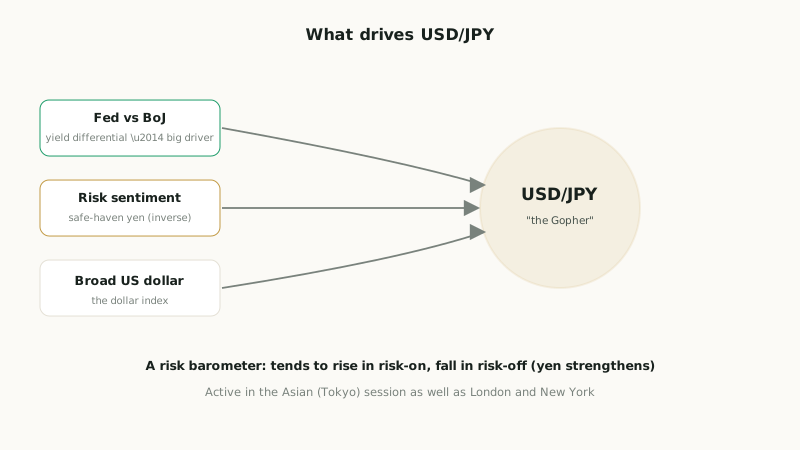
A major driver of USD/JPY is the interest rate (yield) differential between the United States and Japan. This factor is especially pronounced for this pair because the Japanese yen has long been associated with very low interest rates — Japan has maintained ultra-low and at times negative rates for extended periods. With Japanese rates anchored low, the gap between US and Japanese yields, and changes in that gap, becomes a powerful force on the pair: when US yields and rate expectations rise (the Fed tightening or expected to), the dollar's yield advantage over the low-yielding yen widens, drawing capital toward the dollar and pushing USD/JPY up; when US yields fall, the advantage narrows and USD/JPY tends to fall.
This makes USD/JPY notably sensitive to US yields and Fed policy expectations — often more so than other pairs, because the Japanese side of the differential has tended to be relatively static at low levels, so movements in the differential are driven largely by the US side. Traders watching USD/JPY therefore pay especially close attention to US interest rate expectations and yields, as these are a primary engine of the pair. The Bank of Japan's policy matters too — and shifts in the BoJ's long-standing ultra-low-rate stance can move the yen significantly precisely because they are notable departures — but the yield-differential story for USD/JPY has historically been dominated by the US side. This yield sensitivity is one half of the pair's dual character; the other is risk sentiment.
The yen as a safe haven
The second great driver of USD/JPY is the safe-haven status of the yen and the associated role of risk sentiment. As covered in the risk-on/risk-off guide, the yen is one of the world's premier safe-haven currencies, tending to strengthen during times of market fear and uncertainty as capital seeks safety. This gives USD/JPY a strong relationship with risk sentiment: in risk-off conditions (fear), the yen strengthens, pushing USD/JPY down; in risk-on conditions (optimism), the yen weakens, and USD/JPY tends to rise.
This is why USD/JPY serves as a widely watched risk barometer: its direction often reflects the market's prevailing mood, falling when fear dominates and rising when confidence returns. Notably, the yen's safe-haven strength operates regardless of its low yields — in a genuine crisis, capital floods into the yen for safety even though it offers little return, which can push USD/JPY sharply down even if the yield differential would suggest otherwise. This is the dynamic where risk sentiment can override the rate differential, as the risk-on/risk-off guide describes. The interplay between the two drivers — yields pulling one way, risk sentiment sometimes pulling the other — is central to understanding USD/JPY: in calm times the yield differential tends to dominate, while in fearful times the safe-haven flow can take over. The pair also features prominently in the carry trade, with the low-yielding yen a classic funding currency, which is why carry-trade unwinds (risk-off events) produce sharp drops in USD/JPY as the yen is bought back en masse.
USD/JPY has a split personality: the US-Japan yield gap (driven mostly by US rates) and the yen's safe-haven role. In calm markets, yields dominate — USD/JPY tracks US rate expectations. In fearful markets, the safe-haven flow takes over — the yen surges and USD/JPY drops regardless of yields. That's why it's the market's risk barometer, and why carry-trade unwinds hit it hard.
Intervention and sessions
One distinctive feature of USD/JPY is the history of currency intervention. Japanese authorities have at times intervened directly in the market to influence the yen's value — acting to weaken the yen when it is seen as too strong, or to support it when seen as too weak — particularly around extreme levels. As the central banks guide notes, intervention or even the credible threat of it can move a currency sharply and against what the fundamentals alone would suggest. USD/JPY traders should therefore be aware that, especially when the pair reaches levels Japanese authorities consider extreme, the risk of intervention rises, which can produce sudden, sharp moves. This adds a layer of unpredictability near extremes that traders should respect.
On sessions, USD/JPY is active during the Asian (Tokyo) session — the yen's home market — as well as during the London and New York sessions. This gives it a somewhat different session profile from the European-focused EUR/USD and GBP/USD: USD/JPY sees meaningful activity during the Asian session when Japanese markets and news are live, in addition to the European and US hours. Risk-sentiment-driven moves can occur around the clock, since fear and risk events can strike at any time and the yen reacts as the safe haven. Traders following USD/JPY thus watch a broader span of the trading day than they might for purely European pairs, with the Asian session adding relevant activity. As always, liquidity and the cleanest moves tend to concentrate in the active sessions and overlaps, but USD/JPY's risk-barometer nature means it can move on global sentiment shifts whenever they occur.
How to approach trading it
Trading USD/JPY well means keeping both of its drivers in view and understanding which is in control. Watch US yields and Fed expectations as the primary yield-differential driver — USD/JPY is particularly responsive to the US rate story — alongside any notable shifts from the Bank of Japan. Simultaneously, monitor risk sentiment (using the gauges from the risk-on/risk-off guide: equities, volatility, the broad mood), because in fearful conditions the safe-haven flow can dominate and drive USD/JPY down regardless of yields. Recognising whether the market is currently in a yield-driven (calm) or sentiment-driven (fearful) regime helps you interpret the pair's moves correctly.
Be mindful of intervention risk near extreme levels, where sudden, sharp official action can occur, and of the pair's role in carry trades, which means risk-off events can produce fast, violent yen-strengthening moves (USD/JPY drops) as carry positions unwind. The standard technical and fundamental methods apply, but USD/JPY rewards a trader who appreciates its dual nature — reading it as both a yield play and a risk barometer, and watching the broader risk environment as closely as the rate story. Its sensitivity to global sentiment makes it a valuable pair for those who follow risk dynamics, and a window onto the market's mood, but it requires understanding that it can be driven by either of its two forces at different times. Approached with that understanding — yields in calm, safe-haven flows in fear, intervention risk at extremes — USD/JPY is a rich and tradeable pair that also serves as a barometer for the wider market.
USD/JPY and the yen crosses
USD/JPY sits within a broader family of yen pairs — the "yen crosses" such as EUR/JPY and GBP/JPY — and understanding their relationship sharpens your reading of all of them. The yen crosses pair the yen with majors other than the dollar, and because the yen carries the same safe-haven character across all of them, these crosses behave as amplified risk barometers. EUR/JPY and GBP/JPY combine the risk-sensitivity of the yen with the risk-sensitivity of the euro or pound, so they tend to make even larger risk-driven moves than USD/JPY — GBP/JPY in particular is renowned for its volatility, earning nicknames reflecting its wild swings.
This matters for a USD/JPY trader in two ways. First, the yen crosses can confirm a risk-sentiment move: if USD/JPY is falling on risk-off and the yen crosses (EUR/JPY, GBP/JPY) are falling even harder, that broad yen strength across all its pairs confirms a genuine risk-off, safe-haven flow rather than a dollar-specific move. If instead USD/JPY moves while the yen crosses are quiet, the driver is more likely the dollar side than the yen side — a useful diagnostic paralleling the dollar-index logic. Second, the crosses help separate the yen story from the dollar story: by watching whether the yen is moving against multiple currencies (the crosses) or just the dollar, you can tell whether you are seeing broad yen strength/weakness or a USD-specific move.
The practical takeaway is to read USD/JPY in the context of the yen complex and the broader risk environment. When global fear rises, expect yen strength across USD/JPY and the crosses, with the crosses moving most violently; when calm returns, expect the reverse. The yen crosses are not for beginners given their amplified volatility, but awareness of them enriches a USD/JPY trader's picture, confirming risk-driven moves and helping distinguish yen-driven from dollar-driven action — reinforcing the pair's identity as the market's risk barometer.
USD/JPY is driven by the US-Japan yield differential (especially US rates) and by risk sentiment via the safe-haven yen — the market's risk barometer, rising in risk-on and falling in risk-off. In calm markets yields dominate; in fearful markets the safe-haven flow overrides them. It's a classic carry funding currency, so risk-off unwinds drop it sharply, and Japan has intervened near extreme levels. Read it alongside the yen crosses (EUR/JPY, GBP/JPY), which are amplified risk barometers that confirm yen-driven moves. Active in the Asian session as well as London and New York.