Some days the market wants to make money; some days it just wants to not lose it. This shift between collective greed and collective fear — between risk-on and risk-off — is one of the most powerful forces in forex, driving capital between two camps of currencies depending on the mood of the moment. In calm, confident times, money chases yield and growth; in fearful times, it flees to safety. And in a genuine crisis, this risk sentiment can overwhelm even interest rates, the dominant driver in normal conditions. Understanding the risk-on/risk-off framework explains a great deal of currency behaviour that rate analysis alone cannot. This guide covers how it works, the currencies on each side, and what triggers the shifts.
It is a key sentiment-driven force within fundamental analysis, and it explains the safe-haven and commodity-currency behaviour seen in the major pairs.
Key takeaways
Q: What does risk-on and risk-off mean in forex?
A: Risk-on describes periods of market optimism when investors seek higher returns, buying riskier, higher-yielding and commodity currencies. Risk-off describes periods of fear when investors seek safety, buying safe-haven currencies like the US dollar, yen and Swiss franc and selling riskier ones.
Q: Which are the safe-haven currencies?
A: The main safe-haven currencies are the US dollar (the world's reserve currency), the Japanese yen and the Swiss franc. Gold is also a traditional safe haven. These tend to strengthen during market fear and uncertainty, as capital flows toward perceived safety.
Q: Can risk sentiment override interest rates?
A: Yes. During periods of intense fear, the flight to safety can overwhelm normal drivers like interest rate differentials. A low-yielding safe haven such as the yen can surge in a crisis despite its low rates, as the demand for safety outweighs the search for yield.
The two modes
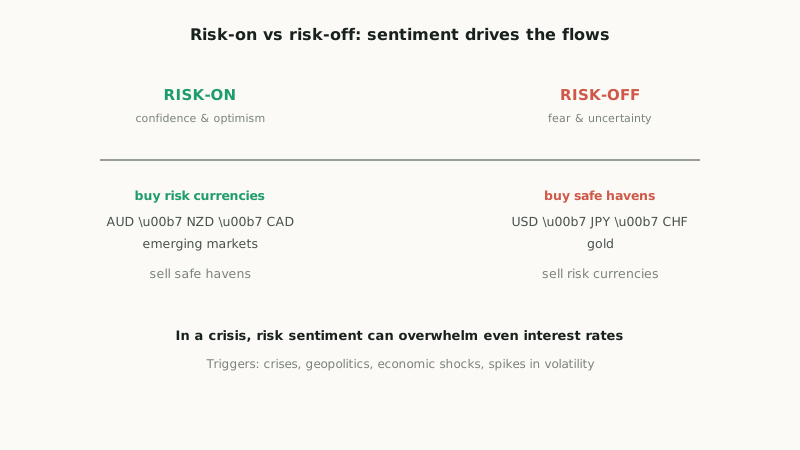
Risk sentiment describes the market's collective appetite for risk at any given time, and it broadly toggles between two modes. In risk-on mode, confidence and optimism prevail: investors are willing to take on risk in pursuit of higher returns, so they buy riskier, higher-yielding assets — and, in forex, the higher-yielding and growth-sensitive currencies. Capital flows toward returns, away from the safety it does not feel it needs. In risk-off mode, fear and uncertainty dominate: investors prioritise protecting capital over earning returns, so they flee risky assets and pile into safety — buying safe-haven currencies and selling the riskier ones.
This toggling between greed and fear is a market-wide phenomenon that affects all asset classes at once — stocks, bonds, commodities and currencies move in characteristic risk-on or risk-off patterns. In forex specifically, it creates a recognisable divide: certain currencies are risk currencies that rise in risk-on conditions, and others are safe havens that rise in risk-off conditions. Recognising which mode the market is in — and that the mode can shift, sometimes abruptly — is essential context, because the same currency pair can behave completely differently depending on whether fear or greed has the upper hand. Risk sentiment is the backdrop against which all the other fundamental forces play out.
The safe havens
The safe-haven currencies are those investors flock to when fear rises, and three stand out. The US dollar is the premier safe haven by virtue of its status as the world's reserve currency and the depth and liquidity of US markets — in a global crisis, capital often rushes into dollars and US assets as the ultimate refuge, even when the crisis originates in the US. The Japanese yen and the Swiss franc are the other classic havens, both backed by stable economies, strong external positions and a long history of strengthening in turbulent times. Gold, while not a currency, is the traditional safe-haven asset alongside them.
The defining feature of the safe havens is that they tend to strengthen during market fear, regardless of their interest rates — and this is the crucial point. The yen and franc have often carried very low interest rates, which would normally weaken a currency, yet they surge in crises because the demand for safety overwhelms the search for yield. This is why safe-haven behaviour cannot be understood through interest rates alone: in risk-off conditions, the haven currencies appreciate because they are safe, not because they offer return. Their counter-cyclical strength — rising precisely when other currencies and assets fall — makes them valuable barometers of fear and important currencies to understand, especially for their role in the carry-trade unwinds covered elsewhere.
The risk currencies
On the other side are the risk currencies — also called "high-beta" or growth-sensitive currencies — which rise in risk-on conditions and fall in risk-off ones. The main risk currencies among the majors are the commodity currencies: the Australian dollar, New Zealand dollar and Canadian dollar, whose economies are tied to global growth and commodity demand. Emerging-market currencies are even more strongly risk-sensitive, often offering high yields that attract capital in good times and suffer sharp outflows in bad times.
These currencies behave as risk barometers in the opposite direction to the havens: they thrive when confidence is high and capital is seeking returns, and they are hit hard when fear takes over and capital retreats to safety. This is why the commodity currencies (covered in detail in the commodities and currencies guide) are described as risk-sensitive — their fortunes are tied not just to commodity prices but to the broader risk mood that drives global growth expectations. The split between risk currencies and safe havens creates the characteristic risk-on/risk-off flows: when sentiment shifts to risk-off, capital moves from the AUD, NZD and emerging markets into the USD, JPY and CHF, and the reverse on a shift to risk-on. Understanding which side a currency sits on tells you how it is likely to behave when the market mood changes.
When sentiment overwhelms rates
The most important practical insight of the risk-on/risk-off framework is that, during periods of intense fear, risk sentiment can overwhelm interest rates — the normally dominant driver. In calm conditions, the rate differential and its expected path largely govern a currency, as the interest rates guide explains. But in a genuine crisis, the flight to safety becomes so powerful that it overrides the usual rate logic: capital floods into safe havens regardless of their yields and out of risk currencies regardless of theirs.
This is why a low-yielding safe haven like the yen can surge in a crisis even as a higher-yielding currency collapses — a complete inversion of the normal "high rates attract capital" rule. The fear-driven demand for safety simply swamps the yield consideration. This dynamic is exactly what produces the violent carry-trade unwinds covered in the carry trade guide: carry trades (long high-yield, short low-yield safe havens) thrive in risk-on calm but are devastated when risk-off fear sends everyone rushing back into the safe-haven funding currencies at once. Recognising that risk sentiment is a force that can temporarily dethrone interest rates explains much that pure rate analysis cannot — and it is why the astute fundamental trader always keeps one eye on the prevailing risk mood, not just on the rate differentials.
In normal times, interest rates rule currencies; in a crisis, fear does. The flight to safety can be so violent that a near-zero-yield haven like the yen rockets higher while high-yielders crash — the exact opposite of the usual rate logic. This is why risk sentiment, not just rate differentials, must be watched, and why carry trades blow up in risk-off panics.
What triggers the shifts
Risk sentiment shifts are driven by events and conditions that alter the market's collective confidence. The main triggers include financial crises (banking failures, debt crises, market crashes), geopolitical events (wars, conflicts, major political shocks), economic shocks (sudden recessions, surprising data, policy errors), and broad spikes in market volatility — often measured by indices like the VIX, sometimes called the market's "fear gauge." When such events strike, sentiment can flip from risk-on to risk-off rapidly, sometimes within hours, sending capital scrambling for safety.
For the trader, the practical implications are to stay aware of the prevailing risk mood and alert to the kinds of events that can shift it. In risk-off conditions, expect safe havens to strengthen and risk currencies to weaken, and be cautious with risk-sensitive positions (and especially carry trades) when fear is rising or could rise. The risk-on/risk-off lens also helps explain currency correlations: risk currencies tend to move together (as do safe havens), because they are all responding to the same underlying sentiment, which is why these correlations can strengthen dramatically during risk events. Combined with the interest-rate and economic analysis covered elsewhere, an awareness of risk sentiment completes the picture — currencies are driven not only by the cold logic of rates and data but by the swings of collective fear and greed, which in extremis can override everything else.
Gauging the risk mood
Since risk sentiment is so influential, how do you read which mode the market is in? Sentiment is not announced; it must be inferred from how markets are behaving across asset classes. Several gauges help. Equity markets are a primary read: rising stock markets generally signal risk-on confidence, while sharp sell-offs signal risk-off fear. Market volatility indices — notably the VIX, the so-called "fear gauge" — measure expected stock-market turbulence, with low readings indicating complacency and risk-on conditions and spikes indicating fear and risk-off. Bond markets also signal sentiment: flows into safe government bonds (driving their yields down) often accompany risk-off moves.
Within forex itself, the behaviour of the safe havens and risk currencies is the risk-mood signal: when the yen, franc and dollar are broadly strengthening while the Aussie, Kiwi and emerging-market currencies weaken, risk-off is in play, and vice versa. Some traders watch specific pairs as barometers — a pairing of a classic risk currency against a classic safe haven, for instance, tends to rise in risk-on conditions and fall in risk-off ones, making it a convenient gauge of the prevailing mood. The point is that risk sentiment leaves fingerprints across all markets simultaneously, and reading those fingerprints — stocks, volatility, bonds, and the relative strength of havens versus risk currencies — lets you judge the mode you are trading in.
This matters practically because, as established, risk sentiment can override the usual drivers, so knowing the prevailing mood frames how to interpret everything else. In a risk-off environment, you would treat safe-haven strength as expected and be wary of risk-currency longs and carry trades; in risk-on, the reverse. The mood also tends to drive the correlations covered elsewhere — risk currencies moving together, havens moving together — because they are all responding to the same sentiment. Developing a habit of gauging the risk mood before placing trades, by glancing at equities, volatility and the haven-versus-risk-currency picture, adds a valuable top-down layer to fundamental analysis, ensuring you are not fighting a powerful sentiment tide you failed to notice.
Risk-on (optimism) sends capital into riskier, higher-yielding and commodity currencies (AUD, NZD, CAD, emerging markets); risk-off (fear) sends it into safe havens (USD, JPY, CHF, gold), which strengthen despite low rates because safety outweighs yield. In intense fear, sentiment can override interest rates, driving carry-trade unwinds. Gauge the mood from equities, volatility (the VIX), bonds, and the relative strength of havens versus risk currencies. Triggers include crises, geopolitics, shocks and volatility spikes — always read the risk mood alongside the rate differentials.