Wars, elections, trade conflicts, political crises, pandemics — geopolitical events can move currencies violently, and they do so chiefly through one channel: fear. When geopolitical uncertainty spikes, capital does not calmly reassess fundamentals; it flees to safety, flowing out of risky assets and currencies and into safe havens. Understanding this flow — the dynamics of risk sentiment and safe-haven demand — matters far more for a trader than trying to predict the inherently unpredictable events themselves. This guide explains how geopolitics affects currencies, which currencies serve as safe havens, the role of risk sentiment, and why the right posture toward geopolitics is to manage it rather than forecast it.
It is the geopolitical dimension of risk-on/risk-off, drives demand for the US dollar and yen (relevant to USD/JPY), and rounds out the fundamental picture.
Key takeaways
Q: How do geopolitical events affect currencies?
A: Mainly through risk sentiment and safe-haven flows. In times of geopolitical uncertainty or fear, capital flees risky assets and currencies toward safe havens, strengthening the latter and weakening the former. Geopolitics can also affect currencies directly through sanctions, trade disruption, or commodity-price effects.
Q: Which currencies are safe havens?
A: The main safe-haven currencies are the US dollar (the world's reserve currency, with the deepest markets), the Japanese yen, and the Swiss franc. Gold is also a traditional safe-haven asset. In risk-off periods driven by geopolitical fear, these tend to strengthen as capital seeks safety.
Q: Can you predict geopolitical events in trading?
A: Generally no — geopolitical events are inherently unpredictable and cause sudden, sharp moves. Rather than trying to forecast them, the sensible approach is to understand the safe-haven and risk-sentiment dynamics they trigger, and to manage the risk of sudden events, since markets dislike uncertainty.
The main channel: risk and safe havens
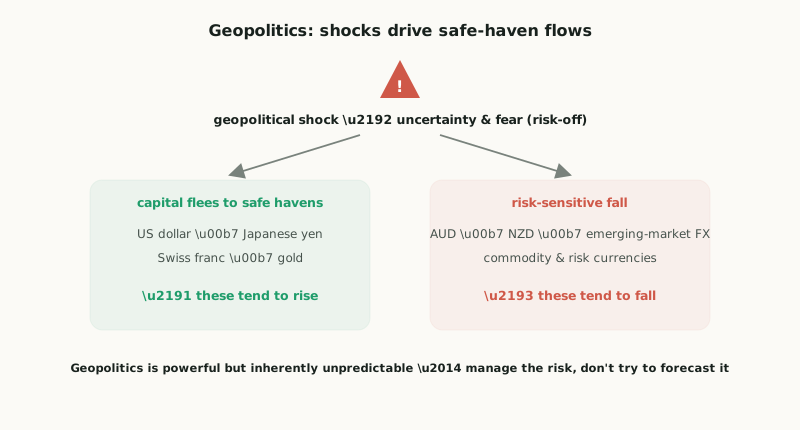
The primary way geopolitical events affect currencies is through risk sentiment and safe-haven flows — the same risk-on/risk-off dynamic covered in its own guide, here driven by geopolitical fear. Markets, above all, dislike uncertainty, and geopolitical events — by their nature sudden, threatening and hard to assess — inject uncertainty and fear. When a serious geopolitical shock hits (an outbreak of conflict, a crisis, a shock election result, escalating tensions), the market's response is typically risk-off: a flight from risk. Investors sell riskier assets and currencies and move capital into safe havens — assets and currencies perceived as safer stores of value in turbulent times.
This flight to safety is the dominant mechanism. In a geopolitical risk-off episode, capital flows out of risk-sensitive currencies and assets (which fall) and into safe-haven currencies and assets (which rise). The trader's key task, therefore, is to understand which currencies are safe havens (and thus tend to strengthen in geopolitical stress) and which are risk-sensitive (and tend to weaken), so as to read the likely currency impact of a risk-off event. The geopolitical event itself need not be analysed in deep detail; what matters for the currency reaction is that it has triggered fear and a flight to safety, and that this flight has predictable directional effects on different currencies. This is why geopolitics and risk sentiment are so intertwined: most geopolitical shocks transmit to currencies via the risk-on/risk-off channel, making safe-haven dynamics the heart of understanding geopolitics in forex.
The safe havens (and the risk-sensitive)
Knowing which currencies are safe havens is the practical core of trading geopolitical risk. The main safe-haven currencies and assets are summarised below.
Safe havens in risk-off episodes
The US dollar is the pre-eminent safe haven, for structural reasons covered in the dollar-index guide: it is the world's reserve currency, backed by the largest, deepest and most liquid financial markets, so in a crisis global capital flows into dollar assets (especially US Treasuries) as the ultimate refuge — the dollar tends to strengthen in risk-off episodes almost regardless of the crisis's origin. The Japanese yen is a traditional safe haven (linked to Japan's status as a major creditor nation and the repatriation of capital in stress), tending to strengthen when fear rises — which is why USD/JPY and yen crosses are sensitive to risk sentiment. The Swiss franc is a long-standing safe haven, associated with Switzerland's stability, neutrality and sound finances. And gold, while not a currency, is the classic safe-haven asset, sought as a store of value in turbulent times. On the other side are the risk-sensitive currencies that tend to fall in geopolitical risk-off: the commodity currencies (Australian dollar, New Zealand dollar, Canadian dollar to a degree) and emerging-market currencies, which are higher-risk, higher-yielding, and tied to global growth and risk appetite — capital flees them in a flight to safety. So the basic geopolitical risk-off pattern is: safe havens (USD, JPY, CHF, gold) up; risk-sensitive currencies (AUD, NZD, EM) down. Reading this pattern lets a trader anticipate the directional currency impact of a risk-off geopolitical event, even without predicting the event itself.
Other channels and the unpredictability
While risk sentiment is the main channel, geopolitics affects currencies through some additional routes worth noting. There is direct economic impact: sanctions, trade disruption, or a crisis centred on a particular country can directly damage that country's economy and weaken its currency specifically (a nation at the centre of a crisis often sees its own currency fall hard, beyond the general risk-off effect). There is the commodity channel: geopolitical events affecting major commodity supplies (a conflict disrupting oil, say) move commodity prices, which in turn affect commodity-linked currencies (the link covered in commodities and currencies) — a war that spikes oil can lift oil-exporter currencies even amid general risk-off. And there is trade and policy: trade tensions, tariffs and shifting alliances affect currencies through their economic implications. These channels can interact and sometimes complicate the simple safe-haven picture (for instance, a crisis in a major economy might weaken its currency directly even if it is normally a safe haven), so the full reading considers both the general risk-sentiment effect and any direct, country-specific or commodity impacts.
The defining feature of geopolitics, however, and the key to the right trading posture, is its unpredictability. Geopolitical events are, by their nature, extremely difficult to forecast — wars, crises, shock election outcomes and sudden escalations arrive unexpectedly and unfold in ways few anticipate — and they cause sudden, sharp currency moves when they hit. This unpredictability has a clear implication: trying to predict geopolitical events and trade on the forecast is largely a fool's errand, fraught with the danger of being wrong about both the event and the market's reaction. The sensible posture, consistent with the site's honest and risk-focused philosophy, is to understand and manage geopolitics rather than predict it. Understand the dynamics — how risk-off fear drives safe-haven flows, which currencies are havens and which are risk-sensitive — so you can read and react to events as they unfold. Manage the risk — recognise that sudden geopolitical shocks are an ever-present hazard that can move the market violently regardless of your technical setup, so maintain sound risk management (position sizing, stops, awareness) that protects you from sudden events you cannot foresee. Be aware of known upcoming risk events (elections, scheduled votes, simmering tensions) as you would any risk on the calendar. The goal is not to be a geopolitical forecaster but to understand the currency dynamics geopolitics triggers and to keep your risk controlled against the unpredictable. In this way, geopolitics is treated like other major sources of sudden risk: powerful and real, impossible to predict reliably, best handled through understanding the mechanisms (safe-haven flows) and disciplined risk management rather than forecasting. That posture — understand and manage, don't predict — is the honest and practical way to deal with one of the most powerful yet least foreseeable forces in forex.
Recurring patterns and defensive positioning
Although individual geopolitical events are unpredictable, the currency patterns they produce are reasonably consistent, and recognising these recurring dynamics is the practical payoff of understanding geopolitics. The classic pattern, repeated across many crises, is the flight to safety: a serious shock triggers risk-off, the US dollar and other safe havens strengthen, risk-sensitive currencies weaken, and (often) gold rises and equities fall. This broad pattern tends to recur regardless of the specific crisis, because it reflects the consistent human response to fear — seeking safety — rather than the particulars of any one event. A trader who knows this pattern can read an unfolding risk-off episode quickly: whatever the trigger, expect safe havens bid and risk currencies offered.
Some nuances recur too. A crisis centred on a specific country or region tends to hit that area's currency hardest (beyond the general risk-off), while the global safe havens still benefit. Crises affecting commodity supply can lift commodity-exporter currencies even amid general risk-off, complicating the simple pattern. And the intensity and duration matter — a brief scare may cause only a sharp, short-lived safe-haven spike that reverses as calm returns, while a sustained crisis can drive a prolonged risk-off regime. Markets also tend to react most to escalation and surprise; once a situation is known and "priced in," its further effect diminishes unless it escalates unexpectedly (the same expectations dynamic seen throughout fundamental analysis).
The practical, defensive posture follows directly. Since you cannot predict geopolitical shocks, position so that you can survive them: sound position sizing and stops (the risk-management foundation) protect you from the sudden adverse moves a shock can cause, whatever your technical setup. Be aware of known risk events on the horizon — scheduled elections, referendums, simmering tensions — and consider reducing exposure around them, much as you would around major economic releases. Recognise the safe-haven pattern so you can interpret and react to risk-off moves as they unfold rather than being baffled by them. And avoid the temptation to make large predictive bets on geopolitical outcomes, which is gambling on the unforecastable. This defensive, pattern-aware approach — manage the risk, recognise the dynamics, react rather than predict — lets a trader handle geopolitics soundly without pretending to a foresight nobody has. It treats geopolitical risk as the ever-present, unpredictable hazard it is, met not with prophecy but with preparation.
Geopolitical events (wars, crises, elections, trade conflicts) move currencies mainly through risk sentiment and safe-haven flows: uncertainty triggers risk-off fear, sending capital into safe havens — the US dollar, Japanese yen, Swiss franc and gold (which rise) — and out of risk-sensitive currencies like the AUD, NZD and emerging-market FX (which fall). Additional channels: direct economic impact (sanctions, a country's own crisis), commodity-price effects, and trade/policy. The defining feature is unpredictability — but the currency patterns (flight to safety) recur consistently. So don't forecast geopolitical events; recognise the safe-haven dynamics, be aware of known risk events, position defensively with sound sizing and stops to survive sudden shocks, and react rather than predict. Understand and manage, don't predict.