
The US dollar sits on one side of every major currency pair, which means a single gauge of its broad strength is invaluable — and that is exactly what the US Dollar Index, ticker DXY, provides. The index distils the dollar's value against a basket of major currencies into one number, rising when the dollar is broadly strong and falling when it is broadly weak. For a forex trader, reading the DXY answers a crucial question: is a given pair moving because of the dollar, or because of the other currency? This guide explains what the dollar index is, its composition, how it relates to every dollar pair, and how to use it as a context and confluence tool.
It puts a number on the "dollar's central role" introduced in the major currency pairs, and it is essential context for EUR/USD and every dollar pair.
Key takeaways
Q: What is the US Dollar Index (DXY)?
A: The US Dollar Index measures the value of the US dollar against a basket of major currencies — the euro, yen, pound, Canadian dollar, Swedish krona and Swiss franc. It rises when the dollar strengthens broadly and falls when it weakens, serving as a gauge of overall dollar strength.
Q: What currencies are in the dollar index?
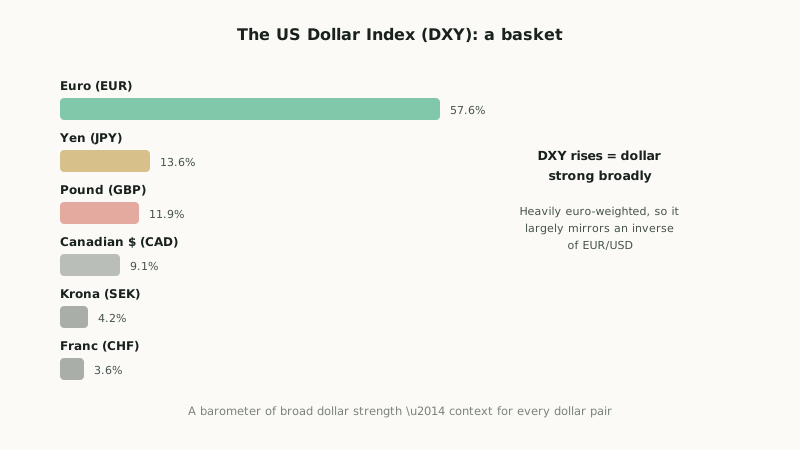
A: The dollar index is a weighted basket: the euro is by far the largest at about 57.6%, followed by the Japanese yen (~13.6%), British pound (~11.9%), Canadian dollar (~9.1%), Swedish krona (~4.2%) and Swiss franc (~3.6%). The heavy euro weighting means the index largely mirrors an inverse of EUR/USD.
Q: How do traders use the dollar index?
A: Traders use the DXY as context to gauge broad dollar strength and to tell whether a pair's move is driven by the dollar or by the other currency. A move visible across all dollar pairs and in the index is dollar-driven; a move that diverges from the index is specific to the other currency.
What the dollar index is
The US Dollar Index measures the value of the US dollar against a basket of major currencies, expressing the dollar's broad strength as a single index value. Rather than looking at the dollar against just one currency (as a single pair does), the DXY aggregates the dollar's value against several major currencies into one number, giving a measure of how the dollar is doing overall against the major world currencies. When the dollar strengthens broadly — gaining against most major currencies at once — the index rises; when it weakens broadly, the index falls.
This makes the DXY a barometer of broad dollar strength, capturing the dollar's general trend in a way that no single pair can. A single pair like EUR/USD shows the dollar only against the euro, conflating dollar moves with euro moves; the index, by averaging across several currencies, isolates the dollar's broad behaviour more cleanly. Because the dollar is the world's primary reserve currency and sits on one side of every major pair, this broad gauge is enormously useful — the dollar's overall strength or weakness is a powerful force across the entire forex market, and the DXY is the tool that measures it. Understanding the index as a distillation of the dollar's broad value is the foundation for using it.
The composition
The dollar index is a weighted basket, and the weights matter greatly for interpreting it. The euro is by far the largest component at roughly 57.6%, followed by the Japanese yen (about 13.6%), the British pound (about 11.9%), the Canadian dollar (about 9.1%), the Swedish krona (about 4.2%) and the Swiss franc (about 3.6%). These weights have been fixed since the euro's introduction, giving the standard index a stable, known composition. The dominance of the euro is the single most important fact about the index's makeup.
Because the euro makes up well over half the basket, the dollar index is heavily influenced by EUR/USD — so much so that the DXY largely mirrors an inverse of EUR/USD: when EUR/USD falls (the dollar strengthening against the euro), the index tends to rise, and vice versa. This is a useful practical relationship: movements in the dollar index and in EUR/USD are closely (inversely) linked, given the euro's dominant weight. It also means the index is somewhat euro-centric — it is more a measure of the dollar against European and developed-market currencies than a truly global dollar gauge (it notably excludes major currencies like the Chinese yuan). Traders should keep this composition in mind: the DXY is an excellent gauge of the dollar against the major developed-market currencies, dominated by the euro, rather than a perfect measure of the dollar against everything. Understanding the weights — especially the euro's dominance — is key to reading the index correctly.
How it relates to dollar pairs
The dollar index's great practical value comes from its relationship to every dollar pair. Since the dollar is on one side of all the majors, broad dollar strength (a rising DXY) tends to push the dollar-quoted pairs down (EUR/USD, GBP/USD, AUD/USD fall as the dollar strengthens against those currencies) and the dollar-base pairs up (USD/JPY, USD/CHF, USD/CAD rise as the dollar strengthens). A falling DXY does the reverse. The index thus moves in a predictable relationship with all the dollar pairs, reflecting the broad dollar force acting on each.
This connects directly to the currency-correlations and "dollar's central role" ideas elsewhere on the site: the dollar pairs are correlated because they share the dollar, and the DXY is the measure of that shared dollar driver. When the dollar index makes a strong move, you can expect to see it reflected across all the dollar pairs at once, in their respective directions. This makes the index a powerful lens for understanding what is driving the market: a coordinated move across all dollar pairs, visible in the DXY, signals that the dollar is the driver, whereas a pair moving on its own while the DXY is quiet signals that the other currency is the driver. Reading the index alongside individual pairs reveals whether you are seeing a broad dollar move or a currency-specific one — a distinction that is genuinely useful for analysis.
The DXY answers a question single pairs can't: is this move about the dollar or the other currency? If EUR/USD drops and the DXY rises (and other dollar pairs move in step), it's a broad dollar move. If EUR/USD drops while the DXY is flat, it's euro weakness. That distinction — dollar-driven versus currency-specific — is one of the most useful reads in forex.
Using the index as context
For the trader, the dollar index is primarily a context and confluence tool rather than something to trade directly (though it can be traded via instruments that track it). Its main uses follow from the relationships above. First, gauging broad dollar direction: the DXY gives a clean read on whether the dollar is broadly strong or weak and trending, valuable context for any dollar pair you trade — if the dollar is in a strong broad uptrend (rising DXY), that is a headwind for long EUR/USD positions and a tailwind for long USD/JPY, useful to know.
Second, and most usefully, distinguishing dollar-driven from currency-specific moves: by checking whether a pair's move coincides with a DXY move (and moves in other dollar pairs), you can tell whether the pair is responding to the broad dollar or to its own currency's factors. A EUR/USD drop that coincides with a DXY rise across all dollar pairs is a dollar story; a EUR/USD drop while the DXY is flat and other dollar pairs are quiet is a euro story. This helps you understand the cause of a move, which informs how durable or relevant it is to your analysis. Third, the index can provide confluence: a EUR/USD short setup is more compelling if the dollar index is also signalling broad dollar strength, since the two align. Keeping the dollar index on your radar — as a gauge of the broad dollar that sits behind every major pair — adds a valuable top-down layer to currency analysis, helping you see the dollar force that is so often the real driver of the pairs you trade. It is one of the most useful context tools available, precisely because the dollar's broad strength is such a pervasive influence across the whole forex market.
Reading the dollar index trend
Beyond using the DXY to diagnose individual moves, watching the dollar index's own trend provides a valuable macro backdrop for all your currency trading. Because the broad dollar is such a pervasive force, the DXY's overall direction — whether the dollar is in a broad uptrend, downtrend or range — sets the prevailing tide that every dollar pair swims within. A trader aware that the dollar is in a sustained broad uptrend knows that long-dollar trades (short EUR/USD, long USD/JPY) are swimming with that tide, while the opposite trades fight it — useful directional context that the top-down approach of fundamental analysis encourages.
The same technical tools used on any chart apply to the dollar index: identifying its trend, key support and resistance levels, and significant turning points. Many traders watch important DXY levels and trend changes as macro signposts — a decisive break in the dollar index often coincides with coordinated moves across all the dollar pairs, since they share the dollar driver the index measures. Treating the DXY as a chart in its own right, with its own trend and levels, adds a layer of broad-market analysis above the individual pairs.
A particularly useful application is watching for divergences between the dollar index and a pair. If, say, EUR/USD fails to make a new low even as the dollar index pushes to a new high, that divergence hints the euro may be showing relative strength against the broad dollar trend — a subtle signal worth noting. More broadly, comparing a pair's behaviour against the backdrop of the dollar index's trend helps you judge whether the pair is being carried by the broad dollar or moving on its own currency's factors, and whether your trade aligns with or fights the prevailing dollar tide. Used this way — as a macro backdrop, a chart with its own trend and levels, and a source of divergence signals — the dollar index becomes a genuine analytical layer rather than just a reference, helping you trade individual pairs with awareness of the powerful broad-dollar current running beneath them all.
The US Dollar Index (DXY) measures the dollar against a basket — euro (~57.6%, dominant), yen, pound, Canadian dollar, krona, franc — rising when the dollar is broadly strong, falling when broadly weak, and largely mirroring an inverse of EUR/USD. Broad dollar strength pushes dollar-quoted pairs down and dollar-base pairs up. Use it as context: gauge broad dollar direction, read its own trend and levels as a macro backdrop, watch for divergences, and — most usefully — tell whether a pair's move is dollar-driven (visible across all pairs and the DXY) or specific to the other currency. A top-down lens on the dollar behind every major pair.